National Institutes of Health/National Institute Of Allergy and Infectious Diseases (NIH/NIAID)
United States
Citation
Journal: Nat Commun / Year: 2025 Title: Rational design of flavivirus E protein vaccine optimizes immunogenicity and mitigates antibody dependent enhancement risk. Authors: Yimeng Wang / Andrey Galkin / Xiaoran Shang / Alexander Marin / Shaohua Jin / Ting-Juan Ye / Shridhar Bale / Chi-I Chiang / Ananda Chowdhury / Agnes L Chenine / Ashley Turonis / Jack ...Authors: Yimeng Wang / Andrey Galkin / Xiaoran Shang / Alexander Marin / Shaohua Jin / Ting-Juan Ye / Shridhar Bale / Chi-I Chiang / Ananda Chowdhury / Agnes L Chenine / Ashley Turonis / Jack Greenhouse / Rebecca Stone / Jaclyn Wear / Swagata Kar / Hanne Andersen / Yan-Jang S Huang / Dana L Vanlandingham / Stephen Higgs / Rena G Lapidus / Thomas Fuerst / David J Weber / Richard T Wyatt / Christel Iffland / Theodore C Pierson / Alexander K Andrianov / Edwin Pozharski / Yuxing Li / Abstract: Flaviviruses are a family of related viruses that cause substantial global morbidity and mortality. Vaccination against one flavivirus can sometimes exacerbate disease caused by related viruses ...Flaviviruses are a family of related viruses that cause substantial global morbidity and mortality. Vaccination against one flavivirus can sometimes exacerbate disease caused by related viruses through antibody-dependent enhancement (ADE) or interfere with the efficacy of subsequent vaccines. To address this challenge, we develop a vaccine strategy by introducing G5C/G102C mutations into the flavivirus envelope (E) glycoprotein. These mutations promote E dimerization through the formation of an inter-chain disulfide bond that conceals the immunodominant and ADE-prone fusion loop epitope (FLE). We validate this design on E proteins from multiple flaviviruses through biochemical, antigenic, and structural analyses. The resulting vaccine candidate, CC_FLE sE, derived from the Zika virus (ZIKV) and formulated with an advanced supramolecular adjuvant, provides significant protection in female mice challenged with ZIKV and prevents ADE caused by a related flavivirus, Dengue virus. In genetically modified mice expressing diverse human immunoglobulin loci, ZIKV CC_FLE sE induces robust neutralizing antibody responses targeting key ZIKV E protein epitopes, including the E-dimer-dependent epitope (EDE), indicating that ZIKV CC_FLE sE can elicit protective antibody responses within the human naïve B cell repertoire. Therefore, CC_FLE sE represents a promising strategy for developing flavivirus vaccines that minimize ADE risk while maintaining high protective efficacy.
In the structure databanks used in Yorodumi, some data are registered as the other names, "COVID-19 virus" and "2019-nCoV". Here are the details of the virus and the list of structure data.
Jan 31, 2019. EMDB accession codes are about to change! (news from PDBe EMDB page)
EMDB accession codes are about to change! (news from PDBe EMDB page)
The allocation of 4 digits for EMDB accession codes will soon come to an end. Whilst these codes will remain in use, new EMDB accession codes will include an additional digit and will expand incrementally as the available range of codes is exhausted. The current 4-digit format prefixed with “EMD-” (i.e. EMD-XXXX) will advance to a 5-digit format (i.e. EMD-XXXXX), and so on. It is currently estimated that the 4-digit codes will be depleted around Spring 2019, at which point the 5-digit format will come into force.
The EM Navigator/Yorodumi systems omit the EMD- prefix.
Related info.:Q: What is EMD? / ID/Accession-code notation in Yorodumi/EM Navigator
Yorodumi is a browser for structure data from EMDB, PDB, SASBDB, etc.
This page is also the successor to EM Navigator detail page, and also detail information page/front-end page for Omokage search.
The word "yorodu" (or yorozu) is an old Japanese word meaning "ten thousand". "mi" (miru) is to see.
Related info.:EMDB / PDB / SASBDB / Comparison of 3 databanks / Yorodumi Search / Aug 31, 2016. New EM Navigator & Yorodumi / Yorodumi Papers / Jmol/JSmol / Function and homology information / Changes in new EM Navigator and Yorodumi
 Movie
Movie Controller


 Open data
 Basic information
 Map data
 Sample
 Keywords
 Function and homology information
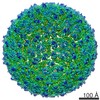 Japanese encephalitis virus
 Authors
 United States, 1 items
  Citation
 Structure visualization
 Downloads & links
 emd_71715.png
 https://data.pdbj.org/pub/emdb/structures/EMD-71715


 Z (Sec.)
 Y (Row.)
 X (Col.)


 Sample components
 Drosophila (fruit flies)
 Processing
 Electron microscopy
 FIELD EMISSION GUN