 Movie
Movie Controller

[English] 日本語
 Yorodumi
- PDB-9od2: Cryo-EM structure of modified Zika virus E protein dimer complexe... -
+ Open data

- Basic information
| Entry | Database: PDB / ID: 9od2 | ||||||||||||||||||||||||
|---|---|---|---|---|---|---|---|---|---|---|---|---|---|---|---|---|---|---|---|---|---|---|---|---|---|
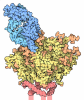
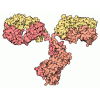
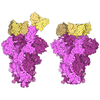
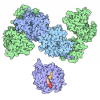
| Title | Cryo-EM structure of modified Zika virus E protein dimer complexed with a neutralizing antibody SMZAb2 Fab | ||||||||||||||||||||||||
 Components Components |
| ||||||||||||||||||||||||
 Keywords Keywords | VIRAL PROTEIN/IMMUNE SYSTEM / neutralizing antibody / VIRAL PROTEIN / VIRAL PROTEIN-Immune System complex | ||||||||||||||||||||||||
| Function / homology |  Function and homology information Function and homology informationhost cell nucleolus / flavivirin / symbiont-mediated suppression of host JAK-STAT cascade via inhibition of host TYK2 activity / 5'-3' RNA polymerase activity / symbiont-mediated suppression of host JAK-STAT cascade via inhibition of STAT2 activity / symbiont-mediated suppression of host JAK-STAT cascade via inhibition of STAT1 activity / negative regulation of innate immune response / viral capsid / 4 iron, 4 sulfur cluster binding / nucleoside-triphosphate phosphatase ...host cell nucleolus / flavivirin / symbiont-mediated suppression of host JAK-STAT cascade via inhibition of host TYK2 activity / 5'-3' RNA polymerase activity / symbiont-mediated suppression of host JAK-STAT cascade via inhibition of STAT2 activity / symbiont-mediated suppression of host JAK-STAT cascade via inhibition of STAT1 activity / negative regulation of innate immune response / viral capsid / 4 iron, 4 sulfur cluster binding / nucleoside-triphosphate phosphatase / double-stranded RNA binding / clathrin-dependent endocytosis of virus by host cell / mRNA (guanine-N7)-methyltransferase / methyltransferase cap1 / molecular adaptor activity / methyltransferase cap1 activity / mRNA 5'-cap (guanine-N7-)-methyltransferase activity / RNA helicase activity / protein dimerization activity / host cell perinuclear region of cytoplasm / host cell endoplasmic reticulum membrane / RNA helicase / symbiont-mediated suppression of host type I interferon-mediated signaling pathway / host cell cytoplasm / serine-type endopeptidase activity / symbiont-mediated activation of host autophagy / RNA-directed RNA polymerase / viral RNA genome replication / RNA-directed RNA polymerase activity / lipid binding / fusion of virus membrane with host endosome membrane / centrosome / viral envelope / GTP binding / virion attachment to host cell / host cell nucleus / virion membrane / structural molecule activity / ATP hydrolysis activity / proteolysis / metal ion binding / extracellular region / ATP binding Similarity search - Function | ||||||||||||||||||||||||
| Biological species |  Homo sapiens (human) Homo sapiens (human) 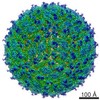 Zika virus Zika virus | ||||||||||||||||||||||||
| Method | ELECTRON MICROSCOPY / single particle reconstruction / cryo EM / Resolution: 4.09 Å | ||||||||||||||||||||||||
 Authors Authors | Galkin, A. / Pozharski, E. | ||||||||||||||||||||||||
| Funding support |  United States, 1items United States, 1items
| ||||||||||||||||||||||||
 Citation Citation | Journal: Nat Commun / Year: 2025 Title: Rational design of flavivirus E protein vaccine optimizes immunogenicity and mitigates antibody dependent enhancement risk. Authors: Yimeng Wang / Andrey Galkin / Xiaoran Shang / Alexander Marin / Shaohua Jin / Ting-Juan Ye / Shridhar Bale / Chi-I Chiang / Ananda Chowdhury / Agnes L Chenine / Ashley Turonis / Jack ...Authors: Yimeng Wang / Andrey Galkin / Xiaoran Shang / Alexander Marin / Shaohua Jin / Ting-Juan Ye / Shridhar Bale / Chi-I Chiang / Ananda Chowdhury / Agnes L Chenine / Ashley Turonis / Jack Greenhouse / Rebecca Stone / Jaclyn Wear / Swagata Kar / Hanne Andersen / Yan-Jang S Huang / Dana L Vanlandingham / Stephen Higgs / Rena G Lapidus / Thomas Fuerst / David J Weber / Richard T Wyatt / Christel Iffland / Theodore C Pierson / Alexander K Andrianov / Edwin Pozharski / Yuxing Li / Abstract: Flaviviruses are a family of related viruses that cause substantial global morbidity and mortality. Vaccination against one flavivirus can sometimes exacerbate disease caused by related viruses ...Flaviviruses are a family of related viruses that cause substantial global morbidity and mortality. Vaccination against one flavivirus can sometimes exacerbate disease caused by related viruses through antibody-dependent enhancement (ADE) or interfere with the efficacy of subsequent vaccines. To address this challenge, we develop a vaccine strategy by introducing G5C/G102C mutations into the flavivirus envelope (E) glycoprotein. These mutations promote E dimerization through the formation of an inter-chain disulfide bond that conceals the immunodominant and ADE-prone fusion loop epitope (FLE). We validate this design on E proteins from multiple flaviviruses through biochemical, antigenic, and structural analyses. The resulting vaccine candidate, CC_FLE sE, derived from the Zika virus (ZIKV) and formulated with an advanced supramolecular adjuvant, provides significant protection in female mice challenged with ZIKV and prevents ADE caused by a related flavivirus, Dengue virus. In genetically modified mice expressing diverse human immunoglobulin loci, ZIKV CC_FLE sE induces robust neutralizing antibody responses targeting key ZIKV E protein epitopes, including the E-dimer-dependent epitope (EDE), indicating that ZIKV CC_FLE sE can elicit protective antibody responses within the human naïve B cell repertoire. Therefore, CC_FLE sE represents a promising strategy for developing flavivirus vaccines that minimize ADE risk while maintaining high protective efficacy. | ||||||||||||||||||||||||
| History |
|
- Structure visualization
| Structure viewer | Molecule: MolmilJmol/JSmol |
|---|
- Downloads & links
-Download
| PDBx/mmCIF format | 9od2.cif.gz | 215.3 KB | Display | PDBx/mmCIF format |
|---|---|---|---|---|
| PDB format | pdb9od2.ent.gz | Display | PDB format | |
| PDBx/mmJSON format | 9od2.json.gz | Tree view | PDBx/mmJSON format | |
| Others |  Other downloads Other downloads |
-Validation report
| Arichive directory | https://data.pdbj.org/pub/pdb/validation_reports/od/9od2ftp://data.pdbj.org/pub/pdb/validation_reports/od/9od2 | HTTPS FTP |
|---|
-Related structure data
| Related structure data |  70338MC  9pl9C  9pm6C M: map data used to model this data C: citing same article ( |
|---|---|
| Similar structure data |


-Links
 PDBj
PDBj
- Assembly
| Deposited unit | 
|
|---|---|
| 1 |
|
-Components
| #1: Protein | Mass: 13566.996 Da / Num. of mol.: 2 Source method: isolated from a genetically manipulated source Source: (gene. exp.) Homo sapiens (human) / Production host: Homo sapiens (human)#2: Antibody | Mass: 11588.911 Da / Num. of mol.: 2 Source method: isolated from a genetically manipulated source Source: (gene. exp.) Homo sapiens (human) / Production host: Homo sapiens (human)#3: Protein | Mass: 47297.340 Da / Num. of mol.: 2 / Mutation: G5C, G102C Source method: isolated from a genetically manipulated source Source: (gene. exp.) Zika virus / Production host:   Drosophila melanogaster (fruit fly) / References: UniProt: A0A024B7W1 Drosophila melanogaster (fruit fly) / References: UniProt: A0A024B7W1Has protein modification | Y | |
|---|
-Experimental details
-Experiment
| Experiment | Method: ELECTRON MICROSCOPY |
|---|---|
| EM experiment | Aggregation state: PARTICLE / 3D reconstruction method: single particle reconstruction |
- Sample preparation
| Component | Name: Zika virus E protein dimer complex with a neutralizing antibody SMZAB2 Fab Type: COMPLEX / Entity ID: all / Source: MULTIPLE SOURCES |
|---|---|
| Source (natural) | Organism: Zika virus |
| Source (recombinant) | Organism: Drosophila (fruit flies) |
| Buffer solution | pH: 7.4 |
| Specimen | Conc.: 0.75 mg/ml / Embedding applied: NO / Shadowing applied: NO / Staining applied: NO / Vitrification applied: YES |
| Specimen support | Grid material: GOLD / Grid mesh size: 300 divisions/in. / Grid type: Quantifoil R2/2 |
| Vitrification | Instrument: FEI VITROBOT MARK IV / Cryogen name: ETHANE / Humidity: 100 % / Chamber temperature: 285 K |
- Electron microscopy imaging
| Microscopy | Model: TFS GLACIOS |
|---|---|
| Electron gun | Electron source:  FIELD EMISSION GUN / Accelerating voltage: 200 kV / Illumination mode: FLOOD BEAM FIELD EMISSION GUN / Accelerating voltage: 200 kV / Illumination mode: FLOOD BEAM |
| Electron lens | Mode: BRIGHT FIELD / Nominal magnification: 45000 X / Calibrated magnification: 56200 X / Nominal defocus max: 2500 nm / Nominal defocus min: 700 nm / Calibrated defocus min: 500 nm / Calibrated defocus max: 2700 nm / Cs: 2.7 mm / C2 aperture diameter: 50 µm / Alignment procedure: COMA FREE |
| Specimen holder | Cryogen: NITROGEN / Specimen holder model: FEI TITAN KRIOS AUTOGRID HOLDER / Residual tilt: 0.5 mradians |
| Image recording | Average exposure time: 2.5 sec. / Electron dose: 52 e/Å2 / Film or detector model: GATAN K3 (6k x 4k) / Num. of grids imaged: 2 / Num. of real images: 3633 |
| Image scans | Width: 5760 / Height: 4092 |
- Processing
| EM software |
| ||||||||||||||||||||||||
|---|---|---|---|---|---|---|---|---|---|---|---|---|---|---|---|---|---|---|---|---|---|---|---|---|---|
| CTF correction | Type: PHASE FLIPPING AND AMPLITUDE CORRECTION | ||||||||||||||||||||||||
| Particle selection | Num. of particles selected: 196387 | ||||||||||||||||||||||||
| Symmetry | Point symmetry: C2 (2 fold cyclic) | ||||||||||||||||||||||||
| 3D reconstruction | Resolution: 4.09 Å / Resolution method: FSC 0.143 CUT-OFF / Num. of particles: 141948 / Symmetry type: POINT |
