[English] 日本語
Yorodumi
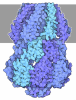
- EMDB-71088: MscS in Glyco-DIBMA Native Nanodiscs (C7 symmetry) -

+
Open data


ID or keywords:

Loading...

-
Basic information

Entry
Database: EMDB / ID: EMD-71088
TitleMscS in Glyco-DIBMA Native Nanodiscs (C7 symmetry)
Map dataSingle particle cryo-EM map of mechanosensitive channel MscS from Escherichia coli in Glyco-DIBMA polymer native nanodiscs at an overall resolution of 2.99 A sharpened and filtered
Sample
  • Complex: MscS in Glyco-DIBMA Native Nanodiscs (C7 symmetry)
    • Protein or peptide: Small-conductance mechanosensitive channel
  • Ligand: (2R)-1-(hexadecanoyloxy)-3-(phosphonooxy)propan-2-yl (9Z)-octadec-9-enoate
  • Ligand: water
Keywordsmechanosensitive channel / membrane protein / native nanodisc / polymer / Glyco-DIBMA / cryo-EM / lipid
Function / homology
Function and homology information


mechanosensitive monoatomic ion channel activity / plasma membrane
Similarity search - Function
Conserved TM helix / Mechanosensitive ion channel, conserved TM helix / Mechanosensitive ion channel MscS, archaea/bacteria type / : / : / Mechanosensitive ion channel MscS, C-terminal / Mechanosensitive ion channel, transmembrane helices 2/3 / Mechanosensitive ion channel MscS, conserved site / Uncharacterized protein family UPF0003 signature. / Mechanosensitive ion channel MscS, C-terminal ...Conserved TM helix / Mechanosensitive ion channel, conserved TM helix / Mechanosensitive ion channel MscS, archaea/bacteria type / : / : / Mechanosensitive ion channel MscS, C-terminal / Mechanosensitive ion channel, transmembrane helices 2/3 / Mechanosensitive ion channel MscS, conserved site / Uncharacterized protein family UPF0003 signature. / Mechanosensitive ion channel MscS, C-terminal / Mechanosensitive ion channel MscS, transmembrane-2 / Mechanosensitive ion channel MscS / Mechanosensitive ion channel, beta-domain / Mechanosensitive ion channel MscS, beta-domain superfamily / LSM domain superfamily
Similarity search - Domain/homology
Small-conductance mechanosensitive channel
Similarity search - Component
Biological speciesEscherichia coli (E. coli)
Methodsingle particle reconstruction / cryo EM / Resolution: 2.99 Å
AuthorsMoller E / Britt M / Zhou F / Yang H / Anishkin A / Ernst R / Juan VM / Sukharev S / Matthies D
Funding support United States, 3 items
OrganizationGrant numberCountry
National Institutes of Health/Eunice Kennedy Shriver National Institute of Child Health & Human Development (NIH/NICHD)Z1A HD008998 United States
National Science Foundation (NSF, United States)DGE 1840340 United States
National Science Foundation (NSF, United States)CHE-1944892/2326678 United States
CitationJournal: bioRxiv / Year: 2025
Title: The lipid-mediated mechanism of mechanosensitive channel MscS inactivation.
Authors: Elissa Moller / Madolyn Britt / Fei Zhou / Hyojik Yang / Andriy Anishkin / Robert Ernst / Juan M Vanegas / Sergei Sukharev / Doreen Matthies
Abstract: Interpretations of experimental conformations of mechanosensitive channels gated by 'force from lipids' become more reliable when native lipids are preserved in the structures. MscS is an adaptive ...Interpretations of experimental conformations of mechanosensitive channels gated by 'force from lipids' become more reliable when native lipids are preserved in the structures. MscS is an adaptive osmolyte release valve that regulates turgor in osmotically stressed cells. MscS promptly opens under abrupt super-threshold tensions in the membrane, but at lower and more gradually applied tensions, it silently inactivates from the closed state. A central question has been whether to assign the commonly observed non-conductive conformation with splayed peripheral helices to a closed or inactivated state. We present a 3-Å MscS cryo-EM structure obtained in Glyco-DIBMA polymers, which avoid complete lipid removal. Within the complex, we observe densities for endogenous phospholipids intercalating between the peripheral and pore-lining helices. The lipidomic analysis shows a 2-3 fold enrichment of phosphatidylglycerol in Glyco-DIBMA-extracted MscS samples. The computed pressure of these lipids on the protein surface enforces the characteristic kinks in the pore-lining helices, sterically stabilizing the separation of the peripheral helices. Mutations of residues coordinating lipids in the crevices eliminate inactivation, allowing us to classify this group of structures as the inactivated state. Our study reveals a novel inactivation mechanism in which intercalated lipids physically decouple the tension-sensing helices from the gate.
History
DepositionJun 7, 2025-
Header (metadata) releaseJan 28, 2026-
Map releaseJan 28, 2026-
UpdateJan 28, 2026-
Current statusJan 28, 2026Processing site: RCSB / Status: Released

-
Structure visualization

Supplemental images

Downloads & links

-
Map

FileDownload / File: emd_71088.map.gz / Format: CCP4 / Size: 178 MB / Type: IMAGE STORED AS FLOATING POINT NUMBER (4 BYTES)
AnnotationSingle particle cryo-EM map of mechanosensitive channel MscS from Escherichia coli in Glyco-DIBMA polymer native nanodiscs at an overall resolution of 2.99 A sharpened and filtered
Projections & slices

Image control

Size
Brightness
Contrast
Others
AxesZ (Sec.)Y (Row.)X (Col.)
0.85 Å/pix.
x 360 pix.
= 304.884 Å
0.85 Å/pix.
x 360 pix.
= 304.884 Å
0.85 Å/pix.
x 360 pix.
= 304.884 Å

Surface

Projections

Slices (1/3)

Slices (1/2)

Slices (2/3)

Images are generated by Spider.

Voxel sizeX=Y=Z: 0.8469 Å
Density
Contour LevelBy AUTHOR: 0.114
Minimum - Maximum-1.0939462 - 1.6600647
Average (Standard dev.)0.0012964609 (±0.029657302)
SymmetrySpace group: 1
Details

EMDB XML:

Map geometry
Axis orderXYZ
Origin000
Dimensions360360360
Spacing360360360
CellA=B=C: 304.884 Å
α=β=γ: 90.0 °

-
Supplemental data

-
Mask #1

Fileemd_71088_msk_1.map
Projections & Slices
AxesZYX

Projections

Slices (1/2)
Density Histograms

-
Additional map: Local Resolution Filtered Map

Fileemd_71088_additional_1.map
AnnotationLocal Resolution Filtered Map
Projections & Slices
AxesZYX

Projections

Slices (1/2)
Density Histograms

-
Additional map: Unsharpened map

Fileemd_71088_additional_2.map
AnnotationUnsharpened map
Projections & Slices
AxesZYX

Projections

Slices (1/2)
Density Histograms

-
Half map: Half Map A

Fileemd_71088_half_map_1.map
AnnotationHalf Map A
Projections & Slices
AxesZYX

Projections

Slices (1/2)
Density Histograms

-
Half map: Half Map B

Fileemd_71088_half_map_2.map
AnnotationHalf Map B
Projections & Slices
AxesZYX

Projections

Slices (1/2)
Density Histograms

-
Sample components

-
Entire : MscS in Glyco-DIBMA Native Nanodiscs (C7 symmetry)

EntireName: MscS in Glyco-DIBMA Native Nanodiscs (C7 symmetry)
Components
  • Complex: MscS in Glyco-DIBMA Native Nanodiscs (C7 symmetry)
    • Protein or peptide: Small-conductance mechanosensitive channel
  • Ligand: (2R)-1-(hexadecanoyloxy)-3-(phosphonooxy)propan-2-yl (9Z)-octadec-9-enoate
  • Ligand: water

-
Supramolecule #1: MscS in Glyco-DIBMA Native Nanodiscs (C7 symmetry)

SupramoleculeName: MscS in Glyco-DIBMA Native Nanodiscs (C7 symmetry) / type: complex / ID: 1 / Parent: 0 / Macromolecule list: #1
Source (natural)Organism: Escherichia coli (E. coli)
Molecular weightTheoretical: 217 KDa

-
Macromolecule #1: Small-conductance mechanosensitive channel

MacromoleculeName: Small-conductance mechanosensitive channel / type: protein_or_peptide / ID: 1 / Number of copies: 7 / Enantiomer: LEVO
Source (natural)Organism: Escherichia coli (E. coli)
Molecular weightTheoretical: 31.751768 KDa
Recombinant expressionOrganism: Escherichia coli (E. coli)
SequenceString: MEDLNVVDSI NGAGSWLVAN QALLLSYAVN IVAALAIIIV GLIIARMISN AVNRLMISRK IDATVADFLS ALVRYGIIAF TLIAALGRV GVQTASVIAV LGAAGLAVGL ALQGSLSNLA AGVLLVMFRP FRAGEYVDLG GVAGTVLSVQ IFSTTMRTAD G KIIVIPNG ...String:
MEDLNVVDSI NGAGSWLVAN QALLLSYAVN IVAALAIIIV GLIIARMISN AVNRLMISRK IDATVADFLS ALVRYGIIAF TLIAALGRV GVQTASVIAV LGAAGLAVGL ALQGSLSNLA AGVLLVMFRP FRAGEYVDLG GVAGTVLSVQ IFSTTMRTAD G KIIVIPNG KIIAGNIINF SREPVRRNEF IIGVAYDSDI DQVKQILTNI IQSEDRILKD REMTVRLNEL GASSINFVVR VW SNSGDLQ NVYWDVLERI KREFDAAGIS FPYPQMDVNF KRVKEDKAAH HHHHH

UniProtKB: Small-conductance mechanosensitive channel

-
Macromolecule #2: (2R)-1-(hexadecanoyloxy)-3-(phosphonooxy)propan-2-yl (9Z)-octadec...

MacromoleculeName: (2R)-1-(hexadecanoyloxy)-3-(phosphonooxy)propan-2-yl (9Z)-octadec-9-enoate
type: ligand / ID: 2 / Number of copies: 28 / Formula: D21
Molecular weightTheoretical: 674.929 Da
Chemical component information

ChemComp-D21:
(2R)-1-(hexadecanoyloxy)-3-(phosphonooxy)propan-2-yl (9Z)-octadec-9-enoate

-
Macromolecule #3: water

MacromoleculeName: water / type: ligand / ID: 3 / Number of copies: 91 / Formula: HOH
Molecular weightTheoretical: 18.015 Da
Chemical component information

ChemComp-HOH:
WATER

-
Experimental details

-
Structure determination

Methodcryo EM
Processingsingle particle reconstruction
Aggregation stateparticle

-
Sample preparation

Concentration0.3 mg/mL
BufferpH: 7.4
Component:
ConcentrationName
20.0 mMHEPES
100.0 mMSodium Chloride
GridModel: Quantifoil R1.2/1.3 / Material: COPPER / Mesh: 400 / Support film - Material: CARBON / Support film - topology: CONTINUOUS / Support film - Film thickness: 2 / Pretreatment - Type: GLOW DISCHARGE / Pretreatment - Time: 15 sec.
VitrificationCryogen name: ETHANE / Chamber humidity: 95 % / Chamber temperature: 277 K / Instrument: LEICA EM GP

-
Electron microscopy

MicroscopeTFS KRIOS
TemperatureMin: 79.0 K / Max: 79.0 K
Specialist opticsEnergy filter - Name: GIF Bioquantum / Energy filter - Slit width: 20 eV
Image recordingFilm or detector model: GATAN K3 BIOQUANTUM (6k x 4k) / Digitization - Dimensions - Width: 5760 pixel / Digitization - Dimensions - Height: 4092 pixel / Number grids imaged: 1 / Number real images: 20649 / Average exposure time: 2.4 sec. / Average electron dose: 50.0 e/Å2
Electron beamAcceleration voltage: 300 kV / Electron source: FIELD EMISSION GUN
Electron opticsC2 aperture diameter: 50.0 µm / Illumination mode: FLOOD BEAM / Imaging mode: BRIGHT FIELD / Cs: 2.7 mm / Nominal defocus max: 1.7 µm / Nominal defocus min: 0.8 µm / Nominal magnification: 105000
Sample stageSpecimen holder model: FEI TITAN KRIOS AUTOGRID HOLDER / Cooling holder cryogen: NITROGEN
Experimental equipment
Model: Titan Krios / Image courtesy: FEI Company

+
Image processing

Particle selectionNumber selected: 3380588
CTF correctionSoftware - Name: cryoSPARC (ver. v3.3.250) / Software - details: Patch CTF estimation (multi) / Type: PHASE FLIPPING AND AMPLITUDE CORRECTION
Startup modelType of model: NONE
Final reconstructionApplied symmetry - Point group: C7 (7 fold cyclic) / Resolution.type: BY AUTHOR / Resolution: 2.99 Å / Resolution method: FSC 0.143 CUT-OFF / Software - Name: cryoSPARC (ver. v3.3.250) / Number images used: 368753
Initial angle assignmentType: MAXIMUM LIKELIHOOD / Software - Name: cryoSPARC (ver. v3.3.250) / Software - details: Ab-Initio Reconstruction
Final angle assignmentType: MAXIMUM LIKELIHOOD / Software - Name: cryoSPARC (ver. v3.3.250) / Software - details: Non-uniform Refinement (Legacy)
FSC plot (resolution estimation)

-
Atomic model buiding 1

Initial modelPDB ID:

Chain - Source name: PDB / Chain - Initial model type: experimental model
RefinementSpace: REAL / Protocol: FLEXIBLE FIT / Overall B value: 127.8
Output model

PDB-9p0n:
MscS in Glyco-DIBMA Native Nanodiscs (C7 symmetry)

+
About Yorodumi

-
News

-
Feb 9, 2022. New format data for meta-information of EMDB entries

New format data for meta-information of EMDB entries

  • Version 3 of the EMDB header file is now the official format.
  • The previous official version 1.9 will be removed from the archive.

Related info.:EMDB header

External links:wwPDB to switch to version 3 of the EMDB data model

-
Aug 12, 2020. Covid-19 info

Covid-19 info

URL: https://pdbj.org/emnavi/covid19.php

New page: Covid-19 featured information page in EM Navigator.

Related info.:Covid-19 info / Mar 5, 2020. Novel coronavirus structure data

+
Mar 5, 2020. Novel coronavirus structure data

Novel coronavirus structure data

Related info.:Yorodumi Speices / Aug 12, 2020. Covid-19 info

External links:COVID-19 featured content - PDBj / Molecule of the Month (242):Coronavirus Proteases

+
Jan 31, 2019. EMDB accession codes are about to change! (news from PDBe EMDB page)

EMDB accession codes are about to change! (news from PDBe EMDB page)

  • The allocation of 4 digits for EMDB accession codes will soon come to an end. Whilst these codes will remain in use, new EMDB accession codes will include an additional digit and will expand incrementally as the available range of codes is exhausted. The current 4-digit format prefixed with “EMD-” (i.e. EMD-XXXX) will advance to a 5-digit format (i.e. EMD-XXXXX), and so on. It is currently estimated that the 4-digit codes will be depleted around Spring 2019, at which point the 5-digit format will come into force.
  • The EM Navigator/Yorodumi systems omit the EMD- prefix.

Related info.:Q: What is EMD? / ID/Accession-code notation in Yorodumi/EM Navigator

External links:EMDB Accession Codes are Changing Soon! / Contact to PDBj

+
Jul 12, 2017. Major update of PDB

Major update of PDB

  • wwPDB released updated PDB data conforming to the new PDBx/mmCIF dictionary.
  • This is a major update changing the version number from 4 to 5, and with Remediation, in which all the entries are updated.
  • In this update, many items about electron microscopy experimental information are reorganized (e.g. em_software).
  • Now, EM Navigator and Yorodumi are based on the updated data.

External links:wwPDB Remediation / Enriched Model Files Conforming to OneDep Data Standards Now Available in the PDB FTP Archive

-
Yorodumi

Thousand views of thousand structures

  • Yorodumi is a browser for structure data from EMDB, PDB, SASBDB, etc.
  • This page is also the successor to EM Navigator detail page, and also detail information page/front-end page for Omokage search.
  • The word "yorodu" (or yorozu) is an old Japanese word meaning "ten thousand". "mi" (miru) is to see.

Related info.:EMDB / PDB / SASBDB / Comparison of 3 databanks / Yorodumi Search / Aug 31, 2016. New EM Navigator & Yorodumi / Yorodumi Papers / Jmol/JSmol / Function and homology information / Changes in new EM Navigator and Yorodumi

Read more