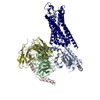
Movie
Movie Controller

[English] 日本語
 Yorodumi
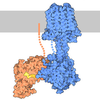
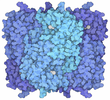
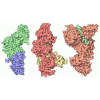
- EMDB-67431: Cryo-EM structure of the human neurotensin receptor 1 (hNTSR1)-Gi... -
+ Open data

- Basic information
| Entry |  | ||||||||||||||||||||||||
|---|---|---|---|---|---|---|---|---|---|---|---|---|---|---|---|---|---|---|---|---|---|---|---|---|---|
| Title | Cryo-EM structure of the human neurotensin receptor 1 (hNTSR1)-Gi1 complex in the GTP-bound, AHD-open NC state 1, plunge-frozen 0-5 seconds after GTP addition | ||||||||||||||||||||||||
 Map data Map data | |||||||||||||||||||||||||
 Sample Sample |
| ||||||||||||||||||||||||
 Keywords Keywords | GPCR / NTSR1 / neurotensin / G-protein / membrane protein | ||||||||||||||||||||||||
| Function / homology |  Function and homology information Function and homology informationG protein-coupled neurotensin receptor activity / inositol phosphate catabolic process / symmetric synapse / positive regulation of locomotion / regulation of inositol trisphosphate biosynthetic process / positive regulation of gamma-aminobutyric acid secretion / L-glutamate import across plasma membrane / D-aspartate import across plasma membrane / positive regulation of arachidonate secretion / vocalization behavior ...G protein-coupled neurotensin receptor activity / inositol phosphate catabolic process / symmetric synapse / positive regulation of locomotion / regulation of inositol trisphosphate biosynthetic process / positive regulation of gamma-aminobutyric acid secretion / L-glutamate import across plasma membrane / D-aspartate import across plasma membrane / positive regulation of arachidonate secretion / vocalization behavior / regulation of behavioral fear response / cAMP biosynthetic process / regulation of respiratory gaseous exchange / negative regulation of systemic arterial blood pressure / positive regulation of inhibitory postsynaptic potential / negative regulation of release of sequestered calcium ion into cytosol / response to food / positive regulation of glutamate secretion / response to lipid / temperature homeostasis / regulation of membrane depolarization / positive regulation of inositol phosphate biosynthetic process / response to stress / detection of temperature stimulus involved in sensory perception of pain / conditioned place preference / regulation of eating behavior / adenylate cyclase inhibitor activity / T cell migration / positive regulation of protein localization to cell cortex / positive regulation of relaxation of smooth muscle / Adenylate cyclase inhibitory pathway / D2 dopamine receptor binding / adenylate cyclase-inhibiting dopamine receptor signaling pathway / adenylate cyclase-inhibiting serotonin receptor signaling pathway / G protein-coupled serotonin receptor binding / regulation of G protein-coupled receptor signaling pathway / positive regulation of release of sequestered calcium ion into cytosol / cellular response to forskolin / regulation of mitotic spindle organization / Peptide ligand-binding receptors / mast cell degranulation / chemokine-mediated signaling pathway / dendritic shaft / establishment of mitotic spindle orientation / neuropeptide signaling pathway / Regulation of insulin secretion / response to prostaglandin E / positive regulation of cholesterol biosynthetic process / G protein-coupled receptor binding / response to peptide hormone / G protein-coupled receptor activity / G-protein beta/gamma-subunit complex binding / adenylate cyclase-inhibiting G protein-coupled receptor signaling pathway / adenylate cyclase-modulating G protein-coupled receptor signaling pathway / Olfactory Signaling Pathway / Activation of the phototransduction cascade / terminal bouton / G protein-coupled acetylcholine receptor signaling pathway / G beta:gamma signalling through PLC beta / Presynaptic function of Kainate receptors / Thromboxane signalling through TP receptor / Activation of G protein gated Potassium channels / Inhibition of voltage gated Ca2+ channels via Gbeta/gamma subunits / G-protein activation / Glucagon signaling in metabolic regulation / G beta:gamma signalling through CDC42 / Prostacyclin signalling through prostacyclin receptor / GDP binding / Synthesis, secretion, and inactivation of Glucagon-like Peptide-1 (GLP-1) / photoreceptor disc membrane / G beta:gamma signalling through BTK / ADP signalling through P2Y purinoceptor 12 / Sensory perception of sweet, bitter, and umami (glutamate) taste / Glucagon-type ligand receptors / Adrenaline,noradrenaline inhibits insulin secretion / Vasopressin regulates renal water homeostasis via Aquaporins / G alpha (z) signalling events / Glucagon-like Peptide-1 (GLP1) regulates insulin secretion / ADP signalling through P2Y purinoceptor 1 / cellular response to catecholamine stimulus / G beta:gamma signalling through PI3Kgamma / ADORA2B mediated anti-inflammatory cytokines production / adenylate cyclase-activating dopamine receptor signaling pathway / cellular response to prostaglandin E stimulus / Cooperation of PDCL (PhLP1) and TRiC/CCT in G-protein beta folding / GPER1 signaling / heterotrimeric G-protein complex / G alpha (12/13) signalling events / Inactivation, recovery and regulation of the phototransduction cascade / G-protein beta-subunit binding / extracellular vesicle / Thrombin signalling through proteinase activated receptors (PARs) / adenylate cyclase-activating G protein-coupled receptor signaling pathway / signaling receptor complex adaptor activity / spindle pole / ciliary basal body / GTPase binding / midbody / chemical synaptic transmission / G protein activity Similarity search - Function | ||||||||||||||||||||||||
| Biological species |  Homo sapiens (human) / Homo sapiens (human) /   Mus musculus (house mouse) / synthetic construct (others) Mus musculus (house mouse) / synthetic construct (others) | ||||||||||||||||||||||||
| Method | single particle reconstruction / Resolution: 2.7 Å | ||||||||||||||||||||||||
 Authors Authors | Kobayashi K / Matsui TE / Fukuda M / Kawakami K / Yamashita K / Kato HE | ||||||||||||||||||||||||
| Funding support |  Japan, 7 items Japan, 7 items
| ||||||||||||||||||||||||
 Citation Citation | Journal: Nature / Year: 2026 Title: The dynamic basis of G-protein recognition and activation by a GPCR. Authors: Kazuhiro Kobayashi / Kouki Kawakami / Toshiki E Matsui / Shun Yokoi / Masahiro Fukuda / Tomohiro J Narita / Hiroki Arai / Mai Tambo / Takashi Sumikama / Manae Tatsumi / Keitaro Yamashita / ...Authors: Kazuhiro Kobayashi / Kouki Kawakami / Toshiki E Matsui / Shun Yokoi / Masahiro Fukuda / Tomohiro J Narita / Hiroki Arai / Mai Tambo / Takashi Sumikama / Manae Tatsumi / Keitaro Yamashita / Junki Koyanagi / Mai Kugawa / Hisako Ikeda / Ayumi Sumino / Ayori Mitsutake / Brian K Kobilka / Asuka Inoue / Hideaki E Kato /  Abstract: G-protein-coupled receptor (GPCR) signalling occurs through heterotrimeric G proteins, whose selective activation leads to distinct cellular outcomes. Although more than 200 GPCR-G protein complex ...G-protein-coupled receptor (GPCR) signalling occurs through heterotrimeric G proteins, whose selective activation leads to distinct cellular outcomes. Although more than 200 GPCR-G protein complex structures have been determined, these static snapshots provide limited insight into the dynamics of G-protein association and dissociation. Here we present cryo-electron microscopy structures of human neurotensin receptor type 1 (NTSR1) with minimally modified G and G, showing how the receptor's intracellular surface dynamically rearranges to accommodate each G-protein subtype. Furthermore, time-resolved cryo-electron microscopy analyses of NTSR1-G visualized G-protein dissociation processes on GDP/GTP binding. Characterization of more than 20 intermediates, complemented by mutational and computational analyses, identifies four key mechanistic features. First, GDP/GTP induces G release from both canonical and non-canonical active conformations with distinct kinetics. Second, NTSR1 uses common intracellular rearrangements to recognize different G-protein subtypes and to promote activation of a single subtype. Third, separation from Gβγ involves stepwise remodelling of the Gα switches I-III. Finally, G dissociates from the receptor through a pathway that is distinct from that of G, and the canonical and non-canonical NTSR1-G complexes further diverge in their dissociation trajectories. These findings provide a comprehensive framework for understanding GPCR signalling dynamics and guiding signal-targeted therapeutic development. | ||||||||||||||||||||||||
| History |
|
- Structure visualization
| Supplemental images |
|---|

- Downloads & links
-EMDB archive
| Map data | emd_67431.map.gz | 18 MB | EMDB map data format | |
|---|---|---|---|---|
| Header (meta data) | emd-67431-v30.xmlemd-67431.xml | 28.9 KB 28.9 KB | Display Display | EMDB header |
| FSC (resolution estimation) | emd_67431_fsc.xml | 9.9 KB | Display | FSC data file |
| Images |  emd_67431.png emd_67431.png | 99.5 KB | ||
| Masks | emd_67431_msk_1.map | 103 MB | Mask map | |
| Filedesc metadata | emd-67431.cif.gz | 7.4 KB | ||
| Others | emd_67431_additional_1.map.gzemd_67431_half_map_1.map.gzemd_67431_half_map_2.map.gz | 96.1 MB 95.5 MB 95.5 MB | ||
| Archive directory |  https://data.pdbj.org/pub/emdb/structures/EMD-67431ftp://data.pdbj.org/pub/emdb/structures/EMD-67431 https://data.pdbj.org/pub/emdb/structures/EMD-67431ftp://data.pdbj.org/pub/emdb/structures/EMD-67431 | HTTPS FTP |
-Related structure data
| Related structure data |  20ziMC  20zcC  20zdC  20zgC  20zhC  20zjC  20zkC  20zlC  9vatC  9vauC  9vavC  9vawC  9vaxC  9vayC  9vazC  9vb0C  9vb1C  9vb2C  9vb3C  9vb4C  9vb5C  9vb6C  9vb7C  9vbaC M: atomic model generated by this map C: citing same article ( |
|---|---|
| Similar structure data |


-Links
| EMDB pages | EMDB (EBI/PDBe) / EMDataResource |
|---|---|
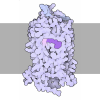
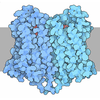
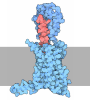
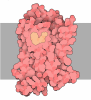
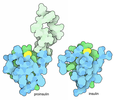
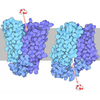
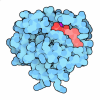
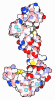
| Related items in Molecule of the Month |

-Map
| File | Download / File: emd_67431.map.gz / Format: CCP4 / Size: 103 MB / Type: IMAGE STORED AS FLOATING POINT NUMBER (4 BYTES) | ||||||||||||||||||||||||||||||||||||
|---|---|---|---|---|---|---|---|---|---|---|---|---|---|---|---|---|---|---|---|---|---|---|---|---|---|---|---|---|---|---|---|---|---|---|---|---|---|
| Projections & slices | Image control
Images are generated by Spider. | ||||||||||||||||||||||||||||||||||||
| Voxel size | X=Y=Z: 0.83 Å | ||||||||||||||||||||||||||||||||||||
| Density |
| ||||||||||||||||||||||||||||||||||||
| Symmetry | Space group: 1 | ||||||||||||||||||||||||||||||||||||
| Details | EMDB XML:
|
 Z (Sec.)
 Y (Row.)
 X (Col.)


-Supplemental data
-Mask #1
| File | emd_67431_msk_1.map | ||||||||||||
|---|---|---|---|---|---|---|---|---|---|---|---|---|---|
| Projections & Slices |
| ||||||||||||
| Density Histograms |


-Additional map: #1
| File | emd_67431_additional_1.map | ||||||||||||
|---|---|---|---|---|---|---|---|---|---|---|---|---|---|
| Projections & Slices |
| ||||||||||||
| Density Histograms |


-Half map: #2
| File | emd_67431_half_map_1.map | ||||||||||||
|---|---|---|---|---|---|---|---|---|---|---|---|---|---|
| Projections & Slices |
| ||||||||||||
| Density Histograms |


-Half map: #1
| File | emd_67431_half_map_2.map | ||||||||||||
|---|---|---|---|---|---|---|---|---|---|---|---|---|---|
| Projections & Slices |
| ||||||||||||
| Density Histograms |


- Sample components
+Entire : JMV449-bound human neurotensin receptor 1 (hNTSR1)-Gi1 complex in...
+Supramolecule #1: JMV449-bound human neurotensin receptor 1 (hNTSR1)-Gi1 complex in...
+Supramolecule #2: JMV449-bound human neurotensin receptor type 1
+Supramolecule #3: heterotrimeric Gi1 protein
+Supramolecule #4: scFv16
+Macromolecule #1: Guanine nucleotide-binding protein G(i) subunit alpha-1
 Trichoplusia ni (cabbage looper)
+Macromolecule #2: Guanine nucleotide-binding protein G(I)/G(S)/G(T) subunit beta-1
+Macromolecule #3: Guanine nucleotide-binding protein G(I)/G(S)/G(O) subunit gamma-2
+Macromolecule #4: scFv16
+Macromolecule #5: Neurotensin receptor type 1
 Spodoptera frugiperda (fall armyworm)
+Macromolecule #6: LYS-LYS-PRO-TYR-ILE-LEU
-Experimental details
-Structure determination
 Processing Processing | single particle reconstruction |
|---|---|
| Aggregation state | particle |
-Sample preparation
| Buffer | pH: 7.5 |
|---|---|
| Grid | Model: Quantifoil R1.2/1.3 / Support film - Material: GOLD / Support film - topology: HOLEY |
- Electron microscopy
| Microscope | TFS KRIOS |
|---|---|
| Image recording | Film or detector model: GATAN K3 BIOQUANTUM (6k x 4k) / Average electron dose: 50.0 e/Å2 |
| Electron beam | Acceleration voltage: 300 kV / Electron source:  FIELD EMISSION GUN FIELD EMISSION GUN |
| Electron optics | Illumination mode: OTHER / Imaging mode: BRIGHT FIELD / Cs: 2.7 mm / Nominal defocus max: 1.6 µm / Nominal defocus min: 0.6 µm |
| Sample stage | Cooling holder cryogen: NITROGEN |
| Experimental equipment |  Model: Titan Krios / Image courtesy: FEI Company |