 Movie
Movie Controller

[English] 日本語
 Yorodumi
- EMDB-66160: 5-HT2AR bound to IHCH-1906 obtained by cryo-electron microscopy (... -
+ Open data

- Basic information
| Entry |  | |||||||||
|---|---|---|---|---|---|---|---|---|---|---|
| Title | 5-HT2AR bound to IHCH-1906 obtained by cryo-electron microscopy (cryoEM) | |||||||||
 Map data Map data | ||||||||||
 Sample Sample |
| |||||||||
 Keywords Keywords | GPCR / serotonin receptor / membrane protein / 5-HT2AR / SIGNALING PROTEIN/IMMUNE SYSTEM / SIGNALING PROTEIN-IMMUNE SYSTEM complex | |||||||||
| Function / homology |  Function and homology information Function and homology informationpositive regulation of heat generation / 1-(4-iodo-2,5-dimethoxyphenyl)propan-2-amine binding / Gq/11-coupled serotonin receptor activity / positive regulation of phosphatidylinositol biosynthetic process / G protein-coupled serotonin receptor signaling pathway / G protein-coupled serotonin receptor complex / neurofilament / cell body fiber / artery smooth muscle contraction / positive regulation of cytokine production involved in immune response ...positive regulation of heat generation / 1-(4-iodo-2,5-dimethoxyphenyl)propan-2-amine binding / Gq/11-coupled serotonin receptor activity / positive regulation of phosphatidylinositol biosynthetic process / G protein-coupled serotonin receptor signaling pathway / G protein-coupled serotonin receptor complex / neurofilament / cell body fiber / artery smooth muscle contraction / positive regulation of cytokine production involved in immune response / sensitization / Serotonin receptors / phospholipase C-activating serotonin receptor signaling pathway / G protein-coupled serotonin receptor activity / serotonin receptor signaling pathway / urinary bladder smooth muscle contraction / serotonin binding / positive regulation of platelet aggregation / negative regulation of synaptic transmission, glutamatergic / neurotransmitter receptor activity / positive regulation of DNA biosynthetic process / negative regulation of potassium ion transport / temperature homeostasis / detection of temperature stimulus involved in sensory perception of pain / regulation of dopamine secretion / detection of mechanical stimulus involved in sensory perception of pain / positive regulation of vasoconstriction / positive regulation of execution phase of apoptosis / protein tyrosine kinase activator activity / G protein-coupled receptor signaling pathway, coupled to cyclic nucleotide second messenger / release of sequestered calcium ion into cytosol / behavioral response to cocaine / presynaptic modulation of chemical synaptic transmission / dendritic shaft / memory / caveola / intracellular calcium ion homeostasis / positive regulation of neuron apoptotic process / positive regulation of inflammatory response / presynapse / positive regulation of cytosolic calcium ion concentration / chemical synaptic transmission / cytoplasmic vesicle / presynaptic membrane / G alpha (q) signalling events / positive regulation of ERK1 and ERK2 cascade / postsynaptic membrane / response to xenobiotic stimulus / axon / neuronal cell body / positive regulation of cell population proliferation / dendrite / protein-containing complex binding / glutamatergic synapse / identical protein binding / plasma membrane Similarity search - Function | |||||||||
| Biological species |  Homo sapiens (human) Homo sapiens (human) | |||||||||
| Method | single particle reconstruction / cryo EM / Resolution: 3.4 Å | |||||||||
 Authors Authors | Li H / Tang L / Zhang J / Meng B / Cao D / Chen Y / Yu J / Liu Z / Wang S / Cheng J | |||||||||
| Funding support |  China, 1 items China, 1 items
| |||||||||
 Citation Citation | Journal: Nat Commun / Year: 2026 Title: Structure-based design of subtype-selective psychedelic analogs. Authors: Huiqiong Li / Lingjie Tang / Jinfeng Zhang / Bing Meng / Dongmei Cao / Yujin Chen / Jing Yu / Huan Wang / Zhi-Jie Liu / Sheng Wang / Jianjun Cheng / Abstract: Classical psychedelics exert hallucinogenic and therapeutic effects primarily through activation of serotonin 2 A receptor (5-HTR), offering promise as transformative treatments for ...Classical psychedelics exert hallucinogenic and therapeutic effects primarily through activation of serotonin 2 A receptor (5-HTR), offering promise as transformative treatments for neuropsychiatric disorders. However, their concurrent activation of 5-HTR-associated with cardiac valvulopathy-raises serious safety concerns, underscoring the need for subtype-selective psychedelics. To address this, we determine the cryo-EM structure of 5-HTR and perform a comparative structural analysis of the orthosteric binding pockets (OBPs) of 5-HTR and 5-HTR. Guided by key residue differences, we develop a trigonal pharmacophore model to inform the design of 5-HTR-selective agonists that avoid 5-HTR activation. Using this model, we design and synthesize two compound series that selectively activate 5-HTR while antagonizing 5-HTR. Molecular basis of subtype selectivity is confirmed by five additional cryo-EM structures of receptor-ligand complexes. Selected compounds also exhibit antidepressant-like efficacy in animal models. Our findings provide a strategy for the development of safer, subtype-selective psychedelic analogs with therapeutic potential. | |||||||||
| History |
|
- Structure visualization
| Supplemental images |
|---|

- Downloads & links
-EMDB archive
| Map data | emd_66160.map.gz | 117.8 MB | EMDB map data format | |
|---|---|---|---|---|
| Header (meta data) | emd-66160-v30.xmlemd-66160.xml | 18 KB 18 KB | Display Display | EMDB header |
| Images |  emd_66160.png emd_66160.png | 69.6 KB | ||
| Filedesc metadata | emd-66160.cif.gz | 6 KB | ||
| Others | emd_66160_half_map_1.map.gzemd_66160_half_map_2.map.gz | 115.9 MB 115.9 MB | ||
| Archive directory |  https://data.pdbj.org/pub/emdb/structures/EMD-66160ftp://data.pdbj.org/pub/emdb/structures/EMD-66160 https://data.pdbj.org/pub/emdb/structures/EMD-66160ftp://data.pdbj.org/pub/emdb/structures/EMD-66160 | HTTPS FTP |
-Related structure data
| Related structure data |  9wq6MC  9wpqC  9wpxC  9wq5C  9wqaC  9wqbC M: atomic model generated by this map C: citing same article ( |
|---|---|
| Similar structure data |


-Links
| EMDB pages | EMDB (EBI/PDBe) / EMDataResource |
|---|---|
| Related items in Molecule of the Month |
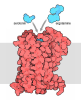
-Map
| File | Download / File: emd_66160.map.gz / Format: CCP4 / Size: 125 MB / Type: IMAGE STORED AS FLOATING POINT NUMBER (4 BYTES) | ||||||||||||||||||||||||||||||||||||
|---|---|---|---|---|---|---|---|---|---|---|---|---|---|---|---|---|---|---|---|---|---|---|---|---|---|---|---|---|---|---|---|---|---|---|---|---|---|
| Projections & slices | Image control
Images are generated by Spider. | ||||||||||||||||||||||||||||||||||||
| Voxel size | X=Y=Z: 0.832 Å | ||||||||||||||||||||||||||||||||||||
| Density |
| ||||||||||||||||||||||||||||||||||||
| Symmetry | Space group: 1 | ||||||||||||||||||||||||||||||||||||
| Details | EMDB XML:
|
 Z (Sec.)
 Y (Row.)
 X (Col.)


-Supplemental data
-Half map: #2
| File | emd_66160_half_map_1.map | ||||||||||||
|---|---|---|---|---|---|---|---|---|---|---|---|---|---|
| Projections & Slices |
| ||||||||||||
| Density Histograms |


-Half map: #1
| File | emd_66160_half_map_2.map | ||||||||||||
|---|---|---|---|---|---|---|---|---|---|---|---|---|---|
| Projections & Slices |
| ||||||||||||
| Density Histograms |


- Sample components
-Entire : 5-HT2AR bound to IHCH-1906 obtained by cryo-electron microscopy (...
| Entire | Name: 5-HT2AR bound to IHCH-1906 obtained by cryo-electron microscopy (cryoEM) |
|---|---|
| Components |
|
-Supramolecule #1: 5-HT2AR bound to IHCH-1906 obtained by cryo-electron microscopy (...
| Supramolecule | Name: 5-HT2AR bound to IHCH-1906 obtained by cryo-electron microscopy (cryoEM) type: complex / ID: 1 / Parent: 0 / Macromolecule list: #1 |
|---|---|
| Source (natural) | Organism: Homo sapiens (human) |
-Macromolecule #1: 5-hydroxytryptamine receptor 2A
| Macromolecule | Name: 5-hydroxytryptamine receptor 2A / type: protein_or_peptide / ID: 1 / Number of copies: 1 / Enantiomer: LEVO |
|---|---|
| Source (natural) | Organism: Homo sapiens (human) |
| Molecular weight | Theoretical: 38.274285 KDa |
| Recombinant expression | Organism:   Spodoptera frugiperda (fall armyworm) Spodoptera frugiperda (fall armyworm) |
| Sequence | String: LSLLHLQEKN WSALLTAVVI ILTIAGNILV IMAVSLEKKL QNATNYFLMS LAIADMLLGF LVMPVSMLTI LYGYRWPLPS KLCAVWIYL DVLFSTASIM HLCAISLDRY VAIQNPIHHS RFNSRTKAFL KIIAVWTISV GISMPIPVFG LQDDSKVFKE G SCLLADDN ...String: LSLLHLQEKN WSALLTAVVI ILTIAGNILV IMAVSLEKKL QNATNYFLMS LAIADMLLGF LVMPVSMLTI LYGYRWPLPS KLCAVWIYL DVLFSTASIM HLCAISLDRY VAIQNPIHHS RFNSRTKAFL KIIAVWTISV GISMPIPVFG LQDDSKVFKE G SCLLADDN FVLIGSFVSF FIPLTIMVIT YFLTIKSLQK EATLCVSDLG TRAKLASFSF LPQSSLSSEK LFQRSIHREP GS YTGRRTM QSISNEQKAC KVLGIVFFLF VVMWCPFFIT NIMAVICKES CNEDVIGALL NVFVWIGYLS SAVNPLVYTL FNK TYRSAF SRYIQCQYKE NKK UniProtKB: 5-hydroxytryptamine receptor 2A |
-Macromolecule #2: 1-(1,2,3,6-tetrahydropyridin-4-yl)-6,7,8,9-tetrahydro-5~{H}-benzo...
| Macromolecule | Name: 1-(1,2,3,6-tetrahydropyridin-4-yl)-6,7,8,9-tetrahydro-5~{H}-benzo[7]annulen-4-ol type: ligand / ID: 2 / Number of copies: 1 / Formula: A1EYE |
|---|---|
| Source (natural) | Organism: Homo sapiens (human) |
| Molecular weight | Theoretical: 243.344 Da |
-Experimental details
-Structure determination
| Method | cryo EM |
|---|---|
 Processing Processing | single particle reconstruction |
| Aggregation state | particle |
-Sample preparation
| Buffer | pH: 7.5 |
|---|---|
| Vitrification | Cryogen name: ETHANE |
- Electron microscopy
| Microscope | TFS KRIOS |
|---|---|
| Image recording | Film or detector model: GATAN K3 BIOQUANTUM (6k x 4k) / Average exposure time: 2.0 sec. / Average electron dose: 60.0 e/Å2 |
| Electron beam | Acceleration voltage: 300 kV / Electron source:  FIELD EMISSION GUN FIELD EMISSION GUN |
| Electron optics | Illumination mode: OTHER / Imaging mode: BRIGHT FIELD / Nominal defocus max: 2.0 µm / Nominal defocus min: 1.0 µm |
| Experimental equipment |  Model: Titan Krios / Image courtesy: FEI Company |

