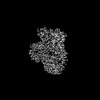
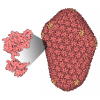
- EMDB-65575: Cryo-EM structure of the Cytoplasmic lattice(CPL) from mouse oocyte -
+
Open data
ID or keywords:
Loading...
-
Basic information
Entry
Database: EMDB / ID: EMD-65575
Title
Cryo-EM structure of the Cytoplasmic lattice(CPL) from mouse oocyte
Map data
Sample
Complex: mouse oocyte cytoplasmic lattices (CPL)
Protein or peptide: x 14 types
Ligand: x 2 types
Keywords
Cytoplasmic lattice / Maternal complex / Cryo-EM structure / Protein assembly / STRUCTURAL PROTEIN
Function / homology
Function and homology information
ooplasm / regulation of translation by machinery localization / Prolactin receptor signaling / Signaling by BMP / subcortical maternal complex / establishment of organelle localization / Microtubule-dependent trafficking of connexons from Golgi to the plasma membrane / Cargo trafficking to the periciliary membrane / Sealing of the nuclear envelope (NE) by ESCRT-III / embryonic process involved in female pregnancy ...ooplasm / regulation of translation by machinery localization / Prolactin receptor signaling / Signaling by BMP / subcortical maternal complex / establishment of organelle localization / Microtubule-dependent trafficking of connexons from Golgi to the plasma membrane / Cargo trafficking to the periciliary membrane / Sealing of the nuclear envelope (NE) by ESCRT-III / embryonic process involved in female pregnancy / Chromatin modifying enzymes / protein storage / structural constituent of cytoplasmic lattice / cytoplasmic lattice / cortical granule exocytosis / establishment or maintenance of apical/basal cell polarity / endoplasmic reticulum localization / Intraflagellar transport / Carboxyterminal post-translational modifications of tubulin / SCF-beta-TrCP mediated degradation of Emi1 / COPI-independent Golgi-to-ER retrograde traffic / E3 ubiquitin ligases ubiquitinate target proteins / ZNF598 and the Ribosome-associated Quality Trigger (RQT) complex dissociate a ribosome stalled on a no-go mRNA / Downregulation of SMAD2/3:SMAD4 transcriptional activity / HSP90 chaperone cycle for steroid hormone receptors (SHR) in the presence of ligand / cytoplasm organization / Regulation of BACH1 activity / histone H3K18 ubiquitin ligase activity / histone H3K14 ubiquitin ligase activity / histone H3 ubiquitin ligase activity / PINK1-PRKN Mediated Mitophagy / Inactivation of CSF3 (G-CSF) signaling / SCF(Skp2)-mediated degradation of p27/p21 / histone H3K23 ubiquitin ligase activity / spermatogonial cell division / MAP3K8 (TPL2)-dependent MAPK1/3 activation / COPI-mediated anterograde transport / Regulation of TNFR1 signaling / Ubiquitin-Mediated Degradation of Phosphorylated Cdc25A / GSK3B-mediated proteasomal degradation of PD-L1(CD274) / Kinesins / histone H3 reader activity / Regulation of RUNX2 expression and activity / Degradation of GLI1 by the proteasome / Cyclin D associated events in G1 / FBXL7 down-regulates AURKA during mitotic entry and in early mitosis / cortical granule / Orc1 removal from chromatin / IKK complex recruitment mediated by RIP1 / GSK3B and BTRC:CUL1-mediated-degradation of NFE2L2 / Dectin-1 mediated noncanonical NF-kB signaling / NIK-->noncanonical NF-kB signaling / PKR-mediated signaling / Aggrephagy / RHO GTPases activate IQGAPs / Oxygen-dependent proline hydroxylation of Hypoxia-inducible Factor Alpha / COPI-dependent Golgi-to-ER retrograde traffic / Mitotic Prometaphase / EML4 and NUDC in mitotic spindle formation / regulation of establishment of protein localization / Resolution of Sister Chromatid Cohesion / Degradation of beta-catenin by the destruction complex / Activation of NF-kappaB in B cells / Recycling pathway of L1 / Iron uptake and transport / The role of GTSE1 in G2/M progression after G2 checkpoint / positive regulation of embryonic development / apical cortex / chromosomal DNA methylation maintenance following DNA replication / intermediate filament cytoskeleton / positive regulation of meiotic nuclear division / regulation of RNA stability / CLEC7A (Dectin-1) signaling / FCERI mediated NF-kB activation / Hedgehog 'off' state / Interleukin-1 signaling / RHO GTPases Activate Formins / F-box domain binding / Separation of Sister Chromatids / Downstream TCR signaling / Recruitment of NuMA to mitotic centrosomes / hemi-methylated DNA-binding / Peroxisomal protein import / GLI3 is processed to GLI3R by the proteasome / Regulation of PLK1 Activity at G2/M Transition / embryonic pattern specification / regulation of epithelial cell proliferation / Neddylation / PcG protein complex / embryonic cleavage / MHC class II antigen presentation / fertilization / mitochondrion localization / gap junction / establishment of spindle localization / (E3-independent) E2 ubiquitin-conjugating enzyme / embryonic brain development / maintenance of protein location in nucleus / positive regulation of epithelial cell apoptotic process / Cul7-RING ubiquitin ligase complex Similarity search - Function
National Natural Science Foundation of China (NSFC)
32070628
China
National Natural Science Foundation of China (NSFC)
32271258
China
Citation
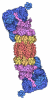
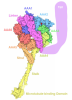
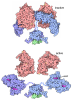
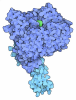
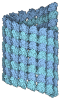
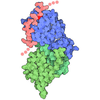
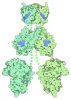
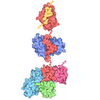
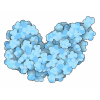
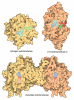
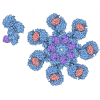
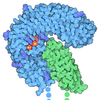
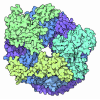
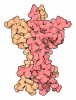
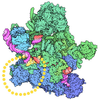
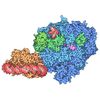
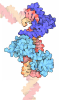
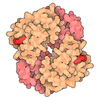
Journal: Nature / Year: 2026 Title: Molecular basis of oocyte cytoplasmic lattice assembly. Authors: Shuxian Liu / Yusong Liu / Junchao Xue / Zhenzhen Li / Yan Zhang / Bailun Li / Lidan Xu / Lili Li / Zhenzhen Yu / Hongtao Yu / Haishan Gao / En-Zhi Shen / Abstract: Mammalian oocytes are filled with fibric structures called cytoplasmic lattice (CPL) that are essential for oocyte maturation and early embryonic development. CPL comprises subcortical maternal ...Mammalian oocytes are filled with fibric structures called cytoplasmic lattice (CPL) that are essential for oocyte maturation and early embryonic development. CPL comprises subcortical maternal complex (SCMC) and multiple components, including PADI6. Although it was first discovered in the 1960s, the molecular architecture and assembly mechanisms of CPL remain poorly understood. Here we present the cryo-electron microscopy structure of CPL isolated from mouse oocytes. Our analysis identified 14 constitutive protein subunits and revealed that CPL is composed of repeating units comprising U-shaped basket (UB) and adapter ring (AR) features, forming a filamentous architecture. The AR adopts a two-fold symmetric conformation, containing two NLRP4F, four SCMC and two ZBED3 subunits circularized via two distinct interaction clusters. The UB is anchored by PADI6, a didecamer composed of ten homodimers assembled by two back-to-back pentamers, each forming the lateral side of the UB. The underfoot base and up and down sides of the UB are formed by multiple central-symmetric assemblies (UBE2D3-UHRF1-NLRP14) and (TUBB2B-TUBB2A-FBXW24-SKP1), respectively, associating with the PADI6 pentamers to construct the intact UB structure. Two SCMC dimers within each AR connect the up and down sides of two adjacent UBs with an extensive protein-protein interaction network, and thus maintain the repetitive connection between the neighbouring CPL units. Our work unveils the architectural principles underlying the assembly of this large, periodic CPL filament, offering a molecular basis for understanding the functions of CPL in early mammalian embryogenesis and female reproductive disorders.
In the structure databanks used in Yorodumi, some data are registered as the other names, "COVID-19 virus" and "2019-nCoV". Here are the details of the virus and the list of structure data.
Jan 31, 2019. EMDB accession codes are about to change! (news from PDBe EMDB page)
EMDB accession codes are about to change! (news from PDBe EMDB page)
The allocation of 4 digits for EMDB accession codes will soon come to an end. Whilst these codes will remain in use, new EMDB accession codes will include an additional digit and will expand incrementally as the available range of codes is exhausted. The current 4-digit format prefixed with “EMD-” (i.e. EMD-XXXX) will advance to a 5-digit format (i.e. EMD-XXXXX), and so on. It is currently estimated that the 4-digit codes will be depleted around Spring 2019, at which point the 5-digit format will come into force.
The EM Navigator/Yorodumi systems omit the EMD- prefix.
Related info.:Q: What is EMD? / ID/Accession-code notation in Yorodumi/EM Navigator
Yorodumi is a browser for structure data from EMDB, PDB, SASBDB, etc.
This page is also the successor to EM Navigator detail page, and also detail information page/front-end page for Omokage search.
The word "yorodu" (or yorozu) is an old Japanese word meaning "ten thousand". "mi" (miru) is to see.
Related info.:EMDB / PDB / SASBDB / Comparison of 3 databanks / Yorodumi Search / Aug 31, 2016. New EM Navigator & Yorodumi / Yorodumi Papers / Jmol/JSmol / Function and homology information / Changes in new EM Navigator and Yorodumi
 Movie
Movie Controller

 Yorodumi
 Open data
 Basic information
 Map data
 Sample
 Keywords
 Function and homology information
 Mus musculus (house mouse)
 Authors
 China, 2 items
  Citation
 Structure visualization
 Downloads & links
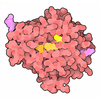
 emd_65575.png
 http://ftp.pdbj.org/pub/emdb/structures/EMD-65575




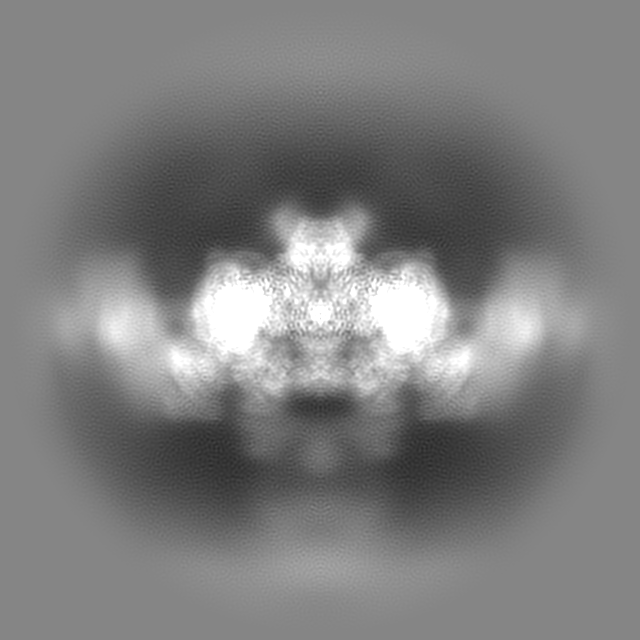
 Z (Sec.)
 Y (Row.)
 X (Col.)




 Sample components
 Processing
 Electron microscopy
 FIELD EMISSION GUN