[English] 日本語
Yorodumi
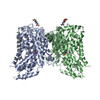
- EMDB-58071: Structure of the NaCT-Na-PF2 complex -

+
Open data


ID or keywords:

Loading...

-
Basic information

Entry
Database: EMDB / ID: EMD-58071
TitleStructure of the NaCT-Na-PF2 complex
Map data
Sample
  • Organelle or cellular component: NaCT-Na-PF2 complex
    • Protein or peptide: Na(+)/citrate cotransporter
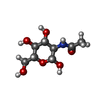
  • Ligand: 2-acetamido-2-deoxy-beta-D-glucopyranose
  • Ligand: (2R)-2-[2-(4-tert-butylphenyl)ethyl]-2-hydroxybutanedioic acid
  • Ligand: SODIUM ION
KeywordsInhibitor / complex / MEMBRANE PROTEIN
Function / homology
Function and homology information


organic acid:sodium symporter activity / fumarate transport / oxaloacetate transport / SLC-mediated transport of organic anions / succinate transport / sodium:dicarboxylate symporter activity / citrate transmembrane transporter activity / citrate transport / alpha-ketoglutarate transport / succinate transmembrane transporter activity ...organic acid:sodium symporter activity / fumarate transport / oxaloacetate transport / SLC-mediated transport of organic anions / succinate transport / sodium:dicarboxylate symporter activity / citrate transmembrane transporter activity / citrate transport / alpha-ketoglutarate transport / succinate transmembrane transporter activity / cellular response to lithium ion / : / transmembrane transport / metal ion binding / identical protein binding / plasma membrane
Similarity search - Function
Sodium/sulphate symporter, conserved site / Sodium:sulfate symporter family signature. / Sodium:sulfate symporter transmembrane region / Solute carrier family 13
Similarity search - Domain/homology
Na(+)/citrate cotransporter
Similarity search - Component
Biological speciesHomo sapiens (human)
Methodsingle particle reconstruction / cryo EM / Resolution: 2.53 Å
AuthorsSauer DB / Song J / Marden JJ / Wang B / Rice WJ / Wang DN
Funding support United States, 5 items
OrganizationGrant numberCountry
National Institutes of Health/National Institute of General Medical Sciences (NIH/NIGMS)R01GM121994 United States
National Institutes of Health/National Institute of Diabetes and Digestive and Kidney Disease (NIH/NIDDK)R01DK135088 United States
National Institutes of Health/National Institute of Neurological Disorders and Stroke (NIH/NINDS)R01NS108151 United States
TESS Research Foundation United States
The G. Harold and Leila Y. Mathers Foundation United States
CitationJournal: bioRxiv / Year: 2026
Title: Structures of the human sodium-citrate cotransporter NaCT with and without substrates.
Authors: David B Sauer / Jinmei Song / Jennifer J Marden / Bing Wang / Kate Sowerby / Joseph C Sudar / William J Rice / Da-Neng Wang /
Abstract: The human sodium-citrate cotransporter NaCT imports various tri- and dicarboxylates into the cell as TCA cycle intermediates. This substrate uptake process is driven by an inward sodium gradient. The ...The human sodium-citrate cotransporter NaCT imports various tri- and dicarboxylates into the cell as TCA cycle intermediates. This substrate uptake process is driven by an inward sodium gradient. The protein is a member of the Divalent Anion-Sodium Symporter (DASS) family. Whereas extensive biochemical and structural studies have been carried out for NaCT, how the substrate binding and translocation is coupled to the sodium gradient remains unclear. Here using single particle cryo-electron microscopy, we determined the structures of the human NaCT protein in three states: sodium-free, in the presence of sodium, and sodium- and substrate-bound. These structures suggest a simultaneous binding mechanism for sodium-substrate coupling, distinct from the sequential binding, conformational selection mechanism previously observed for the bacterial DASS protein VcINDY.
History
DepositionMay 13, 2026-
Header (metadata) releaseJul 29, 2026-
Map releaseJul 29, 2026-
UpdateJul 29, 2026-
Current statusJul 29, 2026Processing site: PDBe / Status: Released

-
Structure visualization

Supplemental images

Downloads & links

-
Map

FileDownload / File: emd_58071.map.gz / Format: CCP4 / Size: 125 MB / Type: IMAGE STORED AS FLOATING POINT NUMBER (4 BYTES)
Projections & slices

Image control

Size
Brightness
Contrast
Others
AxesZ (Sec.)Y (Row.)X (Col.)
0.83 Å/pix.
x 320 pix.
= 264.192 Å
0.83 Å/pix.
x 320 pix.
= 264.192 Å
0.83 Å/pix.
x 320 pix.
= 264.192 Å

Surface

Projections

Slices (1/3)

Slices (1/2)

Slices (2/3)

Images are generated by Spider.

Voxel sizeX=Y=Z: 0.8256 Å
Density
Contour LevelBy AUTHOR: 0.404
Minimum - Maximum-0.4842563 - 1.4166765
Average (Standard dev.)-0.0016598358 (±0.03605145)
SymmetrySpace group: 1
Details

EMDB XML:

Map geometry
Axis orderXYZ
Origin000
Dimensions320320320
Spacing320320320
CellA=B=C: 264.19202 Å
α=β=γ: 90.0 °

-
Supplemental data

-
Half map: #1

Fileemd_58071_half_map_1.map
Projections & Slices
AxesZYX

Projections

Slices (1/2)
Density Histograms

-
Half map: #2

Fileemd_58071_half_map_2.map
Projections & Slices
AxesZYX

Projections

Slices (1/2)
Density Histograms

-
Sample components

-
Entire : NaCT-Na-PF2 complex

EntireName: NaCT-Na-PF2 complex
Components
  • Organelle or cellular component: NaCT-Na-PF2 complex
    • Protein or peptide: Na(+)/citrate cotransporter
  • Ligand: 2-acetamido-2-deoxy-beta-D-glucopyranose
  • Ligand: (2R)-2-[2-(4-tert-butylphenyl)ethyl]-2-hydroxybutanedioic acid
  • Ligand: SODIUM ION

-
Supramolecule #1: NaCT-Na-PF2 complex

SupramoleculeName: NaCT-Na-PF2 complex / type: organelle_or_cellular_component / ID: 1 / Parent: 0 / Macromolecule list: #1
Source (natural)Organism: Homo sapiens (human)

-
Macromolecule #1: Na(+)/citrate cotransporter

MacromoleculeName: Na(+)/citrate cotransporter / type: protein_or_peptide / ID: 1 / Number of copies: 2 / Enantiomer: LEVO
Source (natural)Organism: Homo sapiens (human)
Molecular weightTheoretical: 63.110812 KDa
Recombinant expressionOrganism: Trichoplusia ni (cabbage looper)
SequenceString: MASALSYVSK FKSFVILFVT PLLLLPLVIL MPAKFVRCAY VIILMAIYWC TEVIPLAVTS LMPVLLFPLF QILDSRQVCV QYMKDTNML FLGGLIVAVA VERWNLHKRI ALRTLLWVGA KPARLMLGFM GVTALLSMWI SNTATTAMMV PIVEAILQQM E ATSAATEA ...String:
MASALSYVSK FKSFVILFVT PLLLLPLVIL MPAKFVRCAY VIILMAIYWC TEVIPLAVTS LMPVLLFPLF QILDSRQVCV QYMKDTNML FLGGLIVAVA VERWNLHKRI ALRTLLWVGA KPARLMLGFM GVTALLSMWI SNTATTAMMV PIVEAILQQM E ATSAATEA GLELVDKGKA KELPGSQVIF EGPTLGQQED QERKRLCKAM TLCICYAASI GGTATLTGTG PNVVLLGQMN EL FPDSKDL VNFASWFAFA FPNMLVMLLF AWLWLQFVYM RFNFKKSWGC GLESKKNEKA ALKVLQEEYR KLGPLSFAEI NVL ICFFLL VILWFSRDPG FMPGWLTVAW VEGETKYVSD ATVAIFVATL LFIVPSQKPK FNFRSQTEEE RKTPFYPPPL LDWK VTQEK VPWGIVLLLG GGFALAKGSE ASGLSVWMGK QMEPLHAVPP AAITLILSLL VAVFTECTSN VATTTLFLPI FASMS RSIG LNPLYIMLPC TLSASFAFML PVATPPNAIV FTYGHLKVAD MVKTGVIMNI IGVFCVFLAV NTWGRAIFDL DHFPDW ANV THIET

UniProtKB: Na(+)/citrate cotransporter

-
Macromolecule #2: 2-acetamido-2-deoxy-beta-D-glucopyranose

MacromoleculeName: 2-acetamido-2-deoxy-beta-D-glucopyranose / type: ligand / ID: 2 / Number of copies: 2 / Formula: NAG
Molecular weightTheoretical: 221.208 Da
Chemical component information

ChemComp-NAG:
2-acetamido-2-deoxy-beta-D-glucopyranose

-
Macromolecule #3: (2R)-2-[2-(4-tert-butylphenyl)ethyl]-2-hydroxybutanedioic acid

MacromoleculeName: (2R)-2-[2-(4-tert-butylphenyl)ethyl]-2-hydroxybutanedioic acid
type: ligand / ID: 3 / Number of copies: 2 / Formula: X3M
Molecular weightTheoretical: 294.343 Da
Chemical component information

ChemComp-X3M:
(2R)-2-[2-(4-tert-butylphenyl)ethyl]-2-hydroxybutanedioic acid

-
Macromolecule #4: SODIUM ION

MacromoleculeName: SODIUM ION / type: ligand / ID: 4 / Number of copies: 4
Molecular weightTheoretical: 22.99 Da

-
Experimental details

-
Structure determination

Methodcryo EM
Processingsingle particle reconstruction
Aggregation stateparticle

-
Sample preparation

Concentration0.75 mg/mL
BufferpH: 7.5
Component:
ConcentrationFormulaName
300.0 mMNaClSodium Chloride
25.0 mMTris
0.1 %DDM
100.0 uMPF2
0.1 mMTCEP
GridModel: Quantifoil R1.2/1.3 / Material: GOLD / Mesh: 300 / Pretreatment - Type: GLOW DISCHARGE
VitrificationCryogen name: ETHANE / Chamber humidity: 100 % / Chamber temperature: 277 K / Instrument: FEI VITROBOT MARK IV

-
Electron microscopy

MicroscopeTFS KRIOS
Specialist opticsEnergy filter - Slit width: 20 eV
Image recordingFilm or detector model: GATAN K3 (6k x 4k) / Average electron dose: 63.34 e/Å2
Electron beamAcceleration voltage: 300 kV / Electron source: FIELD EMISSION GUN
Electron opticsIllumination mode: FLOOD BEAM / Imaging mode: BRIGHT FIELD / Nominal defocus max: 6.9 µm / Nominal defocus min: 4.0 µm / Nominal magnification: 105000
Experimental equipment
Model: Titan Krios / Image courtesy: FEI Company

+
Image processing

Particle selectionNumber selected: 2620654
CTF correctionSoftware - Name: Warp / Type: PHASE FLIPPING AND AMPLITUDE CORRECTION
Startup modelType of model: NONE
Final reconstructionApplied symmetry - Point group: C2 (2 fold cyclic) / Resolution.type: BY AUTHOR / Resolution: 2.53 Å / Resolution method: FSC 0.143 CUT-OFF / Software - Name: cryoSPARC / Number images used: 976961
Initial angle assignmentType: MAXIMUM LIKELIHOOD
Final angle assignmentType: MAXIMUM LIKELIHOOD

-
Atomic model buiding 1

Initial modelPDB ID:

Chain - Source name: PDB / Chain - Initial model type: experimental model
RefinementSpace: REAL / Protocol: FLEXIBLE FIT
Output model

PDB-30ut:
Structure of the NaCT-Na-PF2 complex

+
About Yorodumi

-
News

-
Feb 9, 2022. New format data for meta-information of EMDB entries

New format data for meta-information of EMDB entries

  • Version 3 of the EMDB header file is now the official format.
  • The previous official version 1.9 will be removed from the archive.

Related info.:EMDB header

External links:wwPDB to switch to version 3 of the EMDB data model

-
Aug 12, 2020. Covid-19 info

Covid-19 info

URL: https://pdbj.org/emnavi/covid19.php

New page: Covid-19 featured information page in EM Navigator.

Related info.:Covid-19 info / Mar 5, 2020. Novel coronavirus structure data

+
Mar 5, 2020. Novel coronavirus structure data

Novel coronavirus structure data

Related info.:Yorodumi Speices / Aug 12, 2020. Covid-19 info

External links:COVID-19 featured content - PDBj / Molecule of the Month (242):Coronavirus Proteases

+
Jan 31, 2019. EMDB accession codes are about to change! (news from PDBe EMDB page)

EMDB accession codes are about to change! (news from PDBe EMDB page)

  • The allocation of 4 digits for EMDB accession codes will soon come to an end. Whilst these codes will remain in use, new EMDB accession codes will include an additional digit and will expand incrementally as the available range of codes is exhausted. The current 4-digit format prefixed with “EMD-” (i.e. EMD-XXXX) will advance to a 5-digit format (i.e. EMD-XXXXX), and so on. It is currently estimated that the 4-digit codes will be depleted around Spring 2019, at which point the 5-digit format will come into force.
  • The EM Navigator/Yorodumi systems omit the EMD- prefix.

Related info.:Q: What is EMD? / ID/Accession-code notation in Yorodumi/EM Navigator

External links:EMDB Accession Codes are Changing Soon! / Contact to PDBj

+
Jul 12, 2017. Major update of PDB

Major update of PDB

  • wwPDB released updated PDB data conforming to the new PDBx/mmCIF dictionary.
  • This is a major update changing the version number from 4 to 5, and with Remediation, in which all the entries are updated.
  • In this update, many items about electron microscopy experimental information are reorganized (e.g. em_software).
  • Now, EM Navigator and Yorodumi are based on the updated data.

External links:wwPDB Remediation / Enriched Model Files Conforming to OneDep Data Standards Now Available in the PDB FTP Archive

-
Yorodumi

Thousand views of thousand structures

  • Yorodumi is a browser for structure data from EMDB, PDB, SASBDB, etc.
  • This page is also the successor to EM Navigator detail page, and also detail information page/front-end page for Omokage search.
  • The word "yorodu" (or yorozu) is an old Japanese word meaning "ten thousand". "mi" (miru) is to see.

Related info.:EMDB / PDB / SASBDB / Comparison of 3 databanks / Yorodumi Search / Aug 31, 2016. New EM Navigator & Yorodumi / Yorodumi Papers / Jmol/JSmol / Function and homology information / Changes in new EM Navigator and Yorodumi

Read more