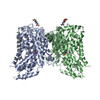
Movie
Movie Controller


+ Open data

- Basic information
| Entry | Database: PDB / ID: 30ut | |||||||||||||||||||||
|---|---|---|---|---|---|---|---|---|---|---|---|---|---|---|---|---|---|---|---|---|---|---|
| Title | Structure of the NaCT-Na-PF2 complex | |||||||||||||||||||||
 Components Components | Na(+)/citrate cotransporter | |||||||||||||||||||||
 Keywords Keywords | MEMBRANE PROTEIN / Inhibitor / complex | |||||||||||||||||||||
| Function / homology |  Function and homology information Function and homology informationfumarate transport / organic acid:sodium symporter activity / oxaloacetate transport / succinate transport / sodium:dicarboxylate symporter activity / SLC-mediated transport of organic anions / citrate transmembrane transporter activity / citrate transport / alpha-ketoglutarate transport / succinate transmembrane transporter activity ...fumarate transport / organic acid:sodium symporter activity / oxaloacetate transport / succinate transport / sodium:dicarboxylate symporter activity / SLC-mediated transport of organic anions / citrate transmembrane transporter activity / citrate transport / alpha-ketoglutarate transport / succinate transmembrane transporter activity / cellular response to lithium ion / transmembrane transport / identical protein binding / plasma membrane Similarity search - Function | |||||||||||||||||||||
| Biological species |  Homo sapiens (human) Homo sapiens (human) | |||||||||||||||||||||
| Method | ELECTRON MICROSCOPY / single particle reconstruction / cryo EM / Resolution: 2.53 Å | |||||||||||||||||||||
 Authors Authors | Sauer, D.B. / Song, J. / Marden, J.J. / Wang, B. / Rice, W.J. / Wang, D.N. | |||||||||||||||||||||
| Funding support |  United States, 5items United States, 5items
| |||||||||||||||||||||
 Citation Citation | Journal: bioRxiv / Year: 2026 Title: Structures of the human sodium-citrate cotransporter NaCT with and without substrates. Authors: David B Sauer / Jinmei Song / Jennifer J Marden / Bing Wang / Kate Sowerby / Joseph C Sudar / William J Rice / Da-Neng Wang / Abstract: The human sodium-citrate cotransporter NaCT imports various tri- and dicarboxylates into the cell as TCA cycle intermediates. This substrate uptake process is driven by an inward sodium gradient. The ...The human sodium-citrate cotransporter NaCT imports various tri- and dicarboxylates into the cell as TCA cycle intermediates. This substrate uptake process is driven by an inward sodium gradient. The protein is a member of the Divalent Anion-Sodium Symporter (DASS) family. Whereas extensive biochemical and structural studies have been carried out for NaCT, how the substrate binding and translocation is coupled to the sodium gradient remains unclear. Here using single particle cryo-electron microscopy, we determined the structures of the human NaCT protein in three states: sodium-free, in the presence of sodium, and sodium- and substrate-bound. These structures suggest a simultaneous binding mechanism for sodium-substrate coupling, distinct from the sequential binding, conformational selection mechanism previously observed for the bacterial DASS protein VcINDY. | |||||||||||||||||||||
| History |
|
- Structure visualization
| Structure viewer | Molecule: MolmilJmol/JSmol |
|---|
- Downloads & links
-Download
| PDBx/mmCIF format | 30ut.cif.gz | 362.5 KB | Display | PDBx/mmCIF format |
|---|---|---|---|---|
| PDB format | pdb30ut.ent.gz | 299.8 KB | Display | PDB format |
| PDBx/mmJSON format | 30ut.json.gz | Tree view | PDBx/mmJSON format | |
| Others |  Other downloads Other downloads |
-Validation report
| Arichive directory | https://data.pdbj.org/pub/pdb/validation_reports/0u/30utftp://data.pdbj.org/pub/pdb/validation_reports/0u/30ut | HTTPS FTP |
|---|
-Related structure data
| Related structure data |  58071MC  30uuC  30uvC M: map data used to model this data C: citing same article ( |
|---|---|
| Similar structure data |


-Links
 PDBj
PDBj- Assembly
| Deposited unit | 
|
|---|---|
| 1 |
|
-Components
| #1: Protein | Mass: 63110.812 Da / Num. of mol.: 2 Source method: isolated from a genetically manipulated source Source: (gene. exp.) Homo sapiens (human) / Gene: SLC13A5, NACT / Production host:  Trichoplusia ni (cabbage looper) / References: UniProt: Q86YT5 Trichoplusia ni (cabbage looper) / References: UniProt: Q86YT5#2: Sugar | 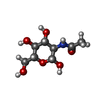 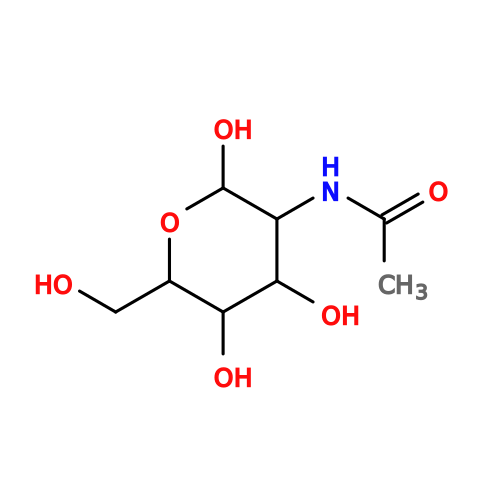 Type: D-saccharide, beta linking / Mass: 221.208 Da / Num. of mol.: 2 / Source method: obtained synthetically / Formula: C8H15NO6 Type: D-saccharide, beta linking / Mass: 221.208 Da / Num. of mol.: 2 / Source method: obtained synthetically / Formula: C8H15NO6#3: Chemical |  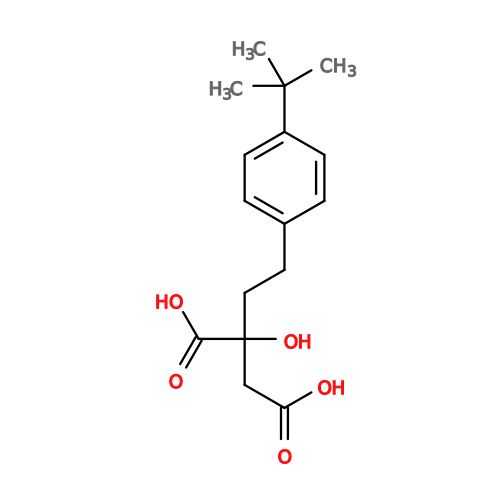 Mass: 294.343 Da / Num. of mol.: 2 / Source method: obtained synthetically / Formula: C16H22O5 / Feature type: SUBJECT OF INVESTIGATION Mass: 294.343 Da / Num. of mol.: 2 / Source method: obtained synthetically / Formula: C16H22O5 / Feature type: SUBJECT OF INVESTIGATION#4: Chemical | ChemComp-NA /   Mass: 22.990 Da / Num. of mol.: 4 / Source method: obtained synthetically / Formula: Na / Feature type: SUBJECT OF INVESTIGATION Mass: 22.990 Da / Num. of mol.: 4 / Source method: obtained synthetically / Formula: Na / Feature type: SUBJECT OF INVESTIGATIONHas ligand of interest | Y | Has protein modification | Y | |
|---|
-Experimental details
-Experiment
| Experiment | Method: ELECTRON MICROSCOPY |
|---|---|
| EM experiment | Aggregation state: PARTICLE / 3D reconstruction method: single particle reconstruction |
- Sample preparation
| Component | Name: NaCT-Na-PF2 complex / Type: ORGANELLE OR CELLULAR COMPONENT / Entity ID: #1 / Source: RECOMBINANT | ||||||||||||||||||||||||||||||
|---|---|---|---|---|---|---|---|---|---|---|---|---|---|---|---|---|---|---|---|---|---|---|---|---|---|---|---|---|---|---|---|
| Molecular weight | Experimental value: NO | ||||||||||||||||||||||||||||||
| Source (natural) | Organism: Homo sapiens (human) | ||||||||||||||||||||||||||||||
| Source (recombinant) | Organism: Trichoplusia ni (cabbage looper) | ||||||||||||||||||||||||||||||
| Buffer solution | pH: 7.5 | ||||||||||||||||||||||||||||||
| Buffer component |
| ||||||||||||||||||||||||||||||
| Specimen | Conc.: 0.75 mg/ml / Embedding applied: NO / Shadowing applied: NO / Staining applied: NO / Vitrification applied: YES | ||||||||||||||||||||||||||||||
| Specimen support | Grid material: GOLD / Grid mesh size: 300 divisions/in. / Grid type: Quantifoil R1.2/1.3 | ||||||||||||||||||||||||||||||
| Vitrification | Instrument: FEI VITROBOT MARK IV / Cryogen name: ETHANE / Humidity: 100 % / Chamber temperature: 277 K |
- Electron microscopy imaging
| Experimental equipment |  Model: Titan Krios / Image courtesy: FEI Company |
|---|---|
| Microscopy | Model: TFS KRIOS |
| Electron gun | Electron source:  FIELD EMISSION GUN / Accelerating voltage: 300 kV / Illumination mode: FLOOD BEAM FIELD EMISSION GUN / Accelerating voltage: 300 kV / Illumination mode: FLOOD BEAM |
| Electron lens | Mode: BRIGHT FIELD / Nominal magnification: 105000 X / Nominal defocus max: 6900 nm / Nominal defocus min: 4000 nm |
| Image recording | Electron dose: 63.34 e/Å2 / Film or detector model: GATAN K3 (6k x 4k) |
| EM imaging optics | Energyfilter slit width: 20 eV |
- Processing
| EM software |
| ||||||||||||||||||||||||||||
|---|---|---|---|---|---|---|---|---|---|---|---|---|---|---|---|---|---|---|---|---|---|---|---|---|---|---|---|---|---|
| CTF correction | Type: PHASE FLIPPING AND AMPLITUDE CORRECTION | ||||||||||||||||||||||||||||
| Particle selection | Num. of particles selected: 2620654 | ||||||||||||||||||||||||||||
| Symmetry | Point symmetry: C2 (2 fold cyclic) | ||||||||||||||||||||||||||||
| 3D reconstruction | Resolution: 2.53 Å / Resolution method: FSC 0.143 CUT-OFF / Num. of particles: 976961 / Symmetry type: POINT | ||||||||||||||||||||||||||||
| Atomic model building | Protocol: FLEXIBLE FIT / Space: REAL | ||||||||||||||||||||||||||||
| Atomic model building | PDB-ID: 7JSJ Accession code: 7JSJ / Source name: PDB / Type: experimental model | ||||||||||||||||||||||||||||
| Refinement | Highest resolution: 2.53 Å Stereochemistry target values: REAL-SPACE (WEIGHTED MAP SUM AT ATOM CENTERS) | ||||||||||||||||||||||||||||
| Refine LS restraints |
|