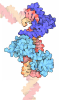
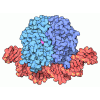
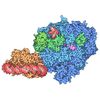
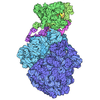
- EMDB-56542: RNA polymerase II bound to RPAP2 and Gdown1 -
+
Open data
ID or keywords:
Loading...
-
Basic information
Entry
Database: EMDB / ID: EMD-56542
Title
RNA polymerase II bound to RPAP2 and Gdown1
Map data
filtered based on local resolution
Sample
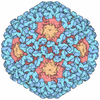
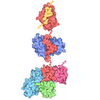
Complex: RNA polymerase II bound to RPAP2 and Gdown1
Protein or peptide: x 14 types
Ligand: x 1 types
Keywords
RNA polymerase II / GENE REGULATION
Function / homology
Function and homology information
maintenance of ER location / RNA polymerase II CTD heptapeptide repeat phosphatase activity / snRNA transcription / RNA polymerase core enzyme binding / microfibril binding / PERK-mediated unfolded protein response / RNA Polymerase III Chain Elongation / RNA Polymerase III Transcription Termination / regulation of transcription by RNA polymerase I / RNA Polymerase III Transcription Initiation From Type 1 Promoter ...maintenance of ER location / RNA polymerase II CTD heptapeptide repeat phosphatase activity / snRNA transcription / RNA polymerase core enzyme binding / microfibril binding / PERK-mediated unfolded protein response / RNA Polymerase III Chain Elongation / RNA Polymerase III Transcription Termination / regulation of transcription by RNA polymerase I / RNA Polymerase III Transcription Initiation From Type 1 Promoter / RNA Polymerase III Transcription Initiation From Type 2 Promoter / RNA Polymerase III Transcription Initiation From Type 3 Promoter / RNA Polymerase III Abortive And Retractive Initiation / Cytosolic sensors of pathogen-associated DNA / transcription elongation factor activity / Abortive elongation of HIV-1 transcript in the absence of Tat / FGFR2 alternative splicing / transcription preinitiation complex / RNA Polymerase I Transcription Termination / Viral Messenger RNA Synthesis / I band / Signaling by FGFR2 IIIa TM / MicroRNA (miRNA) biogenesis / protein-serine/threonine phosphatase / LRR domain binding / RNA Pol II CTD phosphorylation and interaction with CE during HIV infection / RNA Pol II CTD phosphorylation and interaction with CE / Formation of the Early Elongation Complex / Formation of the HIV-1 Early Elongation Complex / mRNA Capping / HIV Transcription Initiation / RNA Polymerase II HIV Promoter Escape / Transcription of the HIV genome / RNA Polymerase II Promoter Escape / RNA Polymerase II Transcription Pre-Initiation And Promoter Opening / RNA Polymerase II Transcription Initiation / RNA Polymerase II Transcription Initiation And Promoter Clearance / Processing of Capped Intron-Containing Pre-mRNA / PIWI-interacting RNA (piRNA) biogenesis / mRNA Splicing - Minor Pathway / positive regulation of nuclear-transcribed mRNA poly(A) tail shortening / protein serine/threonine phosphatase activity / RNA polymerase II complex binding / RNA Polymerase I Transcription Initiation / termination of RNA polymerase II transcription / RNA polymerase II transcribes snRNA genes / Pausing and recovery of Tat-mediated HIV elongation / Tat-mediated HIV elongation arrest and recovery / HIV elongation arrest and recovery / Pausing and recovery of HIV elongation / termination of RNA polymerase I transcription / transcription by RNA polymerase III / maintenance of transcriptional fidelity during transcription elongation by RNA polymerase II / nucleolar large rRNA transcription by RNA polymerase I / transcription initiation at RNA polymerase I promoter / positive regulation of translational initiation / nuclear-transcribed mRNA catabolic process / Tat-mediated elongation of the HIV-1 transcript / Formation of HIV-1 elongation complex containing HIV-1 Tat / Formation of HIV elongation complex in the absence of HIV Tat / termination of RNA polymerase III transcription / transcription initiation at RNA polymerase III promoter / RNA Polymerase II Transcription Elongation / RNA polymerase I complex / RNA polymerase III complex / Formation of RNA Pol II elongation complex / RNA polymerase II, core complex / transcription elongation by RNA polymerase I / tRNA transcription by RNA polymerase III / transcription by RNA polymerase I / RNA Polymerase II Pre-transcription Events / mRNA Splicing - Major Pathway / transcription-coupled nucleotide-excision repair / translation initiation factor binding / positive regulation of RNA splicing / Inhibition of DNA recombination at telomere / DNA-templated transcription elongation / TP53 Regulates Transcription of DNA Repair Genes / Transcriptional regulation by small RNAs / promoter-specific chromatin binding / RNA Polymerase I Promoter Escape / transcription initiation at RNA polymerase II promoter / P-body / DNA-templated transcription termination / protein-DNA complex / transcription elongation by RNA polymerase II / fibrillar center / NoRC negatively regulates rRNA expression / mRNA transcription by RNA polymerase II / B-WICH complex positively regulates rRNA expression / transcription by RNA polymerase II / kinase binding / ribonucleoside binding / Activation of anterior HOX genes in hindbrain development during early embryogenesis / Transcription-Coupled Nucleotide Excision Repair (TC-NER) / Formation of TC-NER Pre-Incision Complex / mRNA Polyadenylation / DNA-directed RNA polymerase / Dual incision in TC-NER / Gap-filling DNA repair synthesis and ligation in TC-NER Similarity search - Function
DNA-directed RNA polymerase II subunit RPB4 / DNA-directed RNA polymerase II subunit GRINL1A / DNA-directed RNA polymerase II subunit RPB3 / DNA-directed RNA polymerases I, II, and III subunit RPABC1 / DNA-directed RNA polymerase II subunit RPB1 / DNA-directed RNA polymerase II subunit RPB2 / DNA-directed RNA polymerase II subunit RPB9 / DNA-directed RNA polymerases I, II, and III subunit RPABC3 / DNA-directed RNA polymerase II subunit RPB11-a / DNA-directed RNA polymerases I, II, and III subunit RPABC4 ...DNA-directed RNA polymerase II subunit RPB4 / DNA-directed RNA polymerase II subunit GRINL1A / DNA-directed RNA polymerase II subunit RPB3 / DNA-directed RNA polymerases I, II, and III subunit RPABC1 / DNA-directed RNA polymerase II subunit RPB1 / DNA-directed RNA polymerase II subunit RPB2 / DNA-directed RNA polymerase II subunit RPB9 / DNA-directed RNA polymerases I, II, and III subunit RPABC3 / DNA-directed RNA polymerase II subunit RPB11-a / DNA-directed RNA polymerases I, II, and III subunit RPABC4 / DNA-directed RNA polymerases I, II, and III subunit RPABC2 / DNA-directed RNA polymerase II subunit RPB7 / DNA-directed RNA polymerases I, II, and III subunit RPABC5 / Putative RNA polymerase II subunit B1 CTD phosphatase RPAP2 Similarity search - Component
Biological species
Homo sapiens (human)
Method
single particle reconstruction / cryo EM / Resolution: 2.94 Å
Journal: Nat Commun / Year: 2026 Title: Structure of human cytoplasmic Pol II complex explains global transcription repression by GDOWN1. Authors: Jana Schmitzová / Yumeng Zhan / Srinivasan Rengachari / Frauke Grabbe / Olexandr Dybkov / Henning Urlaub / Michael Lidschreiber / Christian Dienemann / Patrick Cramer / Abstract: RNA polymerase II (Pol II) is a 12-subunit enzyme crucial for gene transcription in the nucleus. However, its assembly in the cytoplasm, nuclear import, and nuclear function of assembly factors ...RNA polymerase II (Pol II) is a 12-subunit enzyme crucial for gene transcription in the nucleus. However, its assembly in the cytoplasm, nuclear import, and nuclear function of assembly factors remain poorly understood. Here, we isolated Pol II from the cytoplasmic fraction of human cells (cfPol II) and find it associated with the assembly and transport factors GDOWN1, RPAP2, GPN1, and GPN3. Cryo-EM analysis of cfPol II resolves RPAP2 and GDOWN1 bound to Pol II at 2.9 Å resolution and shows that Pol II is fully assembled in the cytoplasm before nuclear import. Our structure of GDOWN1 bound to the Pol II surface reveals three distinct regions of GDOWN1 that interact with the RPB2 protrusion domain, RPB3, and RPB10. Biochemical analyses show that GDOWN1 facilitates soluble expression of a subcomplex comprising RPB3, RPB10, RPB11 and RPB12, suggesting a role for GDOWN1 in Pol II assembly. Further, GDOWN1 binding to Pol II overlaps with binding sites of the essential transcription factors IIB and IIF, rendering cfPol II inactive in promoter-dependent transcription initiation in vitro. Our results provide a basis for GDOWN1-dependent global transcription repression and suggest a model for a role of GDOWN1 in Pol II assembly, import, and transcription regulation.
In the structure databanks used in Yorodumi, some data are registered as the other names, "COVID-19 virus" and "2019-nCoV". Here are the details of the virus and the list of structure data.
Jan 31, 2019. EMDB accession codes are about to change! (news from PDBe EMDB page)
EMDB accession codes are about to change! (news from PDBe EMDB page)
The allocation of 4 digits for EMDB accession codes will soon come to an end. Whilst these codes will remain in use, new EMDB accession codes will include an additional digit and will expand incrementally as the available range of codes is exhausted. The current 4-digit format prefixed with “EMD-” (i.e. EMD-XXXX) will advance to a 5-digit format (i.e. EMD-XXXXX), and so on. It is currently estimated that the 4-digit codes will be depleted around Spring 2019, at which point the 5-digit format will come into force.
The EM Navigator/Yorodumi systems omit the EMD- prefix.
Related info.:Q: What is EMD? / ID/Accession-code notation in Yorodumi/EM Navigator
Yorodumi is a browser for structure data from EMDB, PDB, SASBDB, etc.
This page is also the successor to EM Navigator detail page, and also detail information page/front-end page for Omokage search.
The word "yorodu" (or yorozu) is an old Japanese word meaning "ten thousand". "mi" (miru) is to see.
Related info.:EMDB / PDB / SASBDB / Comparison of 3 databanks / Yorodumi Search / Aug 31, 2016. New EM Navigator & Yorodumi / Yorodumi Papers / Jmol/JSmol / Function and homology information / Changes in new EM Navigator and Yorodumi
 Movie
Movie Controller


 Open data
 Basic information
 Map data
 Sample
 Keywords
 Function and homology information
 Homo sapiens (human)
 Authors
 Germany, 1 items
  Citation
 Structure visualization
 Downloads & links
 emd_56542.png
 http://ftp.pdbj.org/pub/emdb/structures/EMD-56542


 Z (Sec.)
 Y (Row.)
 X (Col.)


 Sample components
 Escherichia coli (E. coli)
 Trichoplusia ni (cabbage looper)
 Processing
 Electron microscopy
 FIELD EMISSION GUN
