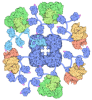
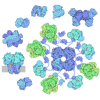
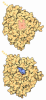
Journal: Nat Commun / Year: 2026 Title: A Bacillales-specific tubular scaffold essential for NADH dehydrogenase activity. Authors: Farida Seduk / Rayan Osman / Pierre Simon Garcia / Lilou Bizien-Jaglin / Pauline Juyoux / Artemis Kosta / Salomé Sauvage / Maria J Maté / Fabien Pierrel / Régine Lebrun / Guy Schoehn / ...Authors: Farida Seduk / Rayan Osman / Pierre Simon Garcia / Lilou Bizien-Jaglin / Pauline Juyoux / Artemis Kosta / Salomé Sauvage / Maria J Maté / Fabien Pierrel / Régine Lebrun / Guy Schoehn / Yoshiki Yamaryo-Botté / Cyrille Y Botté / Yvain Nicolet / Mickael V Cherrier / Anne Walburger / Axel Magalon / Abstract: Respiratory type II NADH:quinone oxidoreductases (NDH-II) are typically monotopic flavoproteins that make direct contact with the membrane to access the quinone pool. Here, we show that in Bacillus ...Respiratory type II NADH:quinone oxidoreductases (NDH-II) are typically monotopic flavoproteins that make direct contact with the membrane to access the quinone pool. Here, we show that in Bacillus subtilis, one NDH-II, termed Ndh, assembles with the helical membrane plugin (HMP) protein YjlC and forms supramolecular fibers. Genetic and biochemical analyses demonstrate that Ndh and YjlC proteins are essential for NADH oxidation. Cryo-EM analysis reveals that YjlC forms a tubular scaffold onto which multiple Ndh subunits are regularly docked via their C-terminal domain, repurposed from its classical role in direct membrane binding. These fibers can extend up to ~1000 Å, creating a continuous hydrophobic tunnel filled with lipids and quinones, thereby mimicking the membrane environment. Comparative genomics unveils that this partnership arose exclusively within Bacillales through the recruitment of an ancestral HMP originally associated with sulfide:quinone reductases. Together, our findings uncover a lineage-specific structural adaptation in which NDH-II enzymes depend on an HMP scaffold, expanding their functional diversity beyond the classical monotopic paradigm.
In the structure databanks used in Yorodumi, some data are registered as the other names, "COVID-19 virus" and "2019-nCoV". Here are the details of the virus and the list of structure data.
Jan 31, 2019. EMDB accession codes are about to change! (news from PDBe EMDB page)
EMDB accession codes are about to change! (news from PDBe EMDB page)
The allocation of 4 digits for EMDB accession codes will soon come to an end. Whilst these codes will remain in use, new EMDB accession codes will include an additional digit and will expand incrementally as the available range of codes is exhausted. The current 4-digit format prefixed with “EMD-” (i.e. EMD-XXXX) will advance to a 5-digit format (i.e. EMD-XXXXX), and so on. It is currently estimated that the 4-digit codes will be depleted around Spring 2019, at which point the 5-digit format will come into force.
The EM Navigator/Yorodumi systems omit the EMD- prefix.
Related info.:Q: What is EMD? / ID/Accession-code notation in Yorodumi/EM Navigator
Yorodumi is a browser for structure data from EMDB, PDB, SASBDB, etc.
This page is also the successor to EM Navigator detail page, and also detail information page/front-end page for Omokage search.
The word "yorodu" (or yorozu) is an old Japanese word meaning "ten thousand". "mi" (miru) is to see.
Related info.:EMDB / PDB / SASBDB / Comparison of 3 databanks / Yorodumi Search / Aug 31, 2016. New EM Navigator & Yorodumi / Yorodumi Papers / Jmol/JSmol / Function and homology information / Changes in new EM Navigator and Yorodumi
 Movie
Movie Controller

 Yorodumi
 Open data
 Basic information
 Map data
 Sample
 Keywords
 Function and homology information
 Bacillus subtilis subsp. subtilis str. 168 (bacteria)
 Authors
 France, 7 items
  Citation
 Structure visualization
 Downloads & links
 emd_55048.png
 http://ftp.pdbj.org/pub/emdb/structures/EMD-55048


 Z (Sec.)
 Y (Row.)
 X (Col.)


 Sample components


 Processing
 Electron microscopy
 FIELD EMISSION GUN

