 Movie
Movie Controller
 Structure viewers
 About Yorodumi Papers


+Search query
-Structure paper
| Title | A Bacillales-specific tubular scaffold essential for NADH dehydrogenase activity. |
|---|---|
| Journal, issue, pages | Nat Commun, Vol. 17, Issue 1, Year 2026 |
| Publish date | Jun 18, 2026 |
 Authors Authors | Farida Seduk / Rayan Osman / Pierre Simon Garcia / Lilou Bizien-Jaglin / Pauline Juyoux / Artemis Kosta / Salomé Sauvage / Maria J Maté / Fabien Pierrel / Régine Lebrun / Guy Schoehn / Yoshiki Yamaryo-Botté / Cyrille Y Botté / Yvain Nicolet / Mickael V Cherrier / Anne Walburger / Axel Magalon /  |
| PubMed Abstract | Respiratory type II NADH:quinone oxidoreductases (NDH-II) are typically monotopic flavoproteins that make direct contact with the membrane to access the quinone pool. Here, we show that in Bacillus ...Respiratory type II NADH:quinone oxidoreductases (NDH-II) are typically monotopic flavoproteins that make direct contact with the membrane to access the quinone pool. Here, we show that in Bacillus subtilis, one NDH-II, termed Ndh, assembles with the helical membrane plugin (HMP) protein YjlC and forms supramolecular fibers. Genetic and biochemical analyses demonstrate that Ndh and YjlC proteins are essential for NADH oxidation. Cryo-EM analysis reveals that YjlC forms a tubular scaffold onto which multiple Ndh subunits are regularly docked via their C-terminal domain, repurposed from its classical role in direct membrane binding. These fibers can extend up to ~1000 Å, creating a continuous hydrophobic tunnel filled with lipids and quinones, thereby mimicking the membrane environment. Comparative genomics unveils that this partnership arose exclusively within Bacillales through the recruitment of an ancestral HMP originally associated with sulfide:quinone reductases. Together, our findings uncover a lineage-specific structural adaptation in which NDH-II enzymes depend on an HMP scaffold, expanding their functional diversity beyond the classical monotopic paradigm. |
 External links External links | Nat Commun / PubMed:42315832 / PubMed Central |
| Methods | EM (single particle) |
| Resolution | 2.59 - 3.61 Å |
| Structure data | EMDB-55048, PDB-9snk:  EMDB-55049: CryoEM structure of NADH:quinone oxidoreductases YjlCD fiber's HMP extremity from Bacillus subtilis  EMDB-55050: CryoEM structure of NADH:quinone oxidoreductases YjlCD fiber's N-terminal extremity from Bacillus subtilis |
| Chemicals | 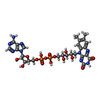 ChemComp-FAD:  ChemComp-SHV:  ChemComp-6NA:  ChemComp-3PE:  ChemComp-LEA:  ChemComp-GOL:  ChemComp-DKA:  ChemComp-HOH: |
| Source |
|
 Keywords Keywords | OXIDOREDUCTASE / Bacterial metabolism / Bioenergetics / Quinone / Helical Membrane Plug-in |


 bacillus subtilis subsp. subtilis str. 168 (bacteria)