[English] 日本語
Yorodumi
- EMDB-54689: Human insulin receptor domains FnIII-1 and L2 bound to HIR-6 DNA ... -

+
Open data


ID or keywords:

Loading...

-
Basic information

Entry
Database: EMDB / ID: EMD-54689
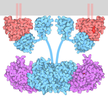
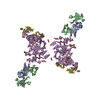
TitleHuman insulin receptor domains FnIII-1 and L2 bound to HIR-6 DNA aptamer
Map dataLocScale filterer map
Sample
  • Complex: Human insulin receptor domains FnIII-1 and L2 bound to HIR-6 DNA aptamer
    • DNA: DNA aptamer HIR-6
  • Protein or peptide: Insulin receptor
  • Protein or peptide: Insulin receptor
Keywordsaptamer / modified aptamer / nucleic acids / human insulin receptor / DNA
Function / homology
Function and homology information


regulation of female gonad development / positive regulation of meiotic cell cycle / insulin-like growth factor II binding / positive regulation of developmental growth / male sex determination / insulin receptor complex / insulin-like growth factor I binding / insulin receptor activity / positive regulation of protein-containing complex disassembly / exocrine pancreas development ...regulation of female gonad development / positive regulation of meiotic cell cycle / insulin-like growth factor II binding / positive regulation of developmental growth / male sex determination / insulin receptor complex / insulin-like growth factor I binding / insulin receptor activity / positive regulation of protein-containing complex disassembly / exocrine pancreas development / dendritic spine maintenance / insulin binding / adrenal gland development / cargo receptor activity / PTB domain binding / Signaling by Insulin receptor / IRS activation / neuronal cell body membrane / positive regulation of respiratory burst / amyloid-beta clearance / regulation of embryonic development / positive regulation of receptor internalization / insulin receptor substrate binding / epidermis development / positive regulation of glycogen biosynthetic process / Signal attenuation / protein kinase activator activity / transport across blood-brain barrier / phosphatidylinositol 3-kinase binding / heart morphogenesis / Insulin receptor recycling / insulin-like growth factor receptor binding / neuron projection maintenance / positive regulation of mitotic nuclear division / Insulin receptor signalling cascade / receptor-mediated endocytosis / dendrite membrane / positive regulation of glycolytic process / positive regulation of D-glucose import across plasma membrane / learning / receptor protein-tyrosine kinase / receptor internalization / caveola / male gonad development / cellular response to growth factor stimulus / cellular response to insulin stimulus / memory / positive regulation of nitric oxide biosynthetic process / insulin receptor signaling pathway / protein autophosphorylation / late endosome / glucose homeostasis / amyloid-beta binding / PI5P, PP2A and IER3 Regulate PI3K/AKT Signaling / protein tyrosine kinase activity / positive regulation of canonical NF-kappaB signal transduction / positive regulation of MAPK cascade / positive regulation of phosphatidylinositol 3-kinase/protein kinase B signal transduction / lysosome / signaling receptor complex / endosome membrane / positive regulation of cell migration / G protein-coupled receptor signaling pathway / external side of plasma membrane / protein domain specific binding / axon / positive regulation of cell population proliferation / symbiont entry into host cell / regulation of DNA-templated transcription / positive regulation of DNA-templated transcription / GTP binding / protein-containing complex binding / extracellular exosome / ATP binding / membrane / identical protein binding / plasma membrane
Similarity search - Function
Insulin receptor, trans-membrane domain / Insulin receptor trans-membrane segment / Tyrosine-protein kinase, insulin-like receptor / Tyrosine-protein kinase, receptor class II, conserved site / Receptor tyrosine kinase class II signature. / Receptor L-domain / Furin-like cysteine-rich domain / Receptor L-domain superfamily / Furin-like cysteine rich region / Receptor L domain ...Insulin receptor, trans-membrane domain / Insulin receptor trans-membrane segment / Tyrosine-protein kinase, insulin-like receptor / Tyrosine-protein kinase, receptor class II, conserved site / Receptor tyrosine kinase class II signature. / Receptor L-domain / Furin-like cysteine-rich domain / Receptor L-domain superfamily / Furin-like cysteine rich region / Receptor L domain / Furin-like repeat / Furin-like repeats / Growth factor receptor cysteine-rich domain superfamily / : / Fibronectin type 3 domain / Fibronectin type-III domain profile. / Fibronectin type III / Fibronectin type III superfamily / Tyrosine-protein kinase, catalytic domain / Tyrosine kinase, catalytic domain / Tyrosine protein kinases specific active-site signature. / Tyrosine-protein kinase, active site / Protein tyrosine and serine/threonine kinase / Serine-threonine/tyrosine-protein kinase, catalytic domain / Protein kinase, ATP binding site / Protein kinases ATP-binding region signature. / Immunoglobulin-like fold / Protein kinase domain profile. / Protein kinase domain / Protein kinase-like domain superfamily
Similarity search - Domain/homology
Biological speciesHomo sapiens (human) / synthetic construct (others)
Methodsingle particle reconstruction / cryo EM / Resolution: 2.88 Å
AuthorsKouba T / Skerlova J / Svachova H / Ondrus M / Franco-Urquijo PA / Hocek M
Funding support Czech Republic, 1 items
OrganizationGrant numberCountry
Czech Science Foundation20-00885X Czech Republic
CitationJournal: To Be Published
Title: Human insulin receptor domains FnIII-1 and L2 bound to HIR-6 DNA aptamer
Authors: Franco-Urquijo PA / Ondrus M / Skerlova J / Kouba T / Hocek M
History
DepositionAug 7, 2025-
Header (metadata) releaseMay 13, 2026-
Map releaseMay 13, 2026-
UpdateMay 20, 2026-
Current statusMay 20, 2026Processing site: PDBe / Status: Released

-
Structure visualization

Supplemental images

Downloads & links

-
Map

FileDownload / File: emd_54689.map.gz / Format: CCP4 / Size: 512 MB / Type: IMAGE STORED AS FLOATING POINT NUMBER (4 BYTES)
AnnotationLocScale filterer map
Projections & slices

Image control

Size
Brightness
Contrast
Others
AxesZ (Sec.)Y (Row.)X (Col.)
1.02 Å/pix.
x 512 pix.
= 523.776 Å
1.02 Å/pix.
x 512 pix.
= 523.776 Å
1.02 Å/pix.
x 512 pix.
= 523.776 Å

Surface

Projections

Slices (1/3)

Slices (1/2)

Slices (2/3)

Images are generated by Spider.

Voxel sizeX=Y=Z: 1.023 Å
Density
Contour LevelBy AUTHOR: 0.16
Minimum - Maximum-0.14504308 - 0.6048825
Average (Standard dev.)0.00005294464 (±0.0032718854)
SymmetrySpace group: 1
Details

EMDB XML:

Map geometry
Axis orderXYZ
Origin000
Dimensions512512512
Spacing512512512
CellA=B=C: 523.776 Å
α=β=γ: 90.0 °

-
Supplemental data

-
Additional map: RELION post-processed map

Fileemd_54689_additional_1.map
AnnotationRELION post-processed map
Projections & Slices
AxesZYX

Projections

Slices (1/2)
Density Histograms

-
Half map: #2

Fileemd_54689_half_map_1.map
Projections & Slices
AxesZYX

Projections

Slices (1/2)
Density Histograms

-
Half map: #1

Fileemd_54689_half_map_2.map
Projections & Slices
AxesZYX

Projections

Slices (1/2)
Density Histograms

-
Sample components

-
Entire : Human insulin receptor domains FnIII-1 and L2 bound to HIR-6 DNA ...

EntireName: Human insulin receptor domains FnIII-1 and L2 bound to HIR-6 DNA aptamer
Components
  • Complex: Human insulin receptor domains FnIII-1 and L2 bound to HIR-6 DNA aptamer
    • DNA: DNA aptamer HIR-6
  • Protein or peptide: Insulin receptor
  • Protein or peptide: Insulin receptor

-
Supramolecule #1: Human insulin receptor domains FnIII-1 and L2 bound to HIR-6 DNA ...

SupramoleculeName: Human insulin receptor domains FnIII-1 and L2 bound to HIR-6 DNA aptamer
type: complex / ID: 1 / Parent: 0 / Macromolecule list: #2
Source (natural)Organism: Homo sapiens (human)
Molecular weightTheoretical: 232 KDa

-
Macromolecule #1: Insulin receptor

MacromoleculeName: Insulin receptor / type: protein_or_peptide / ID: 1 / Number of copies: 1 / Enantiomer: LEVO / EC number: receptor protein-tyrosine kinase
Source (natural)Organism: Homo sapiens (human)
Molecular weightTheoretical: 100.739688 KDa
Recombinant expressionOrganism: Homo sapiens (human)
SequenceString: ENELLKFSYI RTSFDKILLR WEPYWPPDFR DLLGFMLFYK EAPYQNVTEF DGQDACGSNS WTVVDIDPPL RSNDPKSQNH PGWLMRGLK PWTQYAIFVK TLVTFSDERR TYGAKSDIIY VQTDATNPSV PLDPISVSNS SSQIILKWKP PSDPNGNITH Y LVFWERQA ...String:
ENELLKFSYI RTSFDKILLR WEPYWPPDFR DLLGFMLFYK EAPYQNVTEF DGQDACGSNS WTVVDIDPPL RSNDPKSQNH PGWLMRGLK PWTQYAIFVK TLVTFSDERR TYGAKSDIIY VQTDATNPSV PLDPISVSNS SSQIILKWKP PSDPNGNITH Y LVFWERQA EDSELFELDY CLKGLKLPSR TWSPPFESED SQKHNQSEYE DSAGECCSCP KTDSQILKEL EESSFRKTFE DY LHNVVFV PRKTSSGTGA EDPRPSRKRR SLGDVGNVTV AVPTVAAFPN TSSTSVPTSP EEHRPFEKVV NKESLVISGL RHF TGYRIE LQACNQDTPE ERCSVAAYVS ARTMPEAKAD DIVGPVTHEI FENNVVHLMW QEPKEPNGLI VLYEVSYRRY GDEE LHLCV SRKHFALERG CRLRGLSPGN YSVRIRATSL AGNGSWTEPT YFYVTDYLDV PSNIAKIIIG PLIFVFLFSV VIGSI YLFL RKRQPDGPLG PLYASSNPEY LSASDVFPCS VYVPDEWEVS REKITLLREL GQGSFGMVYE GNARDIIKGE AETRVA VKT VNESASLRER IEFLNEASVM KGFTCHHVVR LLGVVSKGQP TLVVMELMAH GDLKSYLRSL RPEAENNPGR PPPTLQE MI QMAAEIADGM AYLNAKKFVH RDLAARNCMV AHDFTVKIGD FGMTRDIYET DYYRKGGKGL LPVRWMAPES LKDGVFTT S SDMWSFGVVL WEITSLAEQP YQGLSNEQVL KFVMDGGYLD QPDNCPERVT DLMRMCWQFN PKMRPTFLEI VNLLKDDLH PSFPEVSFFH SEENKAPESE ELEMEFEDME NVPLDRSSHC QREEAGGRDG GSSLGFKRSY EEHIPYTHMN GGKKNGRILT LPRSNPS

UniProtKB: Insulin receptor

-
Macromolecule #3: Insulin receptor

MacromoleculeName: Insulin receptor / type: protein_or_peptide / ID: 3 / Number of copies: 1 / Enantiomer: LEVO / EC number: receptor protein-tyrosine kinase
Source (natural)Organism: Homo sapiens (human)
Molecular weightTheoretical: 55.797098 KDa
Recombinant expressionOrganism: Homo sapiens (human)
SequenceString: MATGGRRGAA AAPLLVAVAA LLLGAAGHLY PGEVCPGMDI RNNLTRLHEL ENCSVIEGHL QILLMFKTRP EDFRDLSFPK LIMITDYLL LFRVYGLESL KDLFPNLTVI RGSRLFFNYA LVIFEMVHLK ELGLYNLMNI TRGSVRIEKN NELCYLATID W SRILDSVE ...String:
MATGGRRGAA AAPLLVAVAA LLLGAAGHLY PGEVCPGMDI RNNLTRLHEL ENCSVIEGHL QILLMFKTRP EDFRDLSFPK LIMITDYLL LFRVYGLESL KDLFPNLTVI RGSRLFFNYA LVIFEMVHLK ELGLYNLMNI TRGSVRIEKN NELCYLATID W SRILDSVE DNYIVLNKDD NEECGDICPG TAKGKTNCPA TVINGQFVER CWTHSHCQKV CPTICKSHGC TAEGLCCHSE CL GNCSQPD DPTKCVACRN FYLDGRCVET CPPPYYHFQD WRCVNFSFCQ DLHHKCKNSR RQGCHQYVIH NNKCIPECPS GYT MNSSNL LCTPCLGPCP KVCHLLEGEK TIDSVTSAQE LRGCTVINGS LIINIRGGNN LAAELEANLG LIEEISGYLK IRRS YALVS LSFFRKLRLI RGETLEIGNY SFYALDNQNL RQLWDWSKHN LTITQGKLFF HYNPKLCLSE IHKMEEVSGT KGRQE RNDI ALKTNGDQAS C

UniProtKB: Insulin receptor

-
Macromolecule #2: DNA aptamer HIR-6

MacromoleculeName: DNA aptamer HIR-6 / type: dna / ID: 2 / Number of copies: 1 / Classification: DNA
Source (natural)Organism: synthetic construct (others)
Molecular weightTheoretical: 19.62298 KDa
SequenceString: (CY5)(DC)(DA)(DT)(DG)(DA)(DC)(DG)(DC)(DT) (DC)(DA)(DC)(DT)(DG)(DT)(DA)(DT)(DC) (DT)(DC)(DG)(DC)(DG)(A1JNB)(A1JNB)(A1JNB)(A1JNA)(A1JNA) (DC)(DG)(A1JNB)(A1JNA) (A1JNA)(DC)(A1JNA)(DG)(DC) (DG) ...String:
(CY5)(DC)(DA)(DT)(DG)(DA)(DC)(DG)(DC)(DT) (DC)(DA)(DC)(DT)(DG)(DT)(DA)(DT)(DC) (DT)(DC)(DG)(DC)(DG)(A1JNB)(A1JNB)(A1JNB)(A1JNA)(A1JNA) (DC)(DG)(A1JNB)(A1JNA) (A1JNA)(DC)(A1JNA)(DG)(DC) (DG)(TK1)(TK2)(DG)(TK2)(DC)(TK2)(DC)(TK2)(DC) (TK1) (TK2)(DG)(TK1)(TK2)(DG)(TK2)(DC)

-
Experimental details

-
Structure determination

Methodcryo EM
Processingsingle particle reconstruction
Aggregation stateparticle

-
Sample preparation

BufferpH: 7.4
GridModel: Quantifoil R2/1 / Material: GOLD / Mesh: 300 / Support film - Material: CARBON / Support film - topology: HOLEY / Pretreatment - Type: PLASMA CLEANING
VitrificationCryogen name: ETHANE / Instrument: FEI VITROBOT MARK IV

-
Electron microscopy

MicroscopeTFS KRIOS
Specialist opticsEnergy filter - Name: GIF Bioquantum / Energy filter - Slit width: 10 eV
Image recordingFilm or detector model: GATAN K3 BIOQUANTUM (6k x 4k) / Average exposure time: 2.0 sec. / Average electron dose: 51.0 e/Å2
Electron beamAcceleration voltage: 300 kV / Electron source: FIELD EMISSION GUN
Electron opticsIllumination mode: FLOOD BEAM / Imaging mode: BRIGHT FIELD / Nominal defocus max: 3.0 µm / Nominal defocus min: 0.5 µm
Sample stageCooling holder cryogen: NITROGEN
Experimental equipment
Model: Titan Krios / Image courtesy: FEI Company

+
Image processing

CTF correctionSoftware - Name: CTFFIND (ver. 4.1) / Type: PHASE FLIPPING ONLY
Startup modelType of model: PDB ENTRY
PDB model - PDB ID:
Final reconstructionResolution.type: BY AUTHOR / Resolution: 2.88 Å / Resolution method: FSC 0.143 CUT-OFF / Software - Name: RELION (ver. 4.0) / Number images used: 333760
Initial angle assignmentType: MAXIMUM LIKELIHOOD / Software - Name: RELION (ver. 4.0)
Final angle assignmentType: MAXIMUM LIKELIHOOD / Software - Name: RELION (ver. 4.0)
Final 3D classificationSoftware - Name: RELION (ver. 4.0)
FSC plot (resolution estimation)

-
Atomic model buiding 1

Initial modelPDB ID:

Chain - Source name: PDB / Chain - Initial model type: experimental model
RefinementSpace: REAL / Protocol: AB INITIO MODEL
Output model

PDB-9sa8:
Human insulin receptor domains FnIII-1 and L2 bound to HIR-6 DNA aptamer

+
About Yorodumi

-
News

-
Feb 9, 2022. New format data for meta-information of EMDB entries

New format data for meta-information of EMDB entries

  • Version 3 of the EMDB header file is now the official format.
  • The previous official version 1.9 will be removed from the archive.

Related info.:EMDB header

External links:wwPDB to switch to version 3 of the EMDB data model

-
Aug 12, 2020. Covid-19 info

Covid-19 info

URL: https://pdbj.org/emnavi/covid19.php

New page: Covid-19 featured information page in EM Navigator.

Related info.:Covid-19 info / Mar 5, 2020. Novel coronavirus structure data

+
Mar 5, 2020. Novel coronavirus structure data

Novel coronavirus structure data

Related info.:Yorodumi Speices / Aug 12, 2020. Covid-19 info

External links:COVID-19 featured content - PDBj / Molecule of the Month (242):Coronavirus Proteases

+
Jan 31, 2019. EMDB accession codes are about to change! (news from PDBe EMDB page)

EMDB accession codes are about to change! (news from PDBe EMDB page)

  • The allocation of 4 digits for EMDB accession codes will soon come to an end. Whilst these codes will remain in use, new EMDB accession codes will include an additional digit and will expand incrementally as the available range of codes is exhausted. The current 4-digit format prefixed with “EMD-” (i.e. EMD-XXXX) will advance to a 5-digit format (i.e. EMD-XXXXX), and so on. It is currently estimated that the 4-digit codes will be depleted around Spring 2019, at which point the 5-digit format will come into force.
  • The EM Navigator/Yorodumi systems omit the EMD- prefix.

Related info.:Q: What is EMD? / ID/Accession-code notation in Yorodumi/EM Navigator

External links:EMDB Accession Codes are Changing Soon! / Contact to PDBj

+
Jul 12, 2017. Major update of PDB

Major update of PDB

  • wwPDB released updated PDB data conforming to the new PDBx/mmCIF dictionary.
  • This is a major update changing the version number from 4 to 5, and with Remediation, in which all the entries are updated.
  • In this update, many items about electron microscopy experimental information are reorganized (e.g. em_software).
  • Now, EM Navigator and Yorodumi are based on the updated data.

External links:wwPDB Remediation / Enriched Model Files Conforming to OneDep Data Standards Now Available in the PDB FTP Archive

-
Yorodumi

Thousand views of thousand structures

  • Yorodumi is a browser for structure data from EMDB, PDB, SASBDB, etc.
  • This page is also the successor to EM Navigator detail page, and also detail information page/front-end page for Omokage search.
  • The word "yorodu" (or yorozu) is an old Japanese word meaning "ten thousand". "mi" (miru) is to see.

Related info.:EMDB / PDB / SASBDB / Comparison of 3 databanks / Yorodumi Search / Aug 31, 2016. New EM Navigator & Yorodumi / Yorodumi Papers / Jmol/JSmol / Function and homology information / Changes in new EM Navigator and Yorodumi

Read more