photoinhibition / photosystem II oxygen evolving complex / photosystem II assembly / oxygen evolving activity / photosystem II stabilization / photosystem II reaction center / photosystem II / photosynthetic electron transport chain / oxidoreductase activity, acting on diphenols and related substances as donors, oxygen as acceptor / response to herbicide ...photoinhibition / photosystem II oxygen evolving complex / photosystem II assembly / oxygen evolving activity / photosystem II stabilization / photosystem II reaction center / photosystem II / photosynthetic electron transport chain / oxidoreductase activity, acting on diphenols and related substances as donors, oxygen as acceptor / response to herbicide / photosystem II / extrinsic component of membrane / poly(U) RNA binding / photosynthetic electron transport in photosystem II / chlorophyll binding / photosynthesis, light reaction / phosphate ion binding / chloroplast thylakoid membrane / photosynthesis / electron transfer activity / protein stabilization / iron ion binding / heme binding / calcium ion binding / metal ion binding Similarity search - Function
Photosystem II 5kDa protein, chloroplastic / PsbP, C-terminal / : / PsbP / Mog1/PsbP, alpha/beta/alpha sandwich / Photosystem II PsbW, class 2 / Photosystem II reaction centre W protein (PsbW) / Oxygen-evolving enhancer protein 3 / Oxygen evolving enhancer protein 3 / PsbQ-like domain superfamily ...Photosystem II 5kDa protein, chloroplastic / PsbP, C-terminal / : / PsbP / Mog1/PsbP, alpha/beta/alpha sandwich / Photosystem II PsbW, class 2 / Photosystem II reaction centre W protein (PsbW) / Oxygen-evolving enhancer protein 3 / Oxygen evolving enhancer protein 3 / PsbQ-like domain superfamily / Photosystem II PsbJ / Photosystem II PsbJ superfamily / PsbJ / Photosystem II PsbO, manganese-stabilising / Manganese-stabilising protein / photosystem II polypeptide / Photosystem II reaction centre M protein (PsbM) / Photosystem II PsbM superfamily / Photosystem II PsbM / Photosystem II PsbX / Photosystem II reaction centre X protein (PsbX) / Photosystem II PsbT / Photosystem II PsbL / Photosystem II CP43 reaction centre protein / Photosystem II PsbL superfamily / Photosystem II PsbT superfamily / Photosystem II CP43 reaction centre protein superfamily / Photosystem II reaction centre T protein / PsbL protein / Photosystem II PsbK / Photosystem II PsbK superfamily / Photosystem II 4 kDa reaction centre component / Photosystem II PsbI / Photosystem II CP47 reaction centre protein / Photosystem II PsbI superfamily / Photosystem II reaction centre I protein (PSII 4.8 kDa protein) / Photosystem II protein D1 / Photosystem II reaction centre protein H / Photosystem II D2 protein / Photosystem II cytochrome b559, conserved site / Photosystem II cytochrome b559, alpha subunit / Photosystem II cytochrome b559, beta subunit / Photosystem II cytochrome b559, N-terminal / Photosystem II cytochrome b559, alpha subunit, lumenal region / Photosystem II reaction centre protein H superfamily / Photosystem II cytochrome b559, alpha subunit superfamily / Cytochrome b559, alpha (gene psbE) and beta (gene psbF)subunits / Lumenal portion of Cytochrome b559, alpha (gene psbE) subunit / Photosystem II 10 kDa phosphoprotein / Cytochrome b559 subunits heme-binding site signature. / : / Photosystem antenna protein-like / Photosystem antenna protein-like superfamily / Photosystem II protein / Outer membrane protein/outer membrane enzyme PagP, beta-barrel / : / Photosynthetic reaction centre, L/M / Photosystem II protein D1/D2 superfamily / Photosynthetic reaction centre protein / Photosynthetic reaction center proteins signature. Similarity search - Domain/homology
Photosystem II reaction center protein I / Photosystem II 5 kDa protein, chloroplastic / PSII 6.1 kDa protein / Ultraviolet-B-repressible protein / Photosystem II reaction center protein K / Photosystem II CP47 reaction center protein / Photosystem II CP43 reaction center protein / Photosystem II D2 protein / Photosystem II protein D1 / Cytochrome b559 subunit alpha ...Photosystem II reaction center protein I / Photosystem II 5 kDa protein, chloroplastic / PSII 6.1 kDa protein / Ultraviolet-B-repressible protein / Photosystem II reaction center protein K / Photosystem II CP47 reaction center protein / Photosystem II CP43 reaction center protein / Photosystem II D2 protein / Photosystem II protein D1 / Cytochrome b559 subunit alpha / Photosystem II reaction center protein J / Oxygen-evolving enhancer protein 1, chloroplastic / Oxygen-evolving enhancer protein 2, chloroplastic / Photosystem II reaction center protein L / Cytochrome b559 subunit beta / Photosystem II reaction center protein M / 16 kDa subunit of oxygen evolving system of photosystem II / Photosystem II reaction center protein T / Photosystem II reaction center protein H Similarity search - Component
Biological species
Pisum sativum (garden pea)
Method
single particle reconstruction / cryo EM / Resolution: 2.1 Å
Cryogen name: ETHANE / Chamber humidity: 90 % / Chamber temperature: 288 K / Instrument: LEICA EM GP
Details
Chlorophyll concentration
-
Electron microscopy
Microscope
TFS KRIOS
Image recording
Film or detector model: FEI FALCON IV (4k x 4k) / Number grids imaged: 1 / Number real images: 24215 / Average exposure time: 2.2 sec. / Average electron dose: 50.0 e/Å2
Electron beam
Acceleration voltage: 300 kV / Electron source: FIELD EMISSION GUN
In the structure databanks used in Yorodumi, some data are registered as the other names, "COVID-19 virus" and "2019-nCoV". Here are the details of the virus and the list of structure data.
Jan 31, 2019. EMDB accession codes are about to change! (news from PDBe EMDB page)
EMDB accession codes are about to change! (news from PDBe EMDB page)
The allocation of 4 digits for EMDB accession codes will soon come to an end. Whilst these codes will remain in use, new EMDB accession codes will include an additional digit and will expand incrementally as the available range of codes is exhausted. The current 4-digit format prefixed with “EMD-” (i.e. EMD-XXXX) will advance to a 5-digit format (i.e. EMD-XXXXX), and so on. It is currently estimated that the 4-digit codes will be depleted around Spring 2019, at which point the 5-digit format will come into force.
The EM Navigator/Yorodumi systems omit the EMD- prefix.
Related info.:Q: What is EMD? / ID/Accession-code notation in Yorodumi/EM Navigator
Yorodumi is a browser for structure data from EMDB, PDB, SASBDB, etc.
This page is also the successor to EM Navigator detail page, and also detail information page/front-end page for Omokage search.
The word "yorodu" (or yorozu) is an old Japanese word meaning "ten thousand". "mi" (miru) is to see.
Related info.:EMDB / PDB / SASBDB / Comparison of 3 databanks / Yorodumi Search / Aug 31, 2016. New EM Navigator & Yorodumi / Yorodumi Papers / Jmol/JSmol / Function and homology information / Changes in new EM Navigator and Yorodumi
 Movie
Movie Controller

 Yorodumi
 Open data
 Basic information
 Map data
 Sample
 Keywords
 Function and homology information
 Pisum sativum (garden pea)
 Authors
 Israel, 1 items
  Citation
 Structure visualization
 Downloads & links
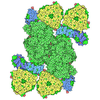
 emd_54531.png
 http://ftp.pdbj.org/pub/emdb/structures/EMD-54531
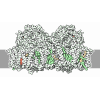
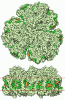
 Z (Sec.)
 Y (Row.)
 X (Col.)


 Sample components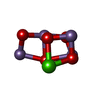

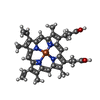
 Processing
 Electron microscopy
 FIELD EMISSION GUN


