[English] 日本語
Yorodumi
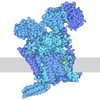
- EMDB-52193: Co-chaperone Bag1-bound human 26S proteasome in SBAG2 state -

+
Open data


ID or keywords:

Loading...

-
Basic information

Entry
Database: EMDB / ID: EMD-52193
TitleCo-chaperone Bag1-bound human 26S proteasome in SBAG2 state
Map data
Sample
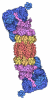
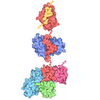
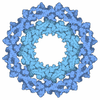
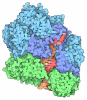
  • Complex: Co-chaperone Bag1-bound human 26S proteasome in SBAG2 state
KeywordsProtein degradation / protease / AAA+ ATPase / Hsp70 / cochaperone / Bag1 / Complex / ubiquitin / HYDROLASE
Function / homology
Function and homology information


adenyl-nucleotide exchange factor activity / positive regulation of smooth muscle cell apoptotic process / thyrotropin-releasing hormone receptor binding / Impaired BRCA2 translocation to the nucleus / Impaired BRCA2 binding to SEM1 (DSS1) / nuclear proteasome complex / host-mediated perturbation of viral transcription / positive regulation of inclusion body assembly / Hydrolases; Acting on peptide bonds (peptidases); Omega peptidases / proteasome accessory complex ...adenyl-nucleotide exchange factor activity / positive regulation of smooth muscle cell apoptotic process / thyrotropin-releasing hormone receptor binding / Impaired BRCA2 translocation to the nucleus / Impaired BRCA2 binding to SEM1 (DSS1) / nuclear proteasome complex / host-mediated perturbation of viral transcription / positive regulation of inclusion body assembly / Hydrolases; Acting on peptide bonds (peptidases); Omega peptidases / proteasome accessory complex / integrator complex / meiosis I / purine ribonucleoside triphosphate binding / Antigen processing: Ub, ATP-independent proteasomal degradation / proteasome regulatory particle / cytosolic proteasome complex / positive regulation of proteasomal protein catabolic process / proteasome-activating activity / proteasome regulatory particle, lid subcomplex / proteasome regulatory particle, base subcomplex / protein K63-linked deubiquitination / negative regulation of programmed cell death / Regulation of ornithine decarboxylase (ODC) / metal-dependent deubiquitinase activity / Proteasome assembly / Cross-presentation of soluble exogenous antigens (endosomes) / proteasome core complex / Somitogenesis / Homologous DNA Pairing and Strand Exchange / Defective homologous recombination repair (HRR) due to BRCA1 loss of function / Defective HDR through Homologous Recombination Repair (HRR) due to PALB2 loss of BRCA1 binding function / Defective HDR through Homologous Recombination Repair (HRR) due to PALB2 loss of BRCA2/RAD51/RAD51C binding function / Resolution of D-loop Structures through Synthesis-Dependent Strand Annealing (SDSA) / K63-linked deubiquitinase activity / Resolution of D-loop Structures through Holliday Junction Intermediates / transcription factor binding / proteasome binding / Impaired BRCA2 binding to RAD51 / regulation of protein catabolic process / myofibril / : / proteasome storage granule / Presynaptic phase of homologous DNA pairing and strand exchange / general transcription initiation factor binding / polyubiquitin modification-dependent protein binding / protein deubiquitination / Regulation of HSF1-mediated heat shock response / blastocyst development / immune system process / proteasome endopeptidase complex / NF-kappaB binding / proteasome core complex, beta-subunit complex / endopeptidase activator activity / threonine-type endopeptidase activity / proteasome assembly / proteasome core complex, alpha-subunit complex / mRNA export from nucleus / enzyme regulator activity / regulation of proteasomal protein catabolic process / inclusion body / proteasome complex / TBP-class protein binding / : / Degradation of CDH1 / stem cell differentiation / sarcomere / Degradation of CRY and PER proteins / Regulation of activated PAK-2p34 by proteasome mediated degradation / Autodegradation of Cdh1 by Cdh1:APC/C / APC/C:Cdc20 mediated degradation of Securin / N-glycan trimming in the ER and Calnexin/Calreticulin cycle / Asymmetric localization of PCP proteins / Ubiquitin-dependent degradation of Cyclin D / SCF-beta-TrCP mediated degradation of Emi1 / NIK-->noncanonical NF-kB signaling / TNFR2 non-canonical NF-kB pathway / AUF1 (hnRNP D0) binds and destabilizes mRNA / negative regulation of inflammatory response to antigenic stimulus / Assembly of the pre-replicative complex / P-body / Vpu mediated degradation of CD4 / Degradation of DVL / Cdc20:Phospho-APC/C mediated degradation of Cyclin A / Dectin-1 mediated noncanonical NF-kB signaling / lipopolysaccharide binding / Degradation of AXIN / Hh mutants are degraded by ERAD / Activation of NF-kappaB in B cells / G2/M Checkpoints / Hedgehog ligand biogenesis / Degradation of GLI1 by the proteasome / Defective CFTR causes cystic fibrosis / Autodegradation of the E3 ubiquitin ligase COP1 / Regulation of RUNX3 expression and activity / GSK3B and BTRC:CUL1-mediated-degradation of NFE2L2 / Negative regulation of NOTCH4 signaling / Ubiquitin-Mediated Degradation of Phosphorylated Cdc25A / Hedgehog 'on' state / Vif-mediated degradation of APOBEC3G / APC/C:Cdh1 mediated degradation of Cdc20 and other APC/C:Cdh1 targeted proteins in late mitosis/early G1
Similarity search - Function
Molecular chaperone regulator BAG / BAG domain superfamily / BAG domain / BAG domain / BAG domain profile. / BAG domains, present in regulator of Hsp70 proteins / : / Ubiquitin interaction motif / : / 26S proteasome regulatory subunit RPN7/PSMD6 C-terminal helix ...Molecular chaperone regulator BAG / BAG domain superfamily / BAG domain / BAG domain / BAG domain profile. / BAG domains, present in regulator of Hsp70 proteins / : / Ubiquitin interaction motif / : / 26S proteasome regulatory subunit RPN7/PSMD6 C-terminal helix / 26S proteasome non-ATPase regulatory subunit Rpn12 / 26S proteasome regulatory subunit, C-terminal / Proteasome regulatory subunit C-terminal / 26S proteasome regulatory subunit RPN5, C-terminal domain / : / 26S proteasome regulatory subunit RPN5 C-terminal domain / PSD13 N-terminal repeats / 26S proteasome regulatory subunit Rpn6, N-terminal / 6S proteasome subunit Rpn6, C-terminal helix domain / 26S proteasome regulatory subunit RPN6 N-terminal domain / 26S proteasome subunit RPN6 C-terminal helix domain / 26S Proteasome non-ATPase regulatory subunit 13 / : / 26S proteasome subunit RPN2, N-terminal domain / 26S proteasome regulatory complex, non-ATPase subcomplex, Rpn2/Psmd1 subunit / 26S proteasome regulatory subunit RPN2, C-terminal / 26S proteasome regulatory subunit RPN2 C-terminal domain / Proteasome subunit Rpn10 / 26S Proteasome non-ATPase regulatory subunit 7/8 / : / 26S proteasome regulatory subunit RPN11 C-terminal domain / 26S proteasome regulatory complex, non-ATPase subcomplex, Rpn1 subunit / RPN1, N-terminal / 26S proteasome non-ATPase regulatory subunit RPN1, C-terminal / RPN1 N-terminal domain / 26S proteasome non-ATPase regulatory subunit RPN1 C-terminal / DSS1/SEM1 / DSS1/SEM1 family / DSS1_SEM1 / Ubiquitin-interacting motif. / Proteasome/cyclosome repeat / : / 26S proteasome regulatory subunit 7, OB domain / Proteasome/cyclosome repeat / von Willebrand factor type A domain / : / : / : / PSMD12/CSN4, N-terminal / : / 26S proteasome regulatory subunit Rpn7/COP9 signalosome complex subunit 1 / 26S proteasome regulatory subunit Rpn7, N-terminal / 26S proteasome subunit RPN7 / 26S Proteasome non-ATPase regulatory subunit 12/COP9 signalosome complex subunit 4 / PCI/PINT associated module / Proteasomal ATPase OB C-terminal domain / Proteasomal ATPase OB C-terminal domain / HEAT repeats / Proteasome subunit alpha 1 / CSN8/PSMD8/EIF3K / CSN8/PSMD8/EIF3K family / Rpn11/EIF3F, C-terminal / Maintenance of mitochondrial structure and function / : / motif in proteasome subunits, Int-6, Nip-1 and TRIP-15 / PCI domain / Proteasome component (PCI) domain / PCI domain profile. / Ubiquitin interacting motif / Ubiquitin-interacting motif (UIM) domain profile. / JAB1/Mov34/MPN/PAD-1 ubiquitin protease / Proteasome beta subunit, C-terminal / Proteasome beta subunits C terminal / Proteasome subunit beta 4 / Proteasome subunit beta 2 / Proteasome beta 3 subunit / Proteasome subunit alpha5 / Proteasome subunit alpha6 / Proteasome beta-type subunits signature. / Peptidase T1A, proteasome beta-subunit / Proteasome beta-type subunit, conserved site / Proteasome subunit A N-terminal signature / Proteasome alpha-type subunits signature. / Proteasome alpha-subunit, N-terminal domain / Proteasome subunit A N-terminal signature Add an annotation / VWFA domain profile. / Proteasome B-type subunit / Proteasome beta-type subunit profile. / von Willebrand factor (vWF) type A domain / : / Proteasome alpha-type subunit / Proteasome alpha-type subunit profile. / Proteasome subunit / Proteasome, subunit alpha/beta / von Willebrand factor, type A / JAB/MPN domain / JAB1/MPN/MOV34 metalloenzyme domain / AAA ATPase, AAA+ lid domain / AAA+ lid domain / MPN domain
Similarity search - Domain/homology
26S proteasome regulatory subunit 10B / 26S proteasome non-ATPase regulatory subunit 11 / 26S proteasome non-ATPase regulatory subunit 12 / 26S proteasome non-ATPase regulatory subunit 14 / Proteasome subunit alpha type-7 / 26S proteasome non-ATPase regulatory subunit 3 / 26S proteasome regulatory subunit 6A / Proteasome subunit beta type-1 / Proteasome subunit alpha type-1 / Proteasome subunit alpha type-2 ...26S proteasome regulatory subunit 10B / 26S proteasome non-ATPase regulatory subunit 11 / 26S proteasome non-ATPase regulatory subunit 12 / 26S proteasome non-ATPase regulatory subunit 14 / Proteasome subunit alpha type-7 / 26S proteasome non-ATPase regulatory subunit 3 / 26S proteasome regulatory subunit 6A / Proteasome subunit beta type-1 / Proteasome subunit alpha type-1 / Proteasome subunit alpha type-2 / Proteasome subunit alpha type-3 / Proteasome subunit alpha type-4 / Proteasome subunit alpha type-5 / Proteasome subunit beta type-4 / Proteasome subunit beta type-6 / Proteasome subunit beta type-5 / 26S proteasome regulatory subunit 7 / 26S proteasome regulatory subunit 6B / 26S proteasome non-ATPase regulatory subunit 8 / Proteasome subunit beta type-3 / Proteasome subunit beta type-2 / 26S proteasome non-ATPase regulatory subunit 7 / 26S proteasome non-ATPase regulatory subunit 4 / 26S proteasome complex subunit SEM1 / Proteasome subunit alpha type-6 / 26S proteasome regulatory subunit 4 / 26S proteasome regulatory subunit 8 / 26S proteasome non-ATPase regulatory subunit 2 / 26S proteasome non-ATPase regulatory subunit 6 / Proteasome subunit beta type-7 / 26S proteasome non-ATPase regulatory subunit 1 / BAG family molecular chaperone regulator 1 / 26S proteasome non-ATPase regulatory subunit 13
Similarity search - Component
Biological speciesHomo sapiens (human)
Methodsingle particle reconstruction / cryo EM / Resolution: 3.5 Å
AuthorsCheng TC / Sakata E / Muntaner J / Maestro-Lopez M / Cuellar J / Valpuesta JM
Funding support Germany, Spain, 6 items
OrganizationGrant numberCountry
German Research Foundation (DFG)154113120 Germany
German Research Foundation (DFG)EXC 2067/1-390729940 Germany
German Research Foundation (DFG)448415290 Germany
Spanish Ministry of Science, Innovation, and UniversitiesPID2022-137175NB-I00 Spain
Spanish Ministry of Science, Innovation, and UniversitiesAEI/10.13039/501100011033 Spain
Spanish Ministry of Science, Innovation, and UniversitiesCEX2023-001386-S Spain
CitationJournal: Sci Adv / Year: 2026
Title: Structures of the 26 proteasome in complex with the Hsp70 co-chaperone Bag1 reveal a mechanism for direct substrate transfer.
Authors: Moisés Maestro-López / Tat Cheung Cheng / Jimena Muntaner / Margarita Menéndez / Melissa Alonso / Andreas Schweitzer / Masato Ishizaka / Robert J Tomko / Jorge Cuéllar / José María ...Authors: Moisés Maestro-López / Tat Cheung Cheng / Jimena Muntaner / Margarita Menéndez / Melissa Alonso / Andreas Schweitzer / Masato Ishizaka / Robert J Tomko / Jorge Cuéllar / José María Valpuesta / Eri Sakata /
Abstract: Coupling between the chaperone and degradation systems, particularly under stress, is essential for eliminating unfolded proteins. The co-chaperone Bag1 links Hsp70 to the 26 proteasome, recruiting ...Coupling between the chaperone and degradation systems, particularly under stress, is essential for eliminating unfolded proteins. The co-chaperone Bag1 links Hsp70 to the 26 proteasome, recruiting Hsp70-bound clients for proteasomal degradation. Here, we present cryo-electron microscopy structures of the Bag1-bound 26 proteasome, revealing unprecedented conformational rearrangements within the 19 regulatory particle. Bag1 binding to the Rpn1 induces a marked reconfiguration of AAA adenosine triphosphatase (ATPase) ring, disrupting its canonical spiral staircase and remodeling the central channel architecture. This reconfiguration generates a large cavity above the substrate entry gate of the 20 core particle. The conserved pore-2 loops of ATPases Rpt2 and Rpt5 play critical roles in opening of the 20 gate, enabling substrate entry into proteolytic chamber independently of ubiquitination. These findings suggest a previously unknown mechanism of the proteasomal degradation, by which remodeling the central cavity and 20 gate in the presence of Bag1, possibly bypassing the need for ubiquitination.
History
DepositionNov 27, 2024-
Header (metadata) releaseDec 31, 2025-
Map releaseDec 31, 2025-
UpdateMar 4, 2026-
Current statusMar 4, 2026Processing site: PDBe / Status: Released

-
Structure visualization

Supplemental images

Downloads & links

-
Map

FileDownload / File: emd_52193.map.gz / Format: CCP4 / Size: 103 MB / Type: IMAGE STORED AS FLOATING POINT NUMBER (4 BYTES)
Projections & slices

Image control

Size
Brightness
Contrast
Others
AxesZ (Sec.)Y (Row.)X (Col.)
1.41 Å/pix.
x 300 pix.
= 423.99 Å
1.41 Å/pix.
x 300 pix.
= 423.99 Å
1.41 Å/pix.
x 300 pix.
= 423.99 Å

Surface

Projections

Slices (1/3)

Slices (1/2)

Slices (2/3)

Images are generated by Spider.

Voxel sizeX=Y=Z: 1.4133 Å
Density
Contour LevelBy AUTHOR: 0.45
Minimum - Maximum-1.0719317 - 2.1679113
Average (Standard dev.)0.0074095875 (±0.10727928)
SymmetrySpace group: 1
Details

EMDB XML:

Map geometry
Axis orderXYZ
Origin000
Dimensions300300300
Spacing300300300
CellA=B=C: 423.99002 Å
α=β=γ: 90.0 °

-
Supplemental data

-
Additional map: Deepemhancer processed map

Fileemd_52193_additional_1.map
AnnotationDeepemhancer processed map
Projections & Slices
AxesZYX

Projections

Slices (1/2)
Density Histograms

-
Half map: #2

Fileemd_52193_half_map_1.map
Projections & Slices
AxesZYX

Projections

Slices (1/2)
Density Histograms

-
Half map: #1

Fileemd_52193_half_map_2.map
Projections & Slices
AxesZYX

Projections

Slices (1/2)
Density Histograms

-
Sample components

-
Entire : Co-chaperone Bag1-bound human 26S proteasome in SBAG2 state

EntireName: Co-chaperone Bag1-bound human 26S proteasome in SBAG2 state
Components
  • Complex: Co-chaperone Bag1-bound human 26S proteasome in SBAG2 state

-
Supramolecule #1: Co-chaperone Bag1-bound human 26S proteasome in SBAG2 state

SupramoleculeName: Co-chaperone Bag1-bound human 26S proteasome in SBAG2 state
type: complex / ID: 1 / Parent: 0 / Macromolecule list: #1-#33
Source (natural)Organism: Homo sapiens (human)

-
Experimental details

-
Structure determination

Methodcryo EM
Processingsingle particle reconstruction
Aggregation stateparticle

-
Sample preparation

BufferpH: 7.6
Component:
ConcentrationFormulaName
20.0 mMHepesHepes
150.0 mMKClPotassium chloride
1.0 mMDTTDithiothreitol
GridModel: Quantifoil R2/2 / Material: COPPER/RHODIUM / Mesh: 300 / Support film - Material: CARBON / Support film - topology: HOLEY
VitrificationCryogen name: ETHANE / Chamber humidity: 100 % / Chamber temperature: 277 K / Instrument: FEI VITROBOT MARK IV

-
Electron microscopy

MicroscopeTFS KRIOS
Image recordingFilm or detector model: GATAN K3 (6k x 4k) / Average electron dose: 37.0 e/Å2
Electron beamAcceleration voltage: 300 kV / Electron source: FIELD EMISSION GUN
Electron opticsIllumination mode: FLOOD BEAM / Imaging mode: BRIGHT FIELD / Nominal defocus max: 3.0 µm / Nominal defocus min: 1.0 µm
Experimental equipment
Model: Titan Krios / Image courtesy: FEI Company

+
Image processing

CTF correctionType: PHASE FLIPPING AND AMPLITUDE CORRECTION
Startup modelType of model: EMDB MAP
EMDB ID:
Final reconstructionResolution.type: BY AUTHOR / Resolution: 3.5 Å / Resolution method: FSC 0.143 CUT-OFF / Number images used: 16466
Initial angle assignmentType: MAXIMUM LIKELIHOOD
Final angle assignmentType: MAXIMUM LIKELIHOOD

+
About Yorodumi

-
News

-
Feb 9, 2022. New format data for meta-information of EMDB entries

New format data for meta-information of EMDB entries

  • Version 3 of the EMDB header file is now the official format.
  • The previous official version 1.9 will be removed from the archive.

Related info.:EMDB header

External links:wwPDB to switch to version 3 of the EMDB data model

-
Aug 12, 2020. Covid-19 info

Covid-19 info

URL: https://pdbj.org/emnavi/covid19.php

New page: Covid-19 featured information page in EM Navigator.

Related info.:Covid-19 info / Mar 5, 2020. Novel coronavirus structure data

+
Mar 5, 2020. Novel coronavirus structure data

Novel coronavirus structure data

Related info.:Yorodumi Speices / Aug 12, 2020. Covid-19 info

External links:COVID-19 featured content - PDBj / Molecule of the Month (242):Coronavirus Proteases

+
Jan 31, 2019. EMDB accession codes are about to change! (news from PDBe EMDB page)

EMDB accession codes are about to change! (news from PDBe EMDB page)

  • The allocation of 4 digits for EMDB accession codes will soon come to an end. Whilst these codes will remain in use, new EMDB accession codes will include an additional digit and will expand incrementally as the available range of codes is exhausted. The current 4-digit format prefixed with “EMD-” (i.e. EMD-XXXX) will advance to a 5-digit format (i.e. EMD-XXXXX), and so on. It is currently estimated that the 4-digit codes will be depleted around Spring 2019, at which point the 5-digit format will come into force.
  • The EM Navigator/Yorodumi systems omit the EMD- prefix.

Related info.:Q: What is EMD? / ID/Accession-code notation in Yorodumi/EM Navigator

External links:EMDB Accession Codes are Changing Soon! / Contact to PDBj

+
Jul 12, 2017. Major update of PDB

Major update of PDB

  • wwPDB released updated PDB data conforming to the new PDBx/mmCIF dictionary.
  • This is a major update changing the version number from 4 to 5, and with Remediation, in which all the entries are updated.
  • In this update, many items about electron microscopy experimental information are reorganized (e.g. em_software).
  • Now, EM Navigator and Yorodumi are based on the updated data.

External links:wwPDB Remediation / Enriched Model Files Conforming to OneDep Data Standards Now Available in the PDB FTP Archive

-
Yorodumi

Thousand views of thousand structures

  • Yorodumi is a browser for structure data from EMDB, PDB, SASBDB, etc.
  • This page is also the successor to EM Navigator detail page, and also detail information page/front-end page for Omokage search.
  • The word "yorodu" (or yorozu) is an old Japanese word meaning "ten thousand". "mi" (miru) is to see.

Related info.:EMDB / PDB / SASBDB / Comparison of 3 databanks / Yorodumi Search / Aug 31, 2016. New EM Navigator & Yorodumi / Yorodumi Papers / Jmol/JSmol / Function and homology information / Changes in new EM Navigator and Yorodumi

Read more