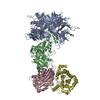
Journal: J Med Chem / Year: 2025 Title: Discovery of Selective and Orally Bioavailable Heterobifunctional Degraders of Cyclin-Dependent Kinase 2. Authors: Philip N Collier / Xiaozhang Zheng / Melissa Ford / Matthew Weiss / Dapeng Chen / Kunhua Li / Joseph D Growney / Annan Yang / Murugappan Sathappa / Susanne B Breitkopf / Brad Enerson / Tong ...Authors: Philip N Collier / Xiaozhang Zheng / Melissa Ford / Matthew Weiss / Dapeng Chen / Kunhua Li / Joseph D Growney / Annan Yang / Murugappan Sathappa / Susanne B Breitkopf / Brad Enerson / Tong Liang / Atanu Paul / Rupa Sawant / Lijing Su / Robert J Aversa / Charles Howarth / Kirti Sharma / Juliet Williams / Nicholas P Kwiatkowski / Abstract: Cyclin-dependent kinase 2 (CDK2) plays an important role in cell cycle regulation and has emerged as a compelling target for the treatment of cancer, largely because of its potential to overcome the ...Cyclin-dependent kinase 2 (CDK2) plays an important role in cell cycle regulation and has emerged as a compelling target for the treatment of cancer, largely because of its potential to overcome the resistance associated with CDK4/6 inhibition. Efforts to develop CDK2 inhibitors have historically proven challenging due to undesirable safety profiles associated with inhibiting off-target CDK isoforms. Herein, we describe the structure-guided discovery of a series of orally bioavailable and selective degraders of CDK2. Degrader demonstrated improved phenotypic selectivity compared to a clinical CDK2 inhibitor, with greater specificity for disease-relevant cyclin E1 (CCNE1)-amplified cancer cells vs nonamplified cohort. The antitumor activity of in mice bearing CCNE1-amplified HCC1569 tumors correlated with sustained >90% degradation of CDK2 and sustained 90% inhibition of Rb phosphorylation.
In the structure databanks used in Yorodumi, some data are registered as the other names, "COVID-19 virus" and "2019-nCoV". Here are the details of the virus and the list of structure data.
Jan 31, 2019. EMDB accession codes are about to change! (news from PDBe EMDB page)
EMDB accession codes are about to change! (news from PDBe EMDB page)
The allocation of 4 digits for EMDB accession codes will soon come to an end. Whilst these codes will remain in use, new EMDB accession codes will include an additional digit and will expand incrementally as the available range of codes is exhausted. The current 4-digit format prefixed with “EMD-” (i.e. EMD-XXXX) will advance to a 5-digit format (i.e. EMD-XXXXX), and so on. It is currently estimated that the 4-digit codes will be depleted around Spring 2019, at which point the 5-digit format will come into force.
The EM Navigator/Yorodumi systems omit the EMD- prefix.
Related info.:Q: What is EMD? / ID/Accession-code notation in Yorodumi/EM Navigator
Yorodumi is a browser for structure data from EMDB, PDB, SASBDB, etc.
This page is also the successor to EM Navigator detail page, and also detail information page/front-end page for Omokage search.
The word "yorodu" (or yorozu) is an old Japanese word meaning "ten thousand". "mi" (miru) is to see.
Related info.:EMDB / PDB / SASBDB / Comparison of 3 databanks / Yorodumi Search / Aug 31, 2016. New EM Navigator & Yorodumi / Yorodumi Papers / Jmol/JSmol / Function and homology information / Changes in new EM Navigator and Yorodumi
 Movie
Movie Controller

 Yorodumi
 Open data
 Basic information
 Map data
 Sample
 Keywords
 Function and homology information
 Homo sapiens (human)
 Authors
 United States, 1 items
  Citation
 Structure visualization
 Downloads & links
 emd_49942.png
 http://ftp.pdbj.org/pub/emdb/structures/EMD-49942

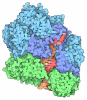
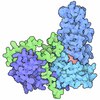
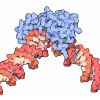

 Z (Sec.)
 Y (Row.)
 X (Col.)


 Sample components
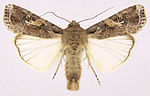 Spodoptera frugiperda (fall armyworm)
 Processing
 Electron microscopy
 FIELD EMISSION GUN