United States, European Union, United Kingdom, 11 items
Organization
Grant number
Country
Howard Hughes Medical Institute (HHMI)
United States
Department of Energy (DOE, United States)
DE-SC0018940 MOD03
United States
National Institutes of Health/National Eye Institute (NIH/NEI)
T32EY032448
United States
National Institutes of Health/National Cancer Institute (NIH/NCI)
R01CA260415
United States
Bill & Melinda Gates Foundation
INV-010680
United States
European Molecular Biology Organization (EMBO)
ALTF 292-2022
European Union
Defense Threat Reduction Agency (DTRA)
HDTRA1-21-1-0007
United States
National Science Foundation (NSF, United States)
NERSC award BER-ERCAP0022018
United States
Cancer Research UK
CGCATF-2021/100002
United Kingdom
National Institutes of Health/National Cancer Institute (NIH/NCI)
CA278687-01
United States
Defense Threat Reduction Agency (DTRA)
HDTRA1-21-1-0038
United States
Citation
Journal: Nature / Year: 2026 Title: Atomically accurate de novo design of antibodies with RFdiffusion. Authors: Nathaniel R Bennett / Joseph L Watson / Robert J Ragotte / Andrew J Borst / DéJenaé L See / Connor Weidle / Riti Biswas / Yutong Yu / Ellen L Shrock / Russell Ault / Philip J Y Leung / ...Authors: Nathaniel R Bennett / Joseph L Watson / Robert J Ragotte / Andrew J Borst / DéJenaé L See / Connor Weidle / Riti Biswas / Yutong Yu / Ellen L Shrock / Russell Ault / Philip J Y Leung / Buwei Huang / Inna Goreshnik / John Tam / Kenneth D Carr / Benedikt Singer / Cameron Criswell / Basile I M Wicky / Dionne Vafeados / Mariana Garcia Sanchez / Ho Min Kim / Susana Vázquez Torres / Sidney Chan / Shirley M Sun / Timothy T Spear / Yi Sun / Keelan O'Reilly / John M Maris / Nikolaos G Sgourakis / Roman A Melnyk / Chang C Liu / David Baker / Abstract: Despite the central role of antibodies in modern medicine, no method currently exists to design novel, epitope-specific antibodies entirely in silico. Instead, antibody discovery currently relies on ...Despite the central role of antibodies in modern medicine, no method currently exists to design novel, epitope-specific antibodies entirely in silico. Instead, antibody discovery currently relies on immunization, random library screening or the isolation of antibodies directly from patients. Here we demonstrate that combining computational protein design using a fine-tuned RFdiffusion network with yeast display screening enables the de novo generation of antibody variable heavy chains (VHHs), single-chain variable fragments (scFvs) and full antibodies that bind to user-specified epitopes with atomic-level precision. We experimentally characterize VHH binders to four disease-relevant epitopes. Cryo-electron microscopy confirms the binding pose of designed VHHs targeting influenza haemagglutinin and Clostridium difficile toxin B (TcdB). A high-resolution structure of the influenza-targeting VHH confirms atomic accuracy of the designed complementarity-determining regions (CDRs). Although initial computational designs exhibit modest affinity (tens to hundreds of nanomolar K), affinity maturation using OrthoRep enables production of single-digit nanomolar binders that maintain the intended epitope selectivity. We further demonstrate the de novo design of scFvs to TcdB and a PHOX2B peptide-MHC complex by combining designed heavy-chain and light-chain CDRs. Cryo-electron microscopy confirms the binding pose for two distinct TcdB scFvs, with high-resolution data for one design verifying the atomically accurate design of the conformations of all six CDR loops. Our approach establishes a framework for the computational design, screening and characterization of fully de novo antibodies with atomic-level precision in both structure and epitope targeting.
Protein or peptide: scFv 6 Heavy Chain, scFv 6 Light Chain
-
Supramolecule #1: Toxin B in complex with scFv 6
Supramolecule
Name: Toxin B in complex with scFv 6 / type: complex / ID: 1 / Parent: 0 / Macromolecule list: #1 Details: Toxin B was expressed and purified. scFv 6 was expressed and purified. scFv 6 was mixed with Toxin B at a 3:1 molar ratio.
Source (natural)
Organism: synthetic construct (others)
Molecular weight
Theoretical: 271.17119 KDa
-
Macromolecule #1: Toxin B
Macromolecule
Name: Toxin B / type: protein_or_peptide / ID: 1 / Number of copies: 1 / Enantiomer: LEVO EC number: Hydrolases; Acting on peptide bonds (peptidases); Cysteine endopeptidases
Model: C-flat-2/2 / Material: COPPER / Mesh: 300 / Support film - Material: CARBON / Support film - topology: HOLEY / Support film - Film thickness: 40 / Pretreatment - Type: GLOW DISCHARGE / Pretreatment - Time: 25 sec. / Pretreatment - Atmosphere: AIR / Pretreatment - Pressure: 39.0 kPa / Details: 15 mA current
Vitrification
Cryogen name: ETHANE / Chamber humidity: 100 % / Chamber temperature: 295.15 K / Instrument: FEI VITROBOT MARK IV
-
Electron microscopy
Microscope
TFS GLACIOS
Specialist optics
Energy filter - Name: GIF Bioquantum
Image recording
Film or detector model: GATAN K3 (6k x 4k) / Number grids imaged: 1 / Number real images: 10897 / Average exposure time: 5.0 sec. / Average electron dose: 44.0 e/Å2
Electron beam
Acceleration voltage: 200 kV / Electron source: FIELD EMISSION GUN
source_name: PDB, initial_model_type: experimental model
TcdB
source_name: Other, initial_model_type: in silico model
De Novo Design
Details
TcdB was built using the published 3.87 Angstrom crystal structure as a starting model (PDB: 6OQ5). The three bound VHH domains in the crystal structure were removed in PyMOL, and the structure was docked into density using Chimera. The initial model was refined in Coot before alignment with the design model in PyMOL, the scFv docked well in density. The entire model was refined with iterative rounds in Coot, Interactive Structure Optimization by Local Direct Exploration (ISOLDE) were performed at a simulated 25 Kelvin, and Phenix real-space refinement. The final model quality was analyzed using Molprobity.
Refinement
Space: REAL / Protocol: FLEXIBLE FIT
Output model
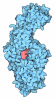
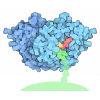
PDB-9nfu: CryoEM Structure of De Novo Antibody Fragment scFv 6 with C. difficile Toxin B (TcdB)
+
About Yorodumi
-
News
-
Feb 9, 2022. New format data for meta-information of EMDB entries
New format data for meta-information of EMDB entries
Version 3 of the EMDB header file is now the official format.
The previous official version 1.9 will be removed from the archive.
In the structure databanks used in Yorodumi, some data are registered as the other names, "COVID-19 virus" and "2019-nCoV". Here are the details of the virus and the list of structure data.
Jan 31, 2019. EMDB accession codes are about to change! (news from PDBe EMDB page)
EMDB accession codes are about to change! (news from PDBe EMDB page)
The allocation of 4 digits for EMDB accession codes will soon come to an end. Whilst these codes will remain in use, new EMDB accession codes will include an additional digit and will expand incrementally as the available range of codes is exhausted. The current 4-digit format prefixed with “EMD-” (i.e. EMD-XXXX) will advance to a 5-digit format (i.e. EMD-XXXXX), and so on. It is currently estimated that the 4-digit codes will be depleted around Spring 2019, at which point the 5-digit format will come into force.
The EM Navigator/Yorodumi systems omit the EMD- prefix.
Related info.:Q: What is EMD? / ID/Accession-code notation in Yorodumi/EM Navigator
Yorodumi is a browser for structure data from EMDB, PDB, SASBDB, etc.
This page is also the successor to EM Navigator detail page, and also detail information page/front-end page for Omokage search.
The word "yorodu" (or yorozu) is an old Japanese word meaning "ten thousand". "mi" (miru) is to see.
Related info.:EMDB / PDB / SASBDB / Comparison of 3 databanks / Yorodumi Search / Aug 31, 2016. New EM Navigator & Yorodumi / Yorodumi Papers / Jmol/JSmol / Function and homology information / Changes in new EM Navigator and Yorodumi
 Movie
Movie Controller

 Yorodumi
 Open data
 Basic information
 Map data
 Sample
 Keywords
 Function and homology information
 Clostridioides difficile (bacteria)
 Authors
 United States, European Union,
  United Kingdom, 11 items
  Citation

 Structure visualization
 Downloads & links
 emd_49373.png
 http://ftp.pdbj.org/pub/emdb/structures/EMD-49373



 Z (Sec.)
 Y (Row.)
 X (Col.)


 Sample components
 Cricetulus griseus (Chinese hamster)
 Processing
 Electron microscopy
 FIELD EMISSION GUN

