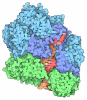
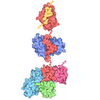
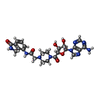
登録情報 データベース : EMDB / ID : EMD-48313 ダウンロードとリンクタイトル PARP1 ART in complex with HPF1 and EB47 マップデータPARP1 ART-HPF1-EB47, non-sharpened map 詳細 試料複合体 : Full-length human PARP1 bound to nicked DNA and in complex with HPF1 and Timeless fragmentタンパク質・ペプチド : Poly [ADP-ribose] polymerase 1タンパク質・ペプチド : Histone PARylation factor 1リガンド : 2-[4-[(2S,3S,4R,5R)-5-(6-aminopurin-9-yl)-3,4-bis(oxidanyl)oxolan-2-yl]carbonylpiperazin-1-yl]-N-(1-oxidanylidene-2,3-dihydroisoindol-4-yl)ethanamide 詳細 キーワード PARP1 / Zinc-finger domains / nicked DNA / DNA BINDING PROTEIN機能・相同性 機能・相同性情報分子機能 ドメイン・相同性 構成要素
regulation of protein ADP-ribosylation / protein ADP-ribosyltransferase-substrate adaptor activity / NAD+-histone H2BS6 serine ADP-ribosyltransferase activity / NAD+-histone H3S10 serine ADP-ribosyltransferase activity / NAD+-histone H2BE35 glutamate ADP-ribosyltransferase activity / positive regulation of myofibroblast differentiation / negative regulation of ATP biosynthetic process / NAD+-protein-tyrosine ADP-ribosyltransferase activity / NAD+-protein-histidine ADP-ribosyltransferase activity / poly-ADP-D-ribose binding ... regulation of protein ADP-ribosylation / protein ADP-ribosyltransferase-substrate adaptor activity / NAD+-histone H2BS6 serine ADP-ribosyltransferase activity / NAD+-histone H3S10 serine ADP-ribosyltransferase activity / NAD+-histone H2BE35 glutamate ADP-ribosyltransferase activity / positive regulation of myofibroblast differentiation / negative regulation of ATP biosynthetic process / NAD+-protein-tyrosine ADP-ribosyltransferase activity / NAD+-protein-histidine ADP-ribosyltransferase activity / poly-ADP-D-ribose binding / regulation of base-excision repair / mitochondrial DNA metabolic process / regulation of circadian sleep/wake cycle, non-REM sleep / vRNA Synthesis / carbohydrate biosynthetic process / NAD+-protein-serine ADP-ribosyltransferase activity / NAD DNA ADP-ribosyltransferase activity / negative regulation of adipose tissue development / DNA ADP-ribosylation / regulation of oxidative stress-induced neuron intrinsic apoptotic signaling pathway / ATP generation from poly-ADP-D-ribose / replication fork reversal / positive regulation of necroptotic process / response to aldosterone / signal transduction involved in regulation of gene expression / transcription regulator activator activity / HDR through MMEJ (alt-NHEJ) / positive regulation of DNA-templated transcription, elongation / NAD+ ADP-ribosyltransferase / protein auto-ADP-ribosylation / negative regulation of telomere maintenance via telomere lengthening / mitochondrial DNA repair / NAD+-protein-aspartate ADP-ribosyltransferase activity / positive regulation of intracellular estrogen receptor signaling pathway / protein poly-ADP-ribosylation / NAD+-protein-glutamate ADP-ribosyltransferase activity / negative regulation of cGAS/STING signaling pathway / positive regulation of cardiac muscle hypertrophy / NAD+-protein mono-ADP-ribosyltransferase activity / DNA repair-dependent chromatin remodeling / positive regulation of mitochondrial depolarization / protein autoprocessing / cellular response to zinc ion / decidualization / nuclear replication fork / R-SMAD binding / macrophage differentiation / 転移酵素; グリコシル基を移すもの; 五炭糖残基を移すもの / positive regulation of SMAD protein signal transduction / negative regulation of transcription elongation by RNA polymerase II / POLB-Dependent Long Patch Base Excision Repair / NAD+ poly-ADP-ribosyltransferase activity / SUMOylation of DNA damage response and repair proteins / nucleosome binding / positive regulation of double-strand break repair via homologous recombination / site of DNA damage / protein localization to chromatin / nucleotidyltransferase activity / positive regulation of adipose tissue development / transforming growth factor beta receptor signaling pathway / negative regulation of innate immune response / telomere maintenance / nuclear estrogen receptor binding / protein modification process / response to gamma radiation / mitochondrion organization / Downregulation of SMAD2/3:SMAD4 transcriptional activity / cellular response to nerve growth factor stimulus / protein-DNA complex / positive regulation of protein localization to nucleus / DNA Damage Recognition in GG-NER / Dual Incision in GG-NER / enzyme activator activity / NAD binding / cellular response to amyloid-beta / histone deacetylase binding / Formation of Incision Complex in GG-NER / cellular response to insulin stimulus / cellular response to UV / nuclear envelope / double-strand break repair / regulation of protein localization / site of double-strand break / cellular response to oxidative stress / histone binding / transcription regulator complex / transcription by RNA polymerase II / damaged DNA binding / response to ethanol / RNA polymerase II-specific DNA-binding transcription factor binding / positive regulation of canonical NF-kappaB signal transduction / chromosome, telomeric region / nuclear body / innate immune response / DNA repair / negative regulation of DNA-templated transcription / apoptotic process / DNA damage response / chromatin binding / ubiquitin protein ligase binding 類似検索 - 分子機能 Histone PARylation factor 1 / Histone PARylation factor 1 / Poly [ADP-ribose] polymerase / PADR1 domain / PADR1 domain superfamily / : / PADR1 domain, zinc ribbon fold / PADR1, N-terminal helical domain / PADR1 domain profile. / PADR1 ... Histone PARylation factor 1 / Histone PARylation factor 1 / Poly [ADP-ribose] polymerase / PADR1 domain / PADR1 domain superfamily / : / PADR1 domain, zinc ribbon fold / PADR1, N-terminal helical domain / PADR1 domain profile. / PADR1 / Zinc finger poly(ADP-ribose) polymerase (PARP)-type signature. / Zinc finger, PARP-type superfamily / Poly(ADP-ribose) polymerase and DNA-Ligase Zn-finger region / Zinc finger poly(ADP-ribose) polymerase (PARP)-type profile. / Poly(ADP-ribose) polymerase and DNA-Ligase Zn-finger region / Zinc finger, PARP-type / : / Poly(ADP-ribose) polymerase, regulatory domain / WGR domain / WGR domain superfamily / WGR domain / WGR domain profile. / Proposed nucleic acid binding domain / Poly(ADP-ribose) polymerase, regulatory domain superfamily / Poly(ADP-ribose) polymerase, regulatory domain / PARP alpha-helical domain profile. / BRCA1 C Terminus (BRCT) domain / Poly(ADP-ribose) polymerase catalytic domain / Poly(ADP-ribose) polymerase, catalytic domain / PARP catalytic domain profile. / breast cancer carboxy-terminal domain / BRCT domain profile. / BRCT domain / BRCT domain superfamily 類似検索 - ドメイン・相同性 Poly [ADP-ribose] polymerase 1 / Histone PARylation factor 1 類似検索 - 構成要素生物種 Homo sapiens (ヒト)手法 単粒子再構成法 / クライオ電子顕微鏡法 / 解像度 : 4.3 Å 詳細 データ登録者Sverzhinsky A / Pascal JM 資金援助 カナダ, 米国, 2件 詳細 詳細を隠すOrganization Grant number 国 Canadian Institutes of Health Research (CIHR) PJT374609 カナダ National Institutes of Health/National Cancer Institute (NIH/NCI) CA92584 米国
引用ジャーナル : Nat Commun / 年 : 2026タイトル : PARP1-HPF1 structure and dynamics on nicked DNA suggest a mechanism for acute and localized ADP-ribosylation.著者 : Aleksandr Sverzhinsky / Huijun Xue / Marie-France Langelier / Marcelo V Muniz Corrêa / Joshua Del Mundo / Scott Classen / Michal Hammel / Eli Rothenberg / John M Pascal / 要旨 : PARP1 detection of DNA strand breaks allosterically leads to PARP1 synthesis of poly(ADP-ribose) modifications that signal DNA damage. HPF1 engages activated PARP1 to control modification site ... PARP1 detection of DNA strand breaks allosterically leads to PARP1 synthesis of poly(ADP-ribose) modifications that signal DNA damage. HPF1 engages activated PARP1 to control modification site selection. Understanding of the mechanism of DNA break detection and catalytic activation is incomplete, due largely to limited structural information for full-length PARP1. Here, single-particle cryo-EM provides views of the full complement of PARP1 domains engaging a DNA single-strand break in the presence of HPF1 and a fragment of binding partner Timeless. Cryo-EM, single-molecule DNA dynamics, and small-angle X-ray scattering analysis indicate that PARP1 remains dynamic even when the multi-domain structure is organized on a DNA break, with the minimal catalytic region displaying high mobility relative to domains engaging damage. We propose that the organization of PARP1 domains on a DNA break releases a tethered, constitutively active catalytic region to modify molecules in a radius surrounding the DNA break site. 履歴 登録 2024年12月14日 - ヘッダ(付随情報) 公開 2026年1月21日 - マップ公開 2026年1月21日 - 更新 2026年4月8日 - 現状 2026年4月8日 処理サイト : RCSB / 状態 : 公開
すべて表示 表示を減らす