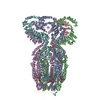
Movie
Movie Controller


+ Open data

- Basic information
| Entry |  | |||||||||
|---|---|---|---|---|---|---|---|---|---|---|
| Title | LRRC8A:D Conformation 2 | |||||||||
 Map data Map data | Sharpened map | |||||||||
 Sample Sample |
| |||||||||
 Keywords Keywords | ION CHANNEL / VOLUME-REGULATION / MEMBRANE PROTEIN | |||||||||
| Function / homology |  Function and homology information Function and homology informationMiscellaneous transport and binding events / pre-B cell differentiation / volume-sensitive anion channel activity / aspartate transmembrane transport / cyclic-GMP-AMP transmembrane transporter activity / cyclic-GMP-AMP transmembrane import across plasma membrane / monoatomic anion transmembrane transport / taurine transmembrane transport / cell volume homeostasis / monoatomic anion transport ...Miscellaneous transport and binding events / pre-B cell differentiation / volume-sensitive anion channel activity / aspartate transmembrane transport / cyclic-GMP-AMP transmembrane transporter activity / cyclic-GMP-AMP transmembrane import across plasma membrane / monoatomic anion transmembrane transport / taurine transmembrane transport / cell volume homeostasis / monoatomic anion transport / cellular response to osmotic stress / protein hexamerization / monoatomic ion channel complex / response to osmotic stress / positive regulation of myoblast differentiation / intracellular glucose homeostasis / chloride transmembrane transport / positive regulation of insulin secretion / electron transport chain / spermatogenesis / electron transfer activity / periplasmic space / iron ion binding / lysosomal membrane / heme binding / endoplasmic reticulum membrane / cell surface / membrane / identical protein binding / plasma membrane / cytoplasm Similarity search - Function | |||||||||
| Biological species |   Mus musculus (house mouse) Mus musculus (house mouse) | |||||||||
| Method | single particle reconstruction / cryo EM / Resolution: 3.4 Å | |||||||||
 Authors Authors | Lurie A / Brohawn SG | |||||||||
| Funding support |  United States, 1 items United States, 1 items
| |||||||||
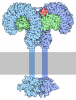
 Citation Citation | Journal: Nat Commun / Year: 2025 Title: Assembly and lipid-gating of LRRC8A:D volume-regulated anion channels. Authors: Antony Lurie / Christina A Stephens / David M Kern / Katharine M Henn / Naomi R Latorraca / Stephen G Brohawn / Abstract: Volume-regulated anion channels (VRACs) are ubiquitously expressed vertebrate ion channels that open in response to hypotonic swelling. VRACs assemble as heteromers of LRRC8A and LRRC8B-E subunits, ...Volume-regulated anion channels (VRACs) are ubiquitously expressed vertebrate ion channels that open in response to hypotonic swelling. VRACs assemble as heteromers of LRRC8A and LRRC8B-E subunits, with different subunit combinations resulting in channels with different properties. Recent studies have described the structures of LRRC8A:C VRACs, but how other VRACs assemble, and which structural features are conserved or variant across channel assemblies remains unknown. Herein, we used cryo-EM to determine structures of a LRRC8A:D VRAC with a 4:2 subunit stoichiometry, which we captured in two conformations. The presence of LRRC8D subunits widens and increases hydrophobicity of the selectivity filter, which may contribute to the unique substrate selectivity of LRRC8D-containing VRACs. The structures reveal lipids bound inside the channel pore, similar to those observed in LRRC8A:C VRACs. We observe that LRRC8D subunit incorporation disrupts packing of the cytoplasmic LRR domains, increasing channel dynamics and opening lateral intersubunit gaps, which we speculate are necessary for pore lipid evacuation and channel activation. Molecular dynamics simulations show that lipids can reside stably within the pore to close the channel. Using electrophysiological experiments, we confirmed that pore lipids block conduction in the closed state, demonstrating that lipid-gating is a general property of VRACs. | |||||||||
| History |
|
- Structure visualization
| Supplemental images |
|---|

- Downloads & links
-EMDB archive
| Map data | emd_47283.map.gz | 259.3 MB | EMDB map data format | |
|---|---|---|---|---|
| Header (meta data) | emd-47283-v30.xmlemd-47283.xml | 24.5 KB 24.5 KB | Display Display | EMDB header |
| Images |  emd_47283.png emd_47283.png | 93.9 KB | ||
| Filedesc metadata | emd-47283.cif.gz | 7.3 KB | ||
| Others | emd_47283_additional_1.map.gzemd_47283_half_map_1.map.gzemd_47283_half_map_2.map.gz | 137.6 MB 254.6 MB 254.6 MB | ||
| Archive directory |  https://data.pdbj.org/pub/emdb/structures/EMD-47283ftp://data.pdbj.org/pub/emdb/structures/EMD-47283 https://data.pdbj.org/pub/emdb/structures/EMD-47283ftp://data.pdbj.org/pub/emdb/structures/EMD-47283 | HTTPS FTP |
-Related structure data
| Related structure data |  9dxaMC  9dx7C C: citing same article ( M: atomic model generated by this map |
|---|---|
| Similar structure data |

-Links
| EMDB pages | EMDB (EBI/PDBe) / EMDataResource |
|---|---|
| Related items in Molecule of the Month |
-Map
| File | Download / File: emd_47283.map.gz / Format: CCP4 / Size: 274.6 MB / Type: IMAGE STORED AS FLOATING POINT NUMBER (4 BYTES) | ||||||||||||||||||||||||||||||||||||
|---|---|---|---|---|---|---|---|---|---|---|---|---|---|---|---|---|---|---|---|---|---|---|---|---|---|---|---|---|---|---|---|---|---|---|---|---|---|
| Annotation | Sharpened map | ||||||||||||||||||||||||||||||||||||
| Projections & slices | Image control
Images are generated by Spider. | ||||||||||||||||||||||||||||||||||||
| Voxel size | X=Y=Z: 1.048 Å | ||||||||||||||||||||||||||||||||||||
| Density |
| ||||||||||||||||||||||||||||||||||||
| Symmetry | Space group: 1 | ||||||||||||||||||||||||||||||||||||
| Details | EMDB XML:
|
 Z (Sec.)
 Y (Row.)
 X (Col.)


-Supplemental data
-Additional map: Unsharpened map
| File | emd_47283_additional_1.map | ||||||||||||
|---|---|---|---|---|---|---|---|---|---|---|---|---|---|
| Annotation | Unsharpened map | ||||||||||||
| Projections & Slices |
| ||||||||||||
| Density Histograms |


-Half map: Half map A
| File | emd_47283_half_map_1.map | ||||||||||||
|---|---|---|---|---|---|---|---|---|---|---|---|---|---|
| Annotation | Half map A | ||||||||||||
| Projections & Slices |
| ||||||||||||
| Density Histograms |


-Half map: Half map B
| File | emd_47283_half_map_2.map | ||||||||||||
|---|---|---|---|---|---|---|---|---|---|---|---|---|---|
| Annotation | Half map B | ||||||||||||
| Projections & Slices |
| ||||||||||||
| Density Histograms |


- Sample components
-Entire : LRRC8A:D channel
| Entire | Name: LRRC8A:D channel |
|---|---|
| Components |
|
-Supramolecule #1: LRRC8A:D channel
| Supramolecule | Name: LRRC8A:D channel / type: complex / ID: 1 / Parent: 0 / Macromolecule list: #1-#2 |
|---|---|
| Source (natural) | Organism: Mus musculus (house mouse) |
| Molecular weight | Theoretical: 620 KDa |
-Macromolecule #1: Volume-regulated anion channel subunit LRRC8A,Soluble cytochrome b562
| Macromolecule | Name: Volume-regulated anion channel subunit LRRC8A,Soluble cytochrome b562 type: protein_or_peptide / ID: 1 / Details: LRRC8A(BRIL),LRRC8A(BRIL),LRRC8A(BRIL) / Number of copies: 4 / Enantiomer: LEVO |
|---|---|
| Source (natural) | Organism: Mus musculus (house mouse) |
| Molecular weight | Theoretical: 105.530102 KDa |
| Recombinant expression | Organism:   Spodoptera frugiperda (fall armyworm) Spodoptera frugiperda (fall armyworm) |
| Sequence | String: MIPVTELRYF ADTQPAYRIL KPWWDVFTDY ISIVMLMIAV FGGTLQVTQD KMICLPCKWV TKDSCNDSFR GWAASSADLE DNWETLNDN LKVIEKADNA AQVKDALTKM RAAALDAQKA TPPKLEDKSP DSPEMKDFRH GFDILVGQID DALKLANEGK V KEAQAAAE ...String: MIPVTELRYF ADTQPAYRIL KPWWDVFTDY ISIVMLMIAV FGGTLQVTQD KMICLPCKWV TKDSCNDSFR GWAASSADLE DNWETLNDN LKVIEKADNA AQVKDALTKM RAAALDAQKA TPPKLEDKSP DSPEMKDFRH GFDILVGQID DALKLANEGK V KEAQAAAE QLKTTRNAYI QKYLDTGPTG IKYDLDRHQY NYVDAVCYEN RLHWFAKYFP YLVLLHTLIF LACSNFWFKF PR TSSKLEH FVSILLKCFD SPWTTRALSE TVVEESDPKP AFSKMNGSMD KKSSTVSEDV EATVPMLQRT KSRIEQGIVD RSE TGVLDK KEGEQAKALF EKVKKFRTHV EEGDIVYRLY MRQTIIKVIK FALIICYTVY YVHNIKFDVD CTVDIESLTG YRTY RCAHP LATLFKILAS FYISLVIFYG LICMYTLWWM LRRSLKKYSF ESIREESSYS DIPDVKNDFA FMLHLIDQYD PLYSK RFAV FLSEVSENKL RQLNLNNEWT LDKLRQRLTK NAQDKLELHL FMLSGIPDTV FDLVELEVLK LELIPDVTIP PSIAQL TGL KELWLYHTAA KIEAPALAFL RENLRALHIK FTDIKEIPLW IYSLKTLEEL HLTGNLSAEN NRYIVIDGLR ELKRLKV LR LKSNLSKLPQ VVTDVGVHLQ KLSINNEGTK LIVLNSLKKM VNLTELELIR CDLERIPHSI FSLHNLQEID LKDNNLKT I EEIISFQHLH RLTCLKLWYN HIAYIPIQIG NLTNLERLYL NRNKIEKIPT QLFYCRKLRY LDLSHNNLTF LPADIGLLQ NLQNLAVTAN RIEALPPELF QCRKLRALHL GNNVLQSLPS RVGELTNLTQ IELRGNRLEC LPVELGECPL LKRSGLVVEE DLFSTLPPE VKERLWRADK EQASNSLEVL FQ UniProtKB: Volume-regulated anion channel subunit LRRC8A, Soluble cytochrome b562, Volume-regulated anion channel subunit LRRC8A |
-Macromolecule #2: Volume-regulated anion channel subunit LRRC8D
| Macromolecule | Name: Volume-regulated anion channel subunit LRRC8D / type: protein_or_peptide / ID: 2 / Number of copies: 2 / Enantiomer: LEVO |
|---|---|
| Source (natural) | Organism: Mus musculus (house mouse) |
| Molecular weight | Theoretical: 99.317867 KDa |
| Recombinant expression | Organism: Spodoptera frugiperda (fall armyworm) |
| Sequence | String: MFTLAEVASL NDIQPTYRIL KPWWDVFMDY LAVVMLMVAI FAGTMQLTKD QVVCLPVLPS PANSKAHTPP GNADITTEVP RMETATHQD QNGQTTTNDV AFGTSAVTPD IPLQATHPHA ESTLPNQEAK KEKRDPTGRK TNLDFQQYVF INQMCYHLAL P WYSKYFPY ...String: MFTLAEVASL NDIQPTYRIL KPWWDVFMDY LAVVMLMVAI FAGTMQLTKD QVVCLPVLPS PANSKAHTPP GNADITTEVP RMETATHQD QNGQTTTNDV AFGTSAVTPD IPLQATHPHA ESTLPNQEAK KEKRDPTGRK TNLDFQQYVF INQMCYHLAL P WYSKYFPY LALIHTIILM VSSNFWFKYP KTCSKVEHFV SILGKCFESP WTTKALSETA CEDSEENKQR ITGAQTLPKH VS TSSDEGS PSASTPMINK TGFKFSAEKP VIEVPSMTIL DKKDGEQAKA LFEKVRKFRA HVEDSDLIYK LYVVQTLIKT AKF IFILCY TANFVNAISF EHVCKPKVEH LTGYEVFECT HNMAYMLKKL LISYISIICV YGFICLYTLF WLFRIPLKEY SFEK VREES SFSDIPDVKN DFAFLLHMVD QYDQLYSKRF GVFLSEVSEN KLREISLNHE WTFEKLRQHV SRNAQDKQEL HLFML SGVP DAVFDLTDLD VLKLELIPEA KIPAKISQMT NLQELHLCHC PAKVEQTAFS FLRDHLRCLH VKFTDVAEIP AWVYLL KNL RELYLIGNLN SENNKMIGLE SLRELRHLKI LHVKSNLTKV PSNITDVAPH LTKLVIHNDG TKLLVLNSLK KMMNVAE LE LQNCELERIP HAIFSLSNLQ ELDLKSNNIR TIEEIISFQH LKRLTCLKLW HNKIVAIPPS ITHVKNLESL YFSNNKLE S LPTAVFSLQK LRCLDVSYNN ISTIPIEIGL LQNLQHLHIT GNKVDILPKQ LFKCVKLRTL NLGQNCIASL PEKISQLTQ LTQLELKGNC LDRLPAQLGQ CRMLKKSGLV VEDQLFDTLP LEVKEALNQD VNVPFANGIS NSENLYFQ UniProtKB: Volume-regulated anion channel subunit LRRC8D |
-Macromolecule #3: 1,2-dioleoyl-sn-glycero-3-phosphoethanolamine
| Macromolecule | Name: 1,2-dioleoyl-sn-glycero-3-phosphoethanolamine / type: ligand / ID: 3 / Number of copies: 18 / Formula: PEE |
|---|---|
| Molecular weight | Theoretical: 744.034 Da |
| Chemical component information | 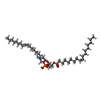 ChemComp-PEE: |
-Experimental details
-Structure determination
| Method | cryo EM |
|---|---|
 Processing Processing | single particle reconstruction |
| Aggregation state | particle |
-Sample preparation
| Buffer | pH: 7.4 |
|---|---|
| Vitrification | Cryogen name: ETHANE |
- Electron microscopy
| Microscope | TFS KRIOS |
|---|---|
| Image recording | Film or detector model: GATAN K3 BIOQUANTUM (6k x 4k) / Average electron dose: 50.0 e/Å2 |
| Electron beam | Acceleration voltage: 300 kV / Electron source:  FIELD EMISSION GUN FIELD EMISSION GUN |
| Electron optics | Illumination mode: FLOOD BEAM / Imaging mode: BRIGHT FIELD / Nominal defocus max: 18.0 µm / Nominal defocus min: 6.0 µm |
| Experimental equipment |  Model: Titan Krios / Image courtesy: FEI Company |