positive regulation of norepinephrine uptake / cellular response to cytochalasin B / Formation of the embryonic stem cell BAF (esBAF) complex / regulation of transepithelial transport / Formation of the canonical BAF (cBAF) complex / morphogenesis of a polarized epithelium / Formation of annular gap junctions / Formation of the dystrophin-glycoprotein complex (DGC) / structural constituent of postsynaptic actin cytoskeleton / Formation of the polybromo-BAF (pBAF) complex ...positive regulation of norepinephrine uptake / cellular response to cytochalasin B / Formation of the embryonic stem cell BAF (esBAF) complex / regulation of transepithelial transport / Formation of the canonical BAF (cBAF) complex / morphogenesis of a polarized epithelium / Formation of annular gap junctions / Formation of the dystrophin-glycoprotein complex (DGC) / structural constituent of postsynaptic actin cytoskeleton / Formation of the polybromo-BAF (pBAF) complex / Gap junction degradation / GBP-mediated host defense / Formation of neuronal progenitor and neuronal BAF (npBAF and nBAF) / protein localization to adherens junction / Formation of the non-canonical BAF (ncBAF) complex / Cell-extracellular matrix interactions / regulation of G0 to G1 transition / dense body / Folding of actin by CCT/TriC / Tat protein binding / postsynaptic actin cytoskeleton / Regulation of CDH1 Function / apical protein localization / Prefoldin mediated transfer of substrate to CCT/TriC / Adherens junctions interactions / regulation of double-strand break repair / microtubule nucleation / adherens junction assembly / RHOF GTPase cycle / Sensory processing of sound by outer hair cells of the cochlea / tight junction / Sensory processing of sound by inner hair cells of the cochlea / regulation of mitotic metaphase/anaphase transition / positive regulation of T cell differentiation / maintenance of blood-brain barrier / Interaction between L1 and Ankyrins / apical junction complex / regulation of nucleotide-excision repair / positive regulation of stem cell population maintenance / NuA4 histone acetyltransferase complex / regulation of norepinephrine uptake / transporter regulator activity / Recycling pathway of L1 / cortical cytoskeleton / positive regulation of double-strand break repair / Regulation of MITF-M-dependent genes involved in pigmentation / negative regulation of cell differentiation / establishment or maintenance of cell polarity / nitric-oxide synthase binding / brush border / EPH-ephrin mediated repulsion of cells / positive regulation of myoblast differentiation / regulation of synaptic vesicle endocytosis / RHO GTPases Activate WASPs and WAVEs / kinesin binding / regulation of protein localization to plasma membrane / RHO GTPases activate IQGAPs / positive regulation of double-strand break repair via homologous recombination / regulation of G1/S transition of mitotic cell cycle / axonogenesis / cytoskeleton organization / EPHB-mediated forward signaling / substantia nigra development / calyx of Held / cell motility / nitric-oxide synthase regulator activity / FCGR3A-mediated phagocytosis / Translocation of SLC2A4 (GLUT4) to the plasma membrane / actin filament / positive regulation of cell differentiation / adherens junction / Regulation of endogenous retroelements by Piwi-interacting RNAs (piRNAs) / RHO GTPases Activate Formins / Signaling by high-kinase activity BRAF mutants / MAP2K and MAPK activation / Regulation of actin dynamics for phagocytic cup formation / platelet aggregation / VEGFA-VEGFR2 Pathway / B-WICH complex positively regulates rRNA expression / tau protein binding / Schaffer collateral - CA1 synapse / DNA Damage Recognition in GG-NER / Hydrolases; Acting on acid anhydrides; Acting on acid anhydrides to facilitate cellular and subcellular movement / structural constituent of cytoskeleton / cytoplasmic ribonucleoprotein granule / kinetochore / nuclear matrix / Signaling by RAF1 mutants / cell-cell junction / Signaling by moderate kinase activity BRAF mutants / Paradoxical activation of RAF signaling by kinase inactive BRAF / Signaling downstream of RAS mutants / actin cytoskeleton / Signaling by BRAF and RAF1 fusions / UCH proteinases / lamellipodium / presynapse / HATs acetylate histones / Clathrin-mediated endocytosis / Factors involved in megakaryocyte development and platelet production Similarity search - Function
National Institutes of Health/National Institute Of Allergy and Infectious Diseases (NIH/NIAID)
R21AI171709
United States
National Institutes of Health/National Institute of General Medical Sciences (NIH/NIGMS)
R01GM126296
United States
Citation
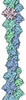
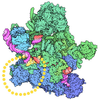
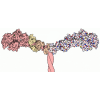
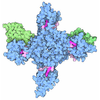
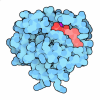
Journal: J Mol Biol / Year: 2025 Title: Cryo-EM Detection of AMPylated Histidine Implies Covalent Catalysis in AMPylation Mediated by a Bacterial Effector. Authors: Zhengrui Zhang / Rishi Patel / Zhao-Qing Luo / Chittaranjan Das / Abstract: AMPylation is a post-translational modification (PTM) whereby adenosine monophosphate (AMP) from adenosine triphosphate (ATP) is transferred onto protein hydroxyl groups of serine, threonine, or ...AMPylation is a post-translational modification (PTM) whereby adenosine monophosphate (AMP) from adenosine triphosphate (ATP) is transferred onto protein hydroxyl groups of serine, threonine, or tyrosine. Recently, an actin-dependent AMPylase namely LnaB from the bacterial pathogen Legionella pneumophila was found to AMPylate phosphate groups of phosphoribosylated ubiquitin and Src family kinases. LnaB represents an evolutionarily distinct family of AMPylases with conserved active site Ser-His-Glu residues. Here, we capture the structure of the LnaB-actin complex in a putative intermediate state via single-particle cryogenic electron microscopy (cryo-EM) and find that the catalytic histidine of LnaB is covalently attached to AMP through a phosphoramidate linkage at the Nδ1 atom. This observation provides direct structural evidence of histidine AMPylation as a PTM and implies the possibility of covalent catalysis in LnaB-mediated AMPylation, a mechanism distinct from known AMPylases. Subsequent biochemical studies confirm the observed AMP binding site and provide additional insights into the catalytic properties of LnaB. Together, our work highlights the power of cryo-EM in capturing labile PTMs and transient species during enzymatic reactions, while opening new avenues of mechanistic investigation into the LnaB family.
In the structure databanks used in Yorodumi, some data are registered as the other names, "COVID-19 virus" and "2019-nCoV". Here are the details of the virus and the list of structure data.
Jan 31, 2019. EMDB accession codes are about to change! (news from PDBe EMDB page)
EMDB accession codes are about to change! (news from PDBe EMDB page)
The allocation of 4 digits for EMDB accession codes will soon come to an end. Whilst these codes will remain in use, new EMDB accession codes will include an additional digit and will expand incrementally as the available range of codes is exhausted. The current 4-digit format prefixed with “EMD-” (i.e. EMD-XXXX) will advance to a 5-digit format (i.e. EMD-XXXXX), and so on. It is currently estimated that the 4-digit codes will be depleted around Spring 2019, at which point the 5-digit format will come into force.
The EM Navigator/Yorodumi systems omit the EMD- prefix.
Related info.:Q: What is EMD? / ID/Accession-code notation in Yorodumi/EM Navigator
Yorodumi is a browser for structure data from EMDB, PDB, SASBDB, etc.
This page is also the successor to EM Navigator detail page, and also detail information page/front-end page for Omokage search.
The word "yorodu" (or yorozu) is an old Japanese word meaning "ten thousand". "mi" (miru) is to see.
Related info.:EMDB / PDB / SASBDB / Comparison of 3 databanks / Yorodumi Search / Aug 31, 2016. New EM Navigator & Yorodumi / Yorodumi Papers / Jmol/JSmol / Function and homology information / Changes in new EM Navigator and Yorodumi
 Movie
Movie Controller

 Yorodumi
 Open data
 Basic information
 Map data
 Sample
 Keywords
 Function and homology information
 Legionella pneumophila subsp. pneumophila str. Philadelphia 1 (bacteria) /
  Homo sapiens (human)
 Authors
 United States, 2 items
  Citation
 Structure visualization
 Downloads & links
 emd_44118.png
 http://ftp.pdbj.org/pub/emdb/structures/EMD-44118





 Z (Sec.)
 Y (Row.)
 X (Col.)


 Sample components
 Escherichia coli BL21(DE3) (bacteria)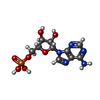
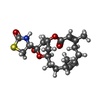
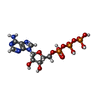
 Processing
 Electron microscopy
 FIELD EMISSION GUN

