Biotechnology and Biological Sciences Research Council (BBSRC)
BB/T015128/1
英国
Biotechnology and Biological Sciences Research Council (BBSRC)
BB/R017913/1
英国
European Research Council (ERC)
101021133
European Union
National Institutes of Health/National Institute Of Allergy and Infectious Diseases (NIH/NIAID)
U54 AI170791-7522
米国
Wellcome Trust
206422/Z/17/Z
英国
引用
ジャーナル: Science / 年: 2025 タイトル: Bacterial pathogen deploys the iminosugar glycosyrin to manipulate plant glycobiology. 著者: Nattapong Sanguankiattichai / Balakumaran Chandrasekar / Yuewen Sheng / Nathan Hardenbrook / Werner W A Tabak / Margit Drapal / Farnusch Kaschani / Clemens Grünwald-Gruber / Daniel Krahn / ...著者: Nattapong Sanguankiattichai / Balakumaran Chandrasekar / Yuewen Sheng / Nathan Hardenbrook / Werner W A Tabak / Margit Drapal / Farnusch Kaschani / Clemens Grünwald-Gruber / Daniel Krahn / Pierre Buscaill / Suzuka Yamamoto / Atsushi Kato / Robert Nash / George Fleet / Richard Strasser / Paul D Fraser / Markus Kaiser / Peijun Zhang / Gail M Preston / Renier A L van der Hoorn / 要旨: The extracellular space (apoplast) in plants is a key battleground during microbial infections. To avoid recognition, the bacterial model phytopathogen pv. DC3000 produces glycosyrin. Glycosyrin ...The extracellular space (apoplast) in plants is a key battleground during microbial infections. To avoid recognition, the bacterial model phytopathogen pv. DC3000 produces glycosyrin. Glycosyrin inhibits the plant-secreted β-galactosidase BGAL1, which would otherwise initiate the release of immunogenic peptides from bacterial flagellin. Here, we report the structure, biosynthesis, and multifunctional roles of glycosyrin. High-resolution cryo-electron microscopy and chemical synthesis revealed that glycosyrin is an iminosugar with a five-membered pyrrolidine ring and a hydrated aldehyde that mimics monosaccharides. Glycosyrin biosynthesis was controlled by virulence regulators, and its production is common in bacteria and prevents flagellin recognition and alters the extracellular glycoproteome and metabolome of infected plants. These findings highlight a potentially wider role for glycobiology manipulation by plant pathogens across the plant kingdom.
 ムービー
ムービー コントローラー


 データを開く
 基本情報
基本情報
 マップデータ
 試料
試料 キーワード
キーワード 機能・相同性情報
 Escherichia coli (大腸菌)
 データ登録者
 英国, European Union,
  米国, 5件
  引用
引用


 構造の表示
構造の表示
 ダウンロードとリンク
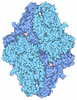
 emd_19181.png
 http://ftp.pdbj.org/pub/emdb/structures/EMD-19181


 Z (Sec.)
 Y (Row.)
 X (Col.)


 試料の構成要素
 解析
解析 電子顕微鏡法
 FIELD EMISSION GUN

