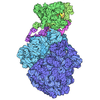
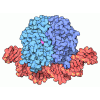
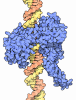
Journal: Nat Struct Mol Biol / Year: 2026 Title: DNA topoisomerase I acts as supercoiling sensor for bacterial transcription elongation. Authors: Vita Vidmar / Céline Borde / Lisa Bruno / Nataliya Miropolskaya / Maria Takacs / Claire Batisse / Charlotte Saint-André / Chengjin Zhu / Olivier Espéli / Valérie Lamour / Albert Weixlbaumer / Abstract: During transcription, RNA polymerase (RNAP) continuously unwinds and rewinds DNA, generating negative and positive supercoils upstream and downstream, respectively. Using single-particle cryo-EM, we ...During transcription, RNA polymerase (RNAP) continuously unwinds and rewinds DNA, generating negative and positive supercoils upstream and downstream, respectively. Using single-particle cryo-EM, we elucidated how bacterial RNAP and DNA topoisomerase I (TopoI), which relaxes negative supercoils, operate in close spatial proximity. TopoI binds to relaxed DNA upstream of RNAP, and this involves a conformational switch in the TopoI functional domains. This suggests that TopoI exerts a sensing role before the formation of negative supercoils. On DNA substrates mimicking negatively supercoiled DNA, TopoI threads one strand into the active site for cleavage and binds the complementary strand with an auxiliary domain. Transcriptomic and phenotypic analyses suggest that mutations affecting conformational changes in TopoI impact gene expression and operon polarity in bacteria. In summary, we propose a comprehensive model for DNA relaxation in the proximity of active bacterial transcription.
Name: non-template DNA strand / type: dna / ID: 7 / Classification: DNA
Source (natural)
Organism: synthetic construct (others)
Sequence
String:
TAGATTGGTC AGTACGTCCT ATCGATCTTC GGAAGAGATT CAGAG
+
Macromolecule #9: template DNA strand
Macromolecule
Name: template DNA strand / type: dna / ID: 9 / Classification: DNA
Source (natural)
Organism: synthetic construct (others)
Sequence
String:
CTCTGAATCT CTTCCGACGC GCCGCGGGAC GTACTGACCT TAGAT
+
Macromolecule #8: RNA
Macromolecule
Name: RNA / type: rna / ID: 8
Source (natural)
Organism: synthetic construct (others)
Sequence
String:
GAGUCCGCGG CGCG
-
Experimental details
-
Structure determination
Method
cryo EM
Processing
single particle reconstruction
Aggregation state
particle
-
Sample preparation
Concentration
10 mg/mL
Buffer
pH: 7.5 Component:
Concentration
Name
10.0 mM
HEPES/KOH
150.0 mM
potassium acetate
5.0 mM
magnesium acetate
0.01 mM
zinc chloride
2.0 mM
DTT
Grid
Model: UltrAuFoil R1.2/1.3 / Material: GOLD / Mesh: 300 / Support film - Material: GOLD / Support film - topology: HOLEY / Support film - Film thickness: 50 / Pretreatment - Type: PLASMA CLEANING / Pretreatment - Time: 35 sec. / Pretreatment - Atmosphere: OTHER
Vitrification
Cryogen name: ETHANE / Chamber humidity: 95 % / Chamber temperature: 283 K / Instrument: FEI VITROBOT MARK IV
-
Electron microscopy
Microscope
FEI TITAN KRIOS
Image recording
Film or detector model: GATAN K3 (6k x 4k) / Average electron dose: 55.55 e/Å2
Electron beam
Acceleration voltage: 300 kV / Electron source: FIELD EMISSION GUN
In the structure databanks used in Yorodumi, some data are registered as the other names, "COVID-19 virus" and "2019-nCoV". Here are the details of the virus and the list of structure data.
Jan 31, 2019. EMDB accession codes are about to change! (news from PDBe EMDB page)
EMDB accession codes are about to change! (news from PDBe EMDB page)
The allocation of 4 digits for EMDB accession codes will soon come to an end. Whilst these codes will remain in use, new EMDB accession codes will include an additional digit and will expand incrementally as the available range of codes is exhausted. The current 4-digit format prefixed with “EMD-” (i.e. EMD-XXXX) will advance to a 5-digit format (i.e. EMD-XXXXX), and so on. It is currently estimated that the 4-digit codes will be depleted around Spring 2019, at which point the 5-digit format will come into force.
The EM Navigator/Yorodumi systems omit the EMD- prefix.
Related info.:Q: What is EMD? / ID/Accession-code notation in Yorodumi/EM Navigator
Yorodumi is a browser for structure data from EMDB, PDB, SASBDB, etc.
This page is also the successor to EM Navigator detail page, and also detail information page/front-end page for Omokage search.
The word "yorodu" (or yorozu) is an old Japanese word meaning "ten thousand". "mi" (miru) is to see.
Related info.:EMDB / PDB / SASBDB / Comparison of 3 databanks / Yorodumi Search / Aug 31, 2016. New EM Navigator & Yorodumi / Yorodumi Papers / Jmol/JSmol / Function and homology information / Changes in new EM Navigator and Yorodumi
 Movie
Movie Controller


 Open data
 Basic information
 Map data
 Sample
 Keywords
 Function and homology information
 Escherichia coli (E. coli) / synthetic construct (others)
 Authors
 France, 2 items
  Citation
 Structure visualization
 Downloads & links
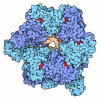
 emd_51270.png
 https://data.pdbj.org/pub/emdb/structures/EMD-51270


 Z (Sec.)
 Y (Row.)
 X (Col.)


 Sample components
 Processing
 Electron microscopy
 FIELD EMISSION GUN

