Kinase / Signalling / MAP kinase / phosphoryl transfer / IMMUNE SYSTEM
Function / homology
Function and homology information
nucleotide-binding domain, leucine rich repeat containing receptor signaling pathway / mitogen-activated protein kinase kinase / Activation of PPARGC1A (PGC-1alpha) by phosphorylation / regulation of synaptic membrane adhesion / stress-induced premature senescence / negative regulation of cold-induced thermogenesis / positive regulation of myoblast fusion / cartilage condensation / stress-activated protein kinase signaling cascade / 3'-UTR-mediated mRNA stabilization ...nucleotide-binding domain, leucine rich repeat containing receptor signaling pathway / mitogen-activated protein kinase kinase / Activation of PPARGC1A (PGC-1alpha) by phosphorylation / regulation of synaptic membrane adhesion / stress-induced premature senescence / negative regulation of cold-induced thermogenesis / positive regulation of myoblast fusion / cartilage condensation / stress-activated protein kinase signaling cascade / 3'-UTR-mediated mRNA stabilization / CD163 mediating an anti-inflammatory response / positive regulation of cyclase activity / response to dietary excess / positive regulation of myotube differentiation / positive regulation of muscle cell differentiation / cellular response to UV-B / KSRP (KHSRP) binds and destabilizes mRNA / mitogen-activated protein kinase p38 binding / Myogenesis / Platelet sensitization by LDL / NFAT protein binding / cellular response to lipoteichoic acid / regulation of cytokine production involved in inflammatory response / Activation of the AP-1 family of transcription factors / p38MAPK cascade / ERK/MAPK targets / PI5P Regulates TP53 Acetylation / MAP kinase kinase activity / Regulation of MITF-M-dependent genes involved in pigmentation / MAP kinase activity / cellular response to vascular endothelial growth factor stimulus / Uptake and function of anthrax toxins / mitogen-activated protein kinase / vascular endothelial growth factor receptor signaling pathway / stress-activated MAPK cascade / RHO GTPases Activate NADPH Oxidases / positive regulation of myoblast differentiation / negative regulation of hippo signaling / osteoclast differentiation / positive regulation of interleukin-12 production / signal transduction in response to DNA damage / p38MAPK events / positive regulation of erythrocyte differentiation / regulation of signal transduction by p53 class mediator / tumor necrosis factor-mediated signaling pathway / response to insulin / cellular response to ionizing radiation / cellular response to virus / activated TAK1 mediates p38 MAPK activation / negative regulation of inflammatory response to antigenic stimulus / negative regulation of canonical Wnt signaling pathway / platelet activation / bone development / NOD1/2 Signaling Pathway / PKR-mediated signaling / VEGFA-VEGFR2 Pathway / cellular senescence / chemotaxis / positive regulation of reactive oxygen species metabolic process / osteoblast differentiation / Ubiquitin-Mediated Degradation of Phosphorylated Cdc25A / Interleukin-1 signaling / MAPK cascade / ADP signalling through P2Y purinoceptor 1 / cellular response to lipopolysaccharide / spindle pole / protein tyrosine kinase activity / secretory granule lumen / protein phosphatase binding / Oxidative Stress Induced Senescence / Regulation of TP53 Activity through Phosphorylation / ficolin-1-rich granule lumen / cytoskeleton / regulation of cell cycle / cell surface receptor signaling pathway / nuclear speck / intracellular signal transduction / apoptotic process / protein serine kinase activity / protein serine/threonine kinase activity / positive regulation of gene expression / regulation of transcription by RNA polymerase II / Neutrophil degranulation / protein kinase binding / glutamatergic synapse / enzyme binding / signal transduction / DNA-templated transcription / mitochondrion / nucleoplasm / extracellular region / ATP binding / identical protein binding / nucleus / cytosol / cytoplasm Similarity search - Function
Mitogen-activated protein kinase 14 / Mitogen-activated protein (MAP) kinase p38-like / Mitogen-activated protein (MAP) kinase, conserved site / MAP kinase signature. / : / Serine/threonine-protein kinase, active site / Serine/Threonine protein kinases active-site signature. / Protein kinase domain / Serine/Threonine protein kinases, catalytic domain / Protein kinase, ATP binding site ...Mitogen-activated protein kinase 14 / Mitogen-activated protein (MAP) kinase p38-like / Mitogen-activated protein (MAP) kinase, conserved site / MAP kinase signature. / : / Serine/threonine-protein kinase, active site / Serine/Threonine protein kinases active-site signature. / Protein kinase domain / Serine/Threonine protein kinases, catalytic domain / Protein kinase, ATP binding site / Protein kinases ATP-binding region signature. / Protein kinase domain profile. / Protein kinase domain / Protein kinase-like domain superfamily Similarity search - Domain/homology
Dual specificity mitogen-activated protein kinase kinase 6 / Mitogen-activated protein kinase 14 Similarity search - Component
Biological species
Homo sapiens (human)
Method
single particle reconstruction / cryo EM / Resolution: 4.0 Å
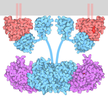
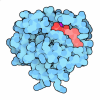
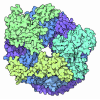
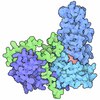
Journal: Science / Year: 2023 Title: Architecture of the MKK6-p38α complex defines the basis of MAPK specificity and activation. Authors: Pauline Juyoux / Ioannis Galdadas / Dorothea Gobbo / Jill von Velsen / Martin Pelosse / Mark Tully / Oscar Vadas / Francesco Luigi Gervasio / Erika Pellegrini / Matthew W Bowler / Abstract: The mitogen-activated protein kinase (MAPK) p38α is a central component of signaling in inflammation and the immune response and is, therefore, an important drug target. Little is known about the ...The mitogen-activated protein kinase (MAPK) p38α is a central component of signaling in inflammation and the immune response and is, therefore, an important drug target. Little is known about the molecular mechanism of its activation by double phosphorylation from MAPK kinases (MAP2Ks), because of the challenge of trapping a transient and dynamic heterokinase complex. We applied a multidisciplinary approach to generate a structural model of p38α in complex with its MAP2K, MKK6, and to understand the activation mechanism. Integrating cryo-electron microscopy with molecular dynamics simulations, hydrogen-deuterium exchange mass spectrometry, and experiments in cells, we demonstrate a dynamic, multistep phosphorylation mechanism, identify catalytically relevant interactions, and show that MAP2K-disordered amino termini determine pathway specificity. Our work captures a fundamental step of cell signaling: a kinase phosphorylating its downstream target kinase.
Name: MAGNESIUM ION / type: ligand / ID: 4 / Number of copies: 4 / Formula: MG
Molecular weight
Theoretical: 24.305 Da
-
Experimental details
-
Structure determination
Method
cryo EM
Processing
single particle reconstruction
Aggregation state
particle
-
Sample preparation
Concentration
0.48 mg/mL
Buffer
pH: 7.5 Component:
Concentration
Formula
Name
200.0 mM
NaCl
sodium chloride
10.0 mM
MgCl2
magnesium chloride
50.0 mM
HEPES
HEPES
Grid
Model: UltrAuFoil R1.2/1.3 / Material: GOLD / Support film - topology: HOLEY / Pretreatment - Type: GLOW DISCHARGE / Pretreatment - Time: 30 sec. / Pretreatment - Atmosphere: AIR / Pretreatment - Pressure: 101.325 kPa
Vitrification
Cryogen name: ETHANE / Chamber humidity: 100 % / Chamber temperature: 298 K / Instrument: FEI VITROBOT MARK IV / Details: blot for 3.5 seconds.
-
Electron microscopy
Microscope
FEI TITAN KRIOS
Temperature
Min: 70.0 K / Max: 70.0 K
Image recording
Film or detector model: GATAN K2 QUANTUM (4k x 4k) / Detector mode: COUNTING / Number grids imaged: 3 / Number real images: 28633 / Average electron dose: 62.77 e/Å2
Electron beam
Acceleration voltage: 300 kV / Electron source: FIELD EMISSION GUN
In the structure databanks used in Yorodumi, some data are registered as the other names, "COVID-19 virus" and "2019-nCoV". Here are the details of the virus and the list of structure data.
Jan 31, 2019. EMDB accession codes are about to change! (news from PDBe EMDB page)
EMDB accession codes are about to change! (news from PDBe EMDB page)
The allocation of 4 digits for EMDB accession codes will soon come to an end. Whilst these codes will remain in use, new EMDB accession codes will include an additional digit and will expand incrementally as the available range of codes is exhausted. The current 4-digit format prefixed with “EMD-” (i.e. EMD-XXXX) will advance to a 5-digit format (i.e. EMD-XXXXX), and so on. It is currently estimated that the 4-digit codes will be depleted around Spring 2019, at which point the 5-digit format will come into force.
The EM Navigator/Yorodumi systems omit the EMD- prefix.
Related info.:Q: What is EMD? / ID/Accession-code notation in Yorodumi/EM Navigator
Yorodumi is a browser for structure data from EMDB, PDB, SASBDB, etc.
This page is also the successor to EM Navigator detail page, and also detail information page/front-end page for Omokage search.
The word "yorodu" (or yorozu) is an old Japanese word meaning "ten thousand". "mi" (miru) is to see.
Related info.:EMDB / PDB / SASBDB / Comparison of 3 databanks / Yorodumi Search / Aug 31, 2016. New EM Navigator & Yorodumi / Yorodumi Papers / Jmol/JSmol / Function and homology information / Changes in new EM Navigator and Yorodumi
 Movie
Movie Controller

 Yorodumi
 Open data
 Basic information
 Map data
 Sample
 Keywords
 Function and homology information
 Homo sapiens (human)
 Authors
 Citation


 Structure visualization
 Downloads & links
 emd_15233.png
 https://data.pdbj.org/pub/emdb/structures/EMD-15233



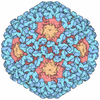
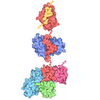

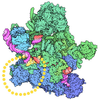

 Z (Sec.)
 Y (Row.)
 X (Col.)





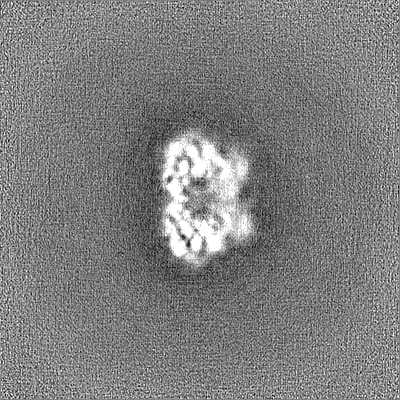



 Sample components
 Escherichia coli (E. coli)
 Spodoptera frugiperda (fall armyworm)
 Processing
 Electron microscopy
 FIELD EMISSION GUN


