peptidyl-lysine trimethylation / microtubule cytoskeleton organization involved in mitosis / [histone H3]-lysine36 N-trimethyltransferase / regulation of mRNA export from nucleus / histone H3K36 trimethyltransferase activity / histone H3K36 methyltransferase activity / nucleosome organization / response to alkaloid / response to type I interferon / protein-lysine N-methyltransferase activity ...peptidyl-lysine trimethylation / microtubule cytoskeleton organization involved in mitosis / [histone H3]-lysine36 N-trimethyltransferase / regulation of mRNA export from nucleus / histone H3K36 trimethyltransferase activity / histone H3K36 methyltransferase activity / nucleosome organization / response to alkaloid / response to type I interferon / protein-lysine N-methyltransferase activity / positive regulation of ossification / regulation of protein localization to chromatin / endodermal cell differentiation / response to metal ion / histone H3 methyltransferase activity / regulation of double-strand break repair via homologous recombination / positive regulation of interferon-alpha production / mismatch repair / alpha-tubulin binding / stem cell differentiation / Replacement of protamines by nucleosomes in the male pronucleus / Packaging Of Telomere Ends / Recognition and association of DNA glycosylase with site containing an affected purine / Cleavage of the damaged purine / positive regulation of autophagy / 転移酵素; 一炭素原子の基を移すもの; メチル基を移すもの / Deposition of new CENPA-containing nucleosomes at the centromere / Recognition and association of DNA glycosylase with site containing an affected pyrimidine / Cleavage of the damaged pyrimidine / RNA Polymerase I Promoter Opening / Inhibition of DNA recombination at telomere / Assembly of the ORC complex at the origin of replication / Meiotic synapsis / Regulation of endogenous retroelements by the Human Silencing Hub (HUSH) complex / regulation of cytokinesis / DNA methylation / Condensation of Prophase Chromosomes / Chromatin modifications during the maternal to zygotic transition (MZT) / SIRT1 negatively regulates rRNA expression / HCMV Late Events / ERCC6 (CSB) and EHMT2 (G9a) positively regulate rRNA expression / PRC2 methylates histones and DNA / Regulation of endogenous retroelements by KRAB-ZFP proteins / Defective pyroptosis / HDACs deacetylate histones / Transcriptional regulation by small RNAs / Regulation of endogenous retroelements by Piwi-interacting RNAs (piRNAs) / RNA Polymerase I Promoter Escape / Nonhomologous End-Joining (NHEJ) / Activated PKN1 stimulates transcription of AR (androgen receptor) regulated genes KLK2 and KLK3 / transcription elongation by RNA polymerase II / RUNX1 regulates genes involved in megakaryocyte differentiation and platelet function / Negative Regulation of CDH1 Gene Transcription / NoRC negatively regulates rRNA expression / G2/M DNA damage checkpoint / PKMTs methylate histone lysines / Formation of the beta-catenin:TCF transactivating complex / B-WICH complex positively regulates rRNA expression / DNA Damage/Telomere Stress Induced Senescence / Meiotic recombination / Pre-NOTCH Transcription and Translation / Activation of anterior HOX genes in hindbrain development during early embryogenesis / Transcriptional regulation of granulopoiesis / Metalloprotease DUBs / RMTs methylate histone arginines / innate immune response in mucosa / HCMV Early Events / structural constituent of chromatin / regulation of gene expression / nucleosome / Regulation of PD-L1(CD274) transcription / UCH proteinases / nucleosome assembly / chromosome / HATs acetylate histones / Recruitment and ATM-mediated phosphorylation of repair and signaling proteins at DNA double strand breaks / MLL4 and MLL3 complexes regulate expression of PPARG target genes in adipogenesis and hepatic steatosis / RUNX1 regulates transcription of genes involved in differentiation of HSCs / Dengue Virus-Host Interactions / Processing of DNA double-strand break ends / Senescence-Associated Secretory Phenotype (SASP) / antimicrobial humoral immune response mediated by antimicrobial peptide / heterochromatin formation / antibacterial humoral response / Oxidative Stress Induced Senescence / chromatin organization / defense response to virus / Estrogen-dependent gene expression / defense response to Gram-positive bacterium / Ub-specific processing proteases / protein heterodimerization activity / Amyloid fiber formation / regulation of DNA-templated transcription / DNA binding / : / extracellular exosome / nucleoplasm / metal ion binding / nucleus / cytoplasm 類似検索 - 分子機能
Histone-lysine N-methyltransferase SETD2, animal / Set2 Rpb1 interacting domain superfamily / SETD2/Set2, SET domain / Set2 Rpb1 interacting domain / SRI (Set2 Rpb1 interacting) domain / AWS domain / AWS domain / AWS domain profile. / associated with SET domains / Cysteine-rich motif following a subset of SET domains ...Histone-lysine N-methyltransferase SETD2, animal / Set2 Rpb1 interacting domain superfamily / SETD2/Set2, SET domain / Set2 Rpb1 interacting domain / SRI (Set2 Rpb1 interacting) domain / AWS domain / AWS domain / AWS domain profile. / associated with SET domains / Cysteine-rich motif following a subset of SET domains / TFIIS/LEDGF domain superfamily / Post-SET domain / Post-SET domain profile. / Histone, subunit A / Histone, subunit A / WW domain / WW/rsp5/WWP domain signature. / SET (Su(var)3-9, Enhancer-of-zeste, Trithorax) domain / WW domain superfamily / WW/rsp5/WWP domain profile. / Domain with 2 conserved Trp (W) residues / SET domain / WW domain / SET domain profile. / SET domain superfamily / SET domain / : / Histone H2A conserved site / Histone H2A signature. / Histone H2B signature. / Histone H2B / Histone H2B / Histone H2A, C-terminal domain / C-terminus of histone H2A / Histone 2A / Histone H2A / Histone H2A/H2B/H3 / Core histone H2A/H2B/H3/H4 domain / Histone-fold / Orthogonal Bundle / Mainly Alpha 類似検索 - ドメイン・相同性
S-ADENOSYLMETHIONINE / DNA / DNA (> 10) / DNA (> 100) / Histone H2A type 1-D / Histone H2B type 2-E / Histone-lysine N-methyltransferase SETD2 類似検索 - 構成要素
National Natural Science Foundation of China (NSFC)
32022036
中国
National Natural Science Foundation of China (NSFC)
31570766
中国
National Natural Science Foundation of China (NSFC)
U1632130
中国
引用
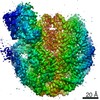
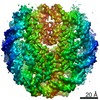
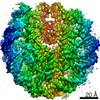
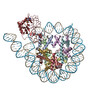
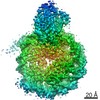
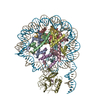
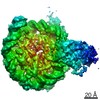
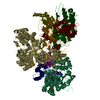
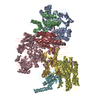
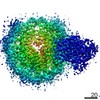
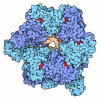
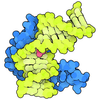
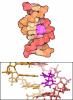
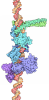
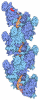
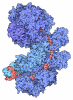
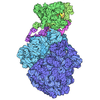
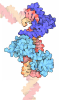
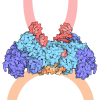
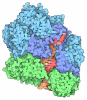
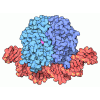
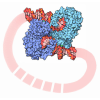
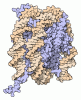
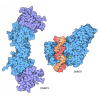
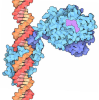
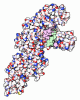
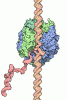
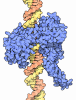
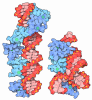
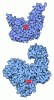
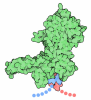
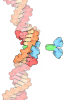
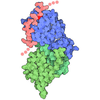
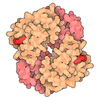
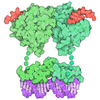
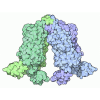
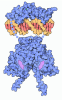
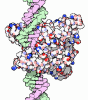
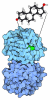
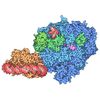
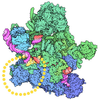
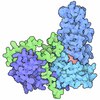
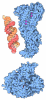
ジャーナル: Cell Discov / 年: 2021 タイトル: Cryo-EM structure of SETD2/Set2 methyltransferase bound to a nucleosome containing oncohistone mutations. 著者: Yingying Liu / Yanjun Zhang / Han Xue / Mi Cao / Guohui Bai / Zongkai Mu / Yanli Yao / Shuyang Sun / Dong Fang / Jing Huang / 要旨: Substitution of lysine 36 with methionine in histone H3.3 (H3.3K36M) is an oncogenic mutation that inhibits SETD2-mediated histone H3K36 tri-methylation in tumors. To investigate how the oncohistone ...Substitution of lysine 36 with methionine in histone H3.3 (H3.3K36M) is an oncogenic mutation that inhibits SETD2-mediated histone H3K36 tri-methylation in tumors. To investigate how the oncohistone mutation affects the function of SETD2 at the nucleosome level, we determined the cryo-EM structure of human SETD2 associated with an H3.3K36M nucleosome and cofactor S-adenosylmethionine (SAM), and revealed that SETD2 is attached to the N-terminal region of histone H3 and the nucleosome DNA at superhelix location 1, accompanied with the partial unwrapping of nucleosome DNA to expose the SETD2-binding site. These structural features were also observed in the previous cryo-EM structure of the fungal Set2-nucleosome complex. By contrast with the stable association of SETD2 with the H3.3K36M nucleosome, the EM densities of SETD2 could not be observed on the wild-type nucleosome surface, suggesting that the association of SETD2 with wild-type nucleosome might be transient. The linker histone H1, which stabilizes the wrapping of nucleosome DNA at the entry/exit sites, exhibits an inhibitory effect on the activities of SETD2 and displays inversely correlated genome distributions with that of the H3K36me3 marks. Cryo-EM analysis of yeast H3K36 methyltransferase Set2 complexed with nucleosomes further revealed evolutionarily conserved structural features for nucleosome recognition in eukaryotes, and provides insights into the mechanism of activity regulation. These findings have advanced our understanding of the structural basis for the tumorigenesis mechanism of the H3.3K36M mutation and highlight the effect of nucleosome conformation on the regulation of histone modification.
 ムービー
ムービー コントローラー


 データを開く
 基本情報
基本情報 要素
要素 キーワード
キーワード 機能・相同性情報
 Homo sapiens (ヒト)
 データ登録者
 中国, 3件
  引用
引用 構造の表示
構造の表示 ダウンロードとリンク
 その他のダウンロード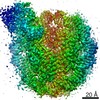


 PDBj
PDBj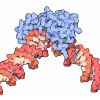

 集合体
集合体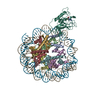

 Escherichia coli BL21(DE3) (大腸菌)
 分子量: 65.409 Da / 分子数: 3 / 由来タイプ: 合成 / 式: Zn
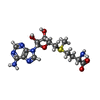
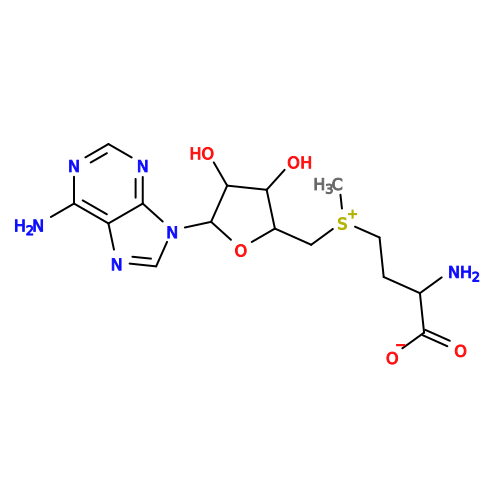 分子量: 398.437 Da / 分子数: 1 / 由来タイプ: 合成 / 式: C15H22N6O5S
 試料調製
試料調製 電子顕微鏡撮影
 FIELD EMISSION GUN / 加速電圧: 300 kV / 照射モード: FLOOD BEAM
 解析
解析