 Movie
Movie Controller

[English] 日本語
 Yorodumi
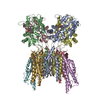
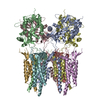
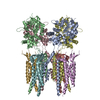
- PDB-5kk2: Architecture of fully occupied GluA2 AMPA receptor - TARP complex... -
+ Open data

- Basic information
| Entry | Database: PDB / ID: 5kk2 | ||||||
|---|---|---|---|---|---|---|---|
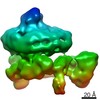
| Title | Architecture of fully occupied GluA2 AMPA receptor - TARP complex elucidated by single particle cryo-electron microscopy | ||||||
 Components Components |
| ||||||
 Keywords Keywords | MEMBRANE PROTEIN / TRANSPORT PROTEIN / SIGNALING PROTEIN / Tetrameric / ionotropic / glutamate receptors / GluA2 - TARP gamma2 complex / fully occupied / antagonist-bound state | ||||||
| Function / homology |  Function and homology information Function and homology informationPresynaptic depolarization and calcium channel opening / eye blink reflex / positive regulation of protein localization to basolateral plasma membrane / positive regulation of AMPA receptor activity / cerebellar mossy fiber / LGI-ADAM interactions / Trafficking of AMPA receptors / postsynaptic neurotransmitter receptor diffusion trapping / membrane hyperpolarization / regulation of AMPA receptor activity ...Presynaptic depolarization and calcium channel opening / eye blink reflex / positive regulation of protein localization to basolateral plasma membrane / positive regulation of AMPA receptor activity / cerebellar mossy fiber / LGI-ADAM interactions / Trafficking of AMPA receptors / postsynaptic neurotransmitter receptor diffusion trapping / membrane hyperpolarization / regulation of AMPA receptor activity / channel regulator activity / protein targeting to membrane / nervous system process / voltage-gated calcium channel complex / regulation of synaptic plasticity by chemical substance / spine synapse / dendritic spine neck / dendritic spine cytoplasm / dendritic spine head / cellular response to amine stimulus / Activation of AMPA receptors / neurotransmitter receptor localization to postsynaptic specialization membrane / ligand-gated monoatomic cation channel activity / perisynaptic space / Trafficking of GluR2-containing AMPA receptors / response to lithium ion / AMPA glutamate receptor activity / AMPA glutamate receptor clustering / regulation of receptor recycling / transmission of nerve impulse / neuromuscular junction development / kainate selective glutamate receptor activity / immunoglobulin binding / AMPA glutamate receptor complex / extracellularly glutamate-gated ion channel activity / ionotropic glutamate receptor complex / membrane depolarization / cellular response to glycine / asymmetric synapse / Unblocking of NMDA receptors, glutamate binding and activation / glutamate receptor binding / positive regulation of synaptic transmission / conditioned place preference / regulation of postsynaptic membrane neurotransmitter receptor levels / regulation of synaptic transmission, glutamatergic / voltage-gated calcium channel activity / response to fungicide / cytoskeletal protein binding / extracellular ligand-gated monoatomic ion channel activity / glutamate-gated receptor activity / cellular response to brain-derived neurotrophic factor stimulus / regulation of long-term synaptic depression / positive regulation of synaptic transmission, glutamatergic / glutamate-gated calcium ion channel activity / somatodendritic compartment / presynaptic active zone membrane / ionotropic glutamate receptor binding / ionotropic glutamate receptor signaling pathway / dendrite cytoplasm / excitatory synapse / ligand-gated monoatomic ion channel activity involved in regulation of presynaptic membrane potential / dendrite membrane / positive regulation of excitatory postsynaptic potential / hippocampal mossy fiber to CA3 synapse / dendritic shaft / SNARE binding / synaptic membrane / PDZ domain binding / calcium channel regulator activity / establishment of protein localization / synaptic transmission, glutamatergic / protein tetramerization / long-term synaptic potentiation / receptor internalization / cerebral cortex development / transmitter-gated monoatomic ion channel activity involved in regulation of postsynaptic membrane potential / response to calcium ion / regulation of membrane potential / postsynaptic density membrane / modulation of chemical synaptic transmission / Schaffer collateral - CA1 synapse / terminal bouton / synaptic vesicle membrane / synaptic vesicle / presynapse / amyloid-beta binding / growth cone / signaling receptor activity / scaffold protein binding / presynaptic membrane / chemical synaptic transmission / dendritic spine / perikaryon / postsynaptic membrane / postsynaptic density / neuron projection / external side of plasma membrane / axon / neuronal cell body / synapse Similarity search - Function | ||||||
| Biological species |   Rattus norvegicus (Norway rat) Rattus norvegicus (Norway rat) | ||||||
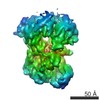
| Method | ELECTRON MICROSCOPY / single particle reconstruction / cryo EM / Resolution: 7.3 Å | ||||||
 Authors Authors | Zhao, Y. / Chen, S. / Yoshioka, C. / Baconguis, I. / Gouaux, E. | ||||||
 Citation Citation | Journal: Nature / Year: 2016 Title: Architecture of fully occupied GluA2 AMPA receptor-TARP complex elucidated by cryo-EM. Abstract: Fast excitatory neurotransmission in the mammalian central nervous system is largely carried out by AMPA-sensitive ionotropic glutamate receptors. Localized within the postsynaptic density of ...Fast excitatory neurotransmission in the mammalian central nervous system is largely carried out by AMPA-sensitive ionotropic glutamate receptors. Localized within the postsynaptic density of glutamatergic spines, AMPA receptors are composed of heterotetrameric receptor assemblies associated with auxiliary subunits, the most common of which are transmembrane AMPA receptor regulatory proteins (TARPs). The association of TARPs with AMPA receptors modulates receptor trafficking and the kinetics of receptor gating and pharmacology. Here we report the cryo-electron microscopy (cryo-EM) structure of the homomeric rat GluA2 AMPA receptor saturated with TARP γ2 subunits, which shows how the TARPs are arranged with four-fold symmetry around the ion channel domain and make extensive interactions with the M1, M2 and M4 transmembrane helices. Poised like partially opened ‘hands’ underneath the two-fold symmetric ligand-binding domain (LBD) 'clamshells', one pair of TARPs is juxtaposed near the LBD dimer interface, whereas the other pair is near the LBD dimer-dimer interface. The extracellular ‘domains’ of TARP are positioned to not only modulate LBD clamshell closure, but also affect conformational rearrangements of the LBD layer associated with receptor activation and desensitization, while the TARP transmembrane domains buttress the ion channel pore. | ||||||
| History |
|
- Structure visualization
| Movie |
Movie viewer |
|---|---|
| Structure viewer | Molecule: MolmilJmol/JSmol |
- Downloads & links
-Download
| PDBx/mmCIF format | 5kk2.cif.gz | 393.1 KB | Display | PDBx/mmCIF format |
|---|---|---|---|---|
| PDB format | pdb5kk2.ent.gz | 265.5 KB | Display | PDB format |
| PDBx/mmJSON format | 5kk2.json.gz | Tree view | PDBx/mmJSON format | |
| Others |  Other downloads Other downloads |
-Validation report
| Arichive directory | https://data.pdbj.org/pub/pdb/validation_reports/kk/5kk2ftp://data.pdbj.org/pub/pdb/validation_reports/kk/5kk2 | HTTPS FTP |
|---|
-Related structure data
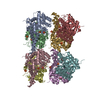
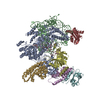
| Related structure data |  8256MC M: map data used to model this data C: citing same article ( |
|---|---|
| Similar structure data |

-Links
 PDBj
PDBj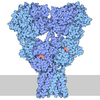
- Assembly
| Deposited unit | 
|
|---|---|
| 1 |
|
-Components
| #1: Protein | Mass: 99530.391 Da / Num. of mol.: 4 Source method: isolated from a genetically manipulated source Source: (gene. exp.) Rattus norvegicus (Norway rat) / Gene: Gria2, Glur2 / Production host:  Homo sapiens (human) / References: UniProt: P19491 Homo sapiens (human) / References: UniProt: P19491#2: Protein | Mass: 35938.746 Da / Num. of mol.: 4 Source method: isolated from a genetically manipulated source Source: (gene. exp.) Rattus norvegicus (Norway rat) / Gene: Cacng2 / Production host: Homo sapiens (human) / References: UniProt: Q71RJ2Has protein modification | Y | |
|---|
-Experimental details
-Experiment
| Experiment | Method: ELECTRON MICROSCOPY |
|---|---|
| EM experiment | Aggregation state: PARTICLE / 3D reconstruction method: single particle reconstruction |
- Sample preparation
| Component | Name: Fully occupied GluA2 AMPA receptor - TARP complex / Type: COMPLEX / Entity ID: all / Source: RECOMBINANT | ||||||||||||||||||||
|---|---|---|---|---|---|---|---|---|---|---|---|---|---|---|---|---|---|---|---|---|---|
| Source (natural) | Organism: Rattus norvegicus (Norway rat) | ||||||||||||||||||||
| Source (recombinant) | Organism: Homo sapiens (human) / Plasmid: pCMVZeocin | ||||||||||||||||||||
| Buffer solution | pH: 8 | ||||||||||||||||||||
| Buffer component |
| ||||||||||||||||||||
| Specimen | Conc.: 3 mg/ml / Embedding applied: NO / Shadowing applied: NO / Staining applied: NO / Vitrification applied: YES | ||||||||||||||||||||
| Vitrification | Cryogen name: ETHANE / Humidity: 100 % / Chamber temperature: 295 K |
- Electron microscopy imaging
| Experimental equipment |  Model: Titan Krios / Image courtesy: FEI Company |
|---|---|
| Microscopy | Model: FEI TITAN KRIOS |
| Electron gun | Electron source:  FIELD EMISSION GUN / Accelerating voltage: 300 kV / Illumination mode: FLOOD BEAM FIELD EMISSION GUN / Accelerating voltage: 300 kV / Illumination mode: FLOOD BEAM |
| Electron lens | Mode: BRIGHT FIELD |
| Image recording | Electron dose: 55 e/Å2 / Detector mode: SUPER-RESOLUTION / Film or detector model: GATAN K2 SUMMIT (4k x 4k) |
- Processing
| EM software |
| ||||||||||||||||||
|---|---|---|---|---|---|---|---|---|---|---|---|---|---|---|---|---|---|---|---|
| CTF correction | Type: PHASE FLIPPING AND AMPLITUDE CORRECTION | ||||||||||||||||||
| 3D reconstruction | Resolution: 7.3 Å / Resolution method: FSC 0.143 CUT-OFF / Num. of particles: 26297 / Symmetry type: POINT | ||||||||||||||||||
| Atomic model building | Protocol: RIGID BODY FIT / Space: REAL |
