 Movie
Movie Controller

[English] 日本語
 Yorodumi
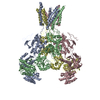
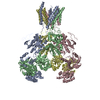
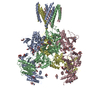
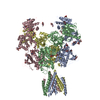
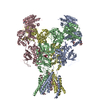
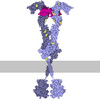
- PDB-5fxi: GluN1b-GluN2B NMDA receptor structure in non-active-2 conformation -
+ Open data

- Basic information
| Entry | Database: PDB / ID: 5fxi | ||||||
|---|---|---|---|---|---|---|---|
| Title | GluN1b-GluN2B NMDA receptor structure in non-active-2 conformation | ||||||
 Components Components |
| ||||||
 Keywords Keywords | TRANSPORT PROTEIN / SIGNALING PROTEIN / NMDA RECEPTOR / GLUTAMATE RECEPTOR / GLUN1 / GLUN2B / ION CHANNEL | ||||||
| Function / homology |  Function and homology information Function and homology informationcellular response to corticosterone stimulus / cellular response to magnesium starvation / trigeminal motor nucleus development / sensory organ development / sensitization / cellular response to curcumin / auditory behavior / response to carbohydrate / pons maturation / regulation of cAMP/PKA signal transduction ...cellular response to corticosterone stimulus / cellular response to magnesium starvation / trigeminal motor nucleus development / sensory organ development / sensitization / cellular response to curcumin / auditory behavior / response to carbohydrate / pons maturation / regulation of cAMP/PKA signal transduction / fear response / EPHB-mediated forward signaling / positive regulation of Schwann cell migration / Assembly and cell surface presentation of NMDA receptors / protein localization to postsynaptic membrane / regulation of cell communication / conditioned taste aversion / suckling behavior / olfactory learning / response to other organism / response to hydrogen sulfide / response to methylmercury / dendritic branch / regulation of ARF protein signal transduction / positive regulation of mitochondrial calcium ion concentration / cellular response to dsRNA / response to manganese ion / response to glycoside / apical dendrite / ciliary transition zone / transmitter-gated monoatomic ion channel activity / interleukin-1 receptor binding / cellular response to lipid / regulation of respiratory gaseous exchange / propylene metabolic process / response to glycine / response to growth hormone / neurotransmitter receptor complex / heterocyclic compound binding / positive regulation of inhibitory postsynaptic potential / RAF/MAP kinase cascade / response to amine / Synaptic adhesion-like molecules / negative regulation of dendritic spine maintenance / NMDA glutamate receptor activity / regulation of monoatomic cation transmembrane transport / neuromuscular process / NMDA selective glutamate receptor complex / glutamate binding / regulation of axonogenesis / behavioral fear response / ligand-gated sodium channel activity / startle response / voltage-gated monoatomic cation channel activity / regulation of synapse assembly / positive regulation of glutamate secretion / calcium ion transmembrane import into cytosol / response to morphine / positive regulation of reactive oxygen species biosynthetic process / male mating behavior / protein heterotetramerization / regulation of dendrite morphogenesis / behavioral response to pain / small molecule binding / receptor clustering / glycine binding / parallel fiber to Purkinje cell synapse / positive regulation of calcium ion transport into cytosol / associative learning / hypothalamus development / social behavior / regulation of neuronal synaptic plasticity / response to electrical stimulus / regulation of MAPK cascade / regulation of postsynaptic membrane potential / multicellular organismal response to stress / action potential / extracellularly glutamate-gated ion channel activity / monoatomic cation transmembrane transport / positive regulation of dendritic spine maintenance / detection of mechanical stimulus involved in sensory perception of pain / cellular response to glycine / Unblocking of NMDA receptors, glutamate binding and activation / response to mechanical stimulus / response to fungicide / monoatomic cation transport / calcium ion homeostasis / glutamate receptor binding / response to magnesium ion / prepulse inhibition / long-term memory / adult locomotory behavior / phosphatase binding / regulation of long-term neuronal synaptic plasticity / postsynaptic density, intracellular component / ciliary tip / monoatomic cation channel activity / response to amphetamine / glutamate-gated receptor activity / cellular response to manganese ion Similarity search - Function | ||||||
| Biological species |   RATTUS NORVEGICUS (Norway rat) RATTUS NORVEGICUS (Norway rat) | ||||||
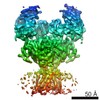
| Method | ELECTRON MICROSCOPY / single particle reconstruction / cryo EM / Resolution: 6.4 Å | ||||||
 Authors Authors | Tajima, N. / Karakas, E. / Grant, T. / Simorowski, N. / Diaz-Avalos, R. / Grigorieff, N. / Furukawa, H. | ||||||
 Citation Citation | Journal: Nature / Year: 2016 Title: Activation of NMDA receptors and the mechanism of inhibition by ifenprodil. Authors: Nami Tajima / Erkan Karakas / Timothy Grant / Noriko Simorowski / Ruben Diaz-Avalos / Nikolaus Grigorieff / Hiro Furukawa /  Abstract: The physiology of N-methyl-d-aspartate (NMDA) receptors is fundamental to brain development and function. NMDA receptors are ionotropic glutamate receptors that function as heterotetramers composed ...The physiology of N-methyl-d-aspartate (NMDA) receptors is fundamental to brain development and function. NMDA receptors are ionotropic glutamate receptors that function as heterotetramers composed mainly of GluN1 and GluN2 subunits. Activation of NMDA receptors requires binding of neurotransmitter agonists to a ligand-binding domain (LBD) and structural rearrangement of an amino-terminal domain (ATD). Recent crystal structures of GluN1-GluN2B NMDA receptors bound to agonists and an allosteric inhibitor, ifenprodil, represent the allosterically inhibited state. However, how the ATD and LBD move to activate the NMDA receptor ion channel remains unclear. Here we applied X-ray crystallography, single-particle electron cryomicroscopy and electrophysiology to rat NMDA receptors to show that, in the absence of ifenprodil, the bi-lobed structure of GluN2 ATD adopts an open conformation accompanied by rearrangement of the GluN1-GluN2 ATD heterodimeric interface, altering subunit orientation in the ATD and LBD and forming an active receptor conformation that gates the ion channel. | ||||||
| History |
|
- Structure visualization
| Movie |
Movie viewer |
|---|---|
| Structure viewer | Molecule: MolmilJmol/JSmol |
- Downloads & links
-Download
| PDBx/mmCIF format | 5fxi.cif.gz | 429.7 KB | Display | PDBx/mmCIF format |
|---|---|---|---|---|
| PDB format | pdb5fxi.ent.gz | 278.8 KB | Display | PDB format |
| PDBx/mmJSON format | 5fxi.json.gz | Tree view | PDBx/mmJSON format | |
| Others |  Other downloads Other downloads |
-Validation report
| Arichive directory | https://data.pdbj.org/pub/pdb/validation_reports/fx/5fxiftp://data.pdbj.org/pub/pdb/validation_reports/fx/5fxi | HTTPS FTP |
|---|
-Related structure data
| Related structure data | 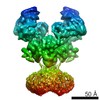 3354MC 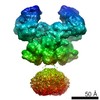 3352C 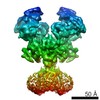 3353C 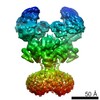 3355C 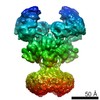 3356C 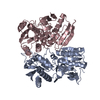 5b3jC 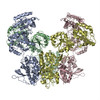 5fxgC 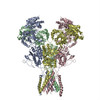 5fxhC 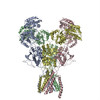 5fxjC 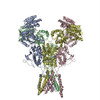 5fxkC C: citing same article ( M: map data used to model this data |
|---|---|
| Similar structure data |
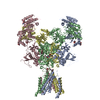
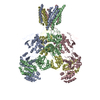
-Links
 PDBj
PDBj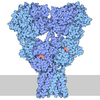

- Assembly
| Deposited unit | 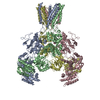
|
|---|---|
| 1 |
|
-Components
| #1: Protein | Mass: 95220.727 Da / Num. of mol.: 2 / Fragment: UNP RESIDUES 23-868 / Mutation: YES Source method: isolated from a genetically manipulated source Source: (gene. exp.) RATTUS NORVEGICUS (Norway rat) / Plasmid: MODIFIED PFL AND PUCDM / Cell line (production host): SF9 / Production host:   SPODOPTERA FRUGIPERDA (fall armyworm) / References: UniProt: P35439 SPODOPTERA FRUGIPERDA (fall armyworm) / References: UniProt: P35439#2: Protein | Mass: 92931.078 Da / Num. of mol.: 2 / Fragment: UNP RESIDUES 27-852 / Mutation: YES Source method: isolated from a genetically manipulated source Source: (gene. exp.) RATTUS NORVEGICUS (Norway rat) / Plasmid: MODIFIED PFL AND PUCDM / Cell line (production host): SF9 / Production host: SPODOPTERA FRUGIPERDA (fall armyworm) / References: UniProt: Q00960 |
|---|
-Experimental details
-Experiment
| Experiment | Method: ELECTRON MICROSCOPY |
|---|---|
| EM experiment | Aggregation state: PARTICLE / 3D reconstruction method: single particle reconstruction |
- Sample preparation
| Component | Name: NMDA RECEPTOR / Type: COMPLEX |
|---|---|
| Buffer solution | Name: 200 MM NACL, 20 MM HEPES PH 7.0, 10 MM GLYCINE, 10 MM L-GLUTAMATE, 0.002 % MNG-3 pH: 7 Details: 200 MM NACL, 20 MM HEPES PH 7.0, 10 MM GLYCINE, 10 MM L-GLUTAMATE, 0.002 % MNG-3 |
| Specimen | Conc.: 2 mg/ml / Embedding applied: NO / Shadowing applied: NO / Staining applied: NO / Vitrification applied: YES |
| Specimen support | Details: HOLEY CARBON |
| Vitrification | Instrument: FEI VITROBOT MARK II / Cryogen name: ETHANE / Details: ETHANE |
- Electron microscopy imaging
| Experimental equipment |  Model: Titan Krios / Image courtesy: FEI Company |
|---|---|
| Microscopy | Model: FEI TITAN KRIOS / Date: Aug 10, 2015 |
| Electron gun | Electron source:  FIELD EMISSION GUN / Accelerating voltage: 300 kV / Illumination mode: FLOOD BEAM FIELD EMISSION GUN / Accelerating voltage: 300 kV / Illumination mode: FLOOD BEAM |
| Electron lens | Mode: BRIGHT FIELD / Nominal magnification: 22500 X / Nominal defocus max: 2500 nm / Nominal defocus min: 1000 nm |
| Image recording | Electron dose: 100 e/Å2 / Film or detector model: GATAN K2 SUMMIT (4k x 4k) |
- Processing
| EM software |
| ||||||||||||||||||||
|---|---|---|---|---|---|---|---|---|---|---|---|---|---|---|---|---|---|---|---|---|---|
| CTF correction | Details: EACH PARTICLE | ||||||||||||||||||||
| Symmetry | Point symmetry: C2 (2 fold cyclic) | ||||||||||||||||||||
| 3D reconstruction | Resolution: 6.4 Å / Num. of particles: 16000 Details: IDE CHAINS WERE EXCLUDED FROM THE MODEL SUBMISSION BASED ON EXPERIMENTAL DATA FROM EMDB EMD-3354. (DEPOSITION ID: 14324). Symmetry type: POINT | ||||||||||||||||||||
| Atomic model building | Protocol: OTHER / Space: REAL / Target criteria: REAL SPACE / Details: METHOD--REAL SPACE | ||||||||||||||||||||
| Refinement | Highest resolution: 6.4 Å | ||||||||||||||||||||
| Refinement step | Cycle: LAST / Highest resolution: 6.4 Å
|
