- PDB-4wnm: SYK catalytic domain in complex with a potent triazolopyridine in... -
+
Open data
ID or keywords:
Loading...
-
Basic information
Entry
Database: PDB / ID: 4wnm
Title
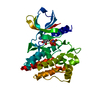
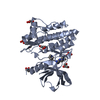
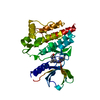
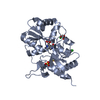
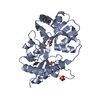
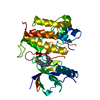
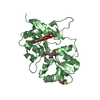
SYK catalytic domain in complex with a potent triazolopyridine inhibitor
Components
Tyrosine-protein kinase SYK
Keywords
TRANSFERASE/TRANSFERASE INHIBITOR / SYK catalytic domain in complex with a potent triazolopyridine based inhibitor / TRANSFERASE-TRANSFERASE INHIBITOR complex
Function / homology
Function and homology information
interleukin-15 receptor binding / regulation of superoxide anion generation / regulation of neutrophil degranulation / regulation of arachidonate secretion / lymph vessel development / cellular response to lectin / B cell receptor complex / serotonin secretion by platelet / regulation of platelet aggregation / Toll-like receptor binding ...interleukin-15 receptor binding / regulation of superoxide anion generation / regulation of neutrophil degranulation / regulation of arachidonate secretion / lymph vessel development / cellular response to lectin / B cell receptor complex / serotonin secretion by platelet / regulation of platelet aggregation / Toll-like receptor binding / neutrophil activation involved in immune response / leukocyte activation involved in immune response / positive regulation of toll-like receptor 9 signaling pathway / cell surface pattern recognition receptor signaling pathway / cell activation / regulation of platelet activation / FLT3 signaling through SRC family kinases / blood vessel morphogenesis / regulation of phagocytosis / early phagosome / macrophage activation involved in immune response / cellular response to molecule of fungal origin / positive regulation of monocyte chemotactic protein-1 production / interleukin-3-mediated signaling pathway / positive regulation of bone resorption / Fc epsilon receptor (FCERI) signaling / Interleukin-2 signaling / positive regulation of cell adhesion mediated by integrin / regulation of tumor necrosis factor-mediated signaling pathway / cellular response to lipid / positive regulation of cGAS/STING signaling pathway / T cell receptor complex / positive regulation of B cell differentiation / leukocyte cell-cell adhesion / positive regulation of interleukin-4 production / Dectin-2 family / stimulatory C-type lectin receptor signaling pathway / Fc-gamma receptor signaling pathway involved in phagocytosis / Fc-epsilon receptor signaling pathway / amyloid-beta clearance / FCGR activation / positive regulation of interleukin-10 production / positive regulation of receptor internalization / Role of LAT2/NTAL/LAB on calcium mobilization / cellular response to low-density lipoprotein particle stimulus / regulation of ERK1 and ERK2 cascade / Role of phospholipids in phagocytosis / positive regulation of interleukin-12 production / phosphatase binding / GPVI-mediated activation cascade / neutrophil chemotaxis / phospholipase binding / Signaling by CSF3 (G-CSF) / positive regulation of superoxide anion generation / Integrin signaling / positive regulation of type I interferon production / phosphotyrosine residue binding / animal organ morphogenesis / peptidyl-tyrosine phosphorylation / FCERI mediated Ca+2 mobilization / SH2 domain binding / B cell receptor signaling pathway / positive regulation of TORC1 signaling / FCGR3A-mediated IL10 synthesis / integrin-mediated signaling pathway / apoptotic signaling pathway / Antigen activates B Cell Receptor (BCR) leading to generation of second messengers / protein import into nucleus / positive regulation of interleukin-8 production / non-specific protein-tyrosine kinase / FCGR3A-mediated phagocytosis / FCERI mediated MAPK activation / negative regulation of inflammatory response to antigenic stimulus / non-membrane spanning protein tyrosine kinase activity / Regulation of signaling by CBL / platelet activation / receptor internalization / positive regulation of protein-containing complex assembly / Regulation of actin dynamics for phagocytic cup formation / positive regulation of interleukin-6 production / Inactivation of CSF3 (G-CSF) signaling / integrin binding / kinase activity / cellular response to amyloid-beta / CLEC7A (Dectin-1) signaling / adaptive immune response / positive regulation of inflammatory response / positive regulation of tumor necrosis factor production / DAP12 signaling / positive regulation of cold-induced thermogenesis / protein tyrosine kinase activity / scaffold protein binding / Potential therapeutics for SARS / defense response to bacterium / protein kinase activity / innate immune response / protein phosphorylation / intracellular signal transduction / signaling receptor binding / protein serine/threonine kinase activity Similarity search - Function
In the structure databanks used in Yorodumi, some data are registered as the other names, "COVID-19 virus" and "2019-nCoV". Here are the details of the virus and the list of structure data.
Jan 31, 2019. EMDB accession codes are about to change! (news from PDBe EMDB page)
EMDB accession codes are about to change! (news from PDBe EMDB page)
The allocation of 4 digits for EMDB accession codes will soon come to an end. Whilst these codes will remain in use, new EMDB accession codes will include an additional digit and will expand incrementally as the available range of codes is exhausted. The current 4-digit format prefixed with “EMD-” (i.e. EMD-XXXX) will advance to a 5-digit format (i.e. EMD-XXXXX), and so on. It is currently estimated that the 4-digit codes will be depleted around Spring 2019, at which point the 5-digit format will come into force.
The EM Navigator/Yorodumi systems omit the EMD- prefix.
Related info.:Q: What is EMD? / ID/Accession-code notation in Yorodumi/EM Navigator
Yorodumi is a browser for structure data from EMDB, PDB, SASBDB, etc.
This page is also the successor to EM Navigator detail page, and also detail information page/front-end page for Omokage search.
The word "yorodu" (or yorozu) is an old Japanese word meaning "ten thousand". "mi" (miru) is to see.
Related info.:EMDB / PDB / SASBDB / Comparison of 3 databanks / Yorodumi Search / Aug 31, 2016. New EM Navigator & Yorodumi / Yorodumi Papers / Jmol/JSmol / Function and homology information / Changes in new EM Navigator and Yorodumi
 Movie
Movie Controller

 Yorodumi
 Open data
 Basic information
 Components
 Keywords
 Function and homology information
 Homo sapiens (human)
 X-RAY DIFFRACTION /
  Authors
 Citation
 Structure visualization
 Downloads & links
 Other downloads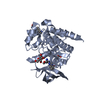
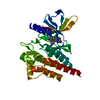

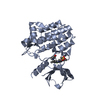
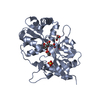
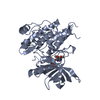
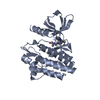


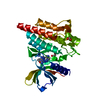
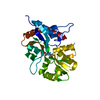


 PDBj
PDBj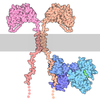
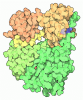

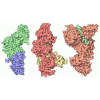
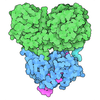
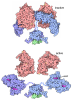
 Assembly

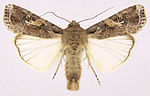 Spodoptera frugiperda (fall armyworm)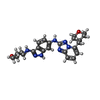
 Mass: 447.533 Da / Num. of mol.: 1 / Source method: obtained synthetically / Formula: C24H29N7O2
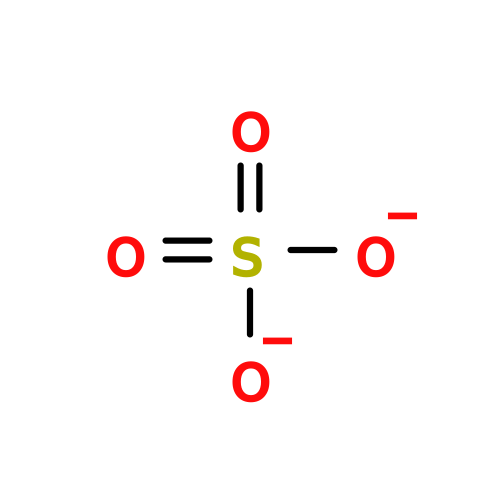 Mass: 96.063 Da / Num. of mol.: 1 / Source method: obtained synthetically / Formula: SO4
 Mass: 18.015 Da / Num. of mol.: 16 / Source method: isolated from a natural source / Formula: H2O
 Sample preparation
 / Beamline: 5.0.2 / Wavelength: 1 Å
 Processing