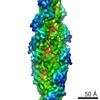
 Movie
Movie Controller


+ Open data

- Basic information
| Entry | Database: PDB / ID: 3lue | ||||||
|---|---|---|---|---|---|---|---|
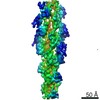
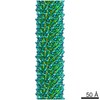
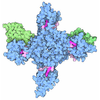
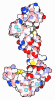
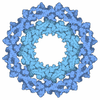
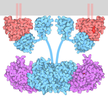
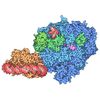
| Title | Model of alpha-actinin CH1 bound to F-actin | ||||||
 Components Components |
| ||||||
 Keywords Keywords | STRUCTURAL PROTEIN / calponin homology domains / Acetylation / ATP-binding / Cytoplasm / Cytoskeleton / Methylation / Nucleotide-binding / Phosphoprotein / Actin-binding / Calcium / Polymorphism / Deafness / Disease mutation / Dystonia | ||||||
| Function / homology |  Function and homology information Function and homology informationpositive regulation of glucose catabolic process to lactate via pyruvate / negative regulation of relaxation of muscle / positive regulation of skeletal muscle fiber development / skeletal muscle atrophy / transition between fast and slow fiber / regulation of the force of skeletal muscle contraction / positive regulation of skeletal muscle tissue growth / positive regulation of fast-twitch skeletal muscle fiber contraction / response to denervation involved in regulation of muscle adaptation / positive regulation of norepinephrine uptake ...positive regulation of glucose catabolic process to lactate via pyruvate / negative regulation of relaxation of muscle / positive regulation of skeletal muscle fiber development / skeletal muscle atrophy / transition between fast and slow fiber / regulation of the force of skeletal muscle contraction / positive regulation of skeletal muscle tissue growth / positive regulation of fast-twitch skeletal muscle fiber contraction / response to denervation involved in regulation of muscle adaptation / positive regulation of norepinephrine uptake / positive regulation of bone mineralization involved in bone maturation / focal adhesion assembly / cellular response to cytochalasin B / Formation of the embryonic stem cell BAF (esBAF) complex / regulation of transepithelial transport / Formation of the canonical BAF (cBAF) complex / morphogenesis of a polarized epithelium / Formation of annular gap junctions / Formation of the dystrophin-glycoprotein complex (DGC) / Formation of the polybromo-BAF (pBAF) complex / structural constituent of postsynaptic actin cytoskeleton / Gap junction degradation / GBP-mediated host defense / Formation of neuronal progenitor and neuronal BAF (npBAF and nBAF) / protein localization to adherens junction / muscle cell development / Formation of the non-canonical BAF (ncBAF) complex / negative regulation of oxidative phosphorylation / Cell-extracellular matrix interactions / regulation of G0 to G1 transition / dense body / Tat protein binding / negative regulation of calcineurin-NFAT signaling cascade / Folding of actin by CCT/TriC / Striated Muscle Contraction / bone morphogenesis / Regulation of CDH1 Function / postsynaptic actin cytoskeleton / apical protein localization / Nephrin family interactions / Adherens junctions interactions / Prefoldin mediated transfer of substrate to CCT/TriC / microtubule nucleation / RHOF GTPase cycle / adherens junction assembly / regulation of double-strand break repair / negative regulation of cold-induced thermogenesis / Sensory processing of sound by outer hair cells of the cochlea / tight junction / positive regulation of T cell differentiation / regulation of mitotic metaphase/anaphase transition / Sensory processing of sound by inner hair cells of the cochlea / regulation of aerobic respiration / structural constituent of muscle / maintenance of blood-brain barrier / Interaction between L1 and Ankyrins / negative regulation of glycolytic process / apical junction complex / cortical actin cytoskeleton / cell projection / regulation of nucleotide-excision repair / positive regulation of stem cell population maintenance / NuA4 histone acetyltransferase complex / regulation of norepinephrine uptake / transporter regulator activity / Recycling pathway of L1 / positive regulation of double-strand break repair / cortical cytoskeleton / Regulation of MITF-M-dependent genes involved in pigmentation / pseudopodium / establishment or maintenance of cell polarity / negative regulation of cell differentiation / nitric-oxide synthase binding / brush border / EPH-ephrin mediated repulsion of cells / RHO GTPases Activate WASPs and WAVEs / regulation of synaptic vesicle endocytosis / positive regulation of myoblast differentiation / kinesin binding / regulation of protein localization to plasma membrane / RHO GTPases activate IQGAPs / positive regulation of double-strand break repair via homologous recombination / regulation of G1/S transition of mitotic cell cycle / axonogenesis / cytoskeleton organization / EPHB-mediated forward signaling / substantia nigra development / cell motility / calyx of Held / nitric-oxide synthase regulator activity / FCGR3A-mediated phagocytosis / adherens junction / actin filament / positive regulation of cell differentiation / Translocation of SLC2A4 (GLUT4) to the plasma membrane / Regulation of endogenous retroelements by Piwi-interacting RNAs (piRNAs) / RHO GTPases Activate Formins / Signaling by high-kinase activity BRAF mutants / MAP2K and MAPK activation / Regulation of actin dynamics for phagocytic cup formation Similarity search - Function | ||||||
| Biological species |  Homo sapiens (human) Homo sapiens (human) | ||||||
| Method | ELECTRON MICROSCOPY / helical reconstruction / cryo EM / Resolution: 15 Å | ||||||
 Authors Authors | Galkin, V.E. / Orlova, A. / Salmazo, A. / Djinovic-Carugo, K. / Egelman, E.H. | ||||||
 Citation Citation | Journal: Nat Struct Mol Biol / Year: 2010 Title: Opening of tandem calponin homology domains regulates their affinity for F-actin. Authors: Vitold E Galkin / Albina Orlova / Anita Salmazo / Kristina Djinovic-Carugo / Edward H Egelman /  Abstract: Many actin-binding proteins contain calponin homology (CH) domains, but the manner in which these domains interact with F-actin has been controversial. Crystal structures have shown the tandem CH ...Many actin-binding proteins contain calponin homology (CH) domains, but the manner in which these domains interact with F-actin has been controversial. Crystal structures have shown the tandem CH domains of alpha-actinin to be in a compact, closed conformation, but the interpretations of complexes of such tandem CH domains with F-actin have been ambiguous. We show that the tandem CH domains of alpha-actinin bind F-actin in an open conformation, explaining mutations that cause human diseases and suggesting that the opening of these domains may be one of the main regulatory mechanisms for proteins with tandem CH domains. | ||||||
| History |
|
- Structure visualization
| Movie |
Movie viewer |
|---|---|
| Structure viewer | Molecule: MolmilJmol/JSmol |
- Downloads & links
-Download
| PDBx/mmCIF format | 3lue.cif.gz | 824.1 KB | Display | PDBx/mmCIF format |
|---|---|---|---|---|
| PDB format | pdb3lue.ent.gz | 640.8 KB | Display | PDB format |
| PDBx/mmJSON format | 3lue.json.gz | Tree view | PDBx/mmJSON format | |
| Others |  Other downloads Other downloads |
-Validation report
| Arichive directory | https://data.pdbj.org/pub/pdb/validation_reports/lu/3lueftp://data.pdbj.org/pub/pdb/validation_reports/lu/3lue | HTTPS FTP |
|---|
-Related structure data
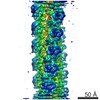
| Related structure data | 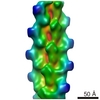 5170MC M: map data used to model this data C: citing same article ( |
|---|---|
| Similar structure data |
-Links
 PDBj
PDBj


- Assembly
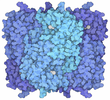
| Deposited unit | 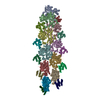
|
|---|---|
| 1 |
|
| Details | Authors state that the model is from a continuous helix where the rotation per subunit is -167.2 degrees and the rise per subunit is 26.6 Angstroms. |
-Components
| #1: Protein | Mass: 41651.465 Da / Num. of mol.: 10 Source method: isolated from a genetically manipulated source Source: (gene. exp.) Homo sapiens (human) / Gene: ACTB / Production host:   Escherichia coli (E. coli) / References: UniProt: P60709 Escherichia coli (E. coli) / References: UniProt: P60709#2: Protein | Mass: 12471.712 Da / Num. of mol.: 10 Source method: isolated from a genetically manipulated source Source: (gene. exp.) Homo sapiens (human) / Gene: ACTN3 / Production host: Escherichia coli (E. coli) / References: UniProt: Q08043 |
|---|
-Experimental details
-Experiment
| Experiment | Method: ELECTRON MICROSCOPY |
|---|---|
| EM experiment | Aggregation state: FILAMENT / 3D reconstruction method: helical reconstruction |
- Sample preparation
| Component |
| ||||||||||||||||||
|---|---|---|---|---|---|---|---|---|---|---|---|---|---|---|---|---|---|---|---|
| Specimen | Embedding applied: NO / Shadowing applied: NO / Staining applied: NO / Vitrification applied: YES | ||||||||||||||||||
| Vitrification | Cryogen name: ETHANE |
- Electron microscopy imaging
| Experimental equipment | 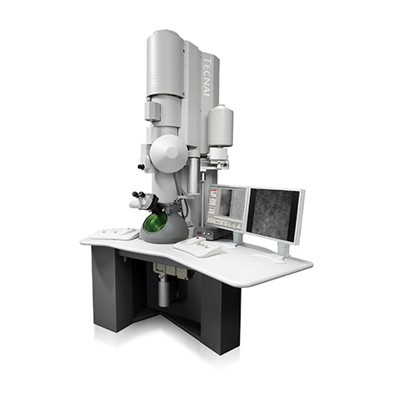 Model: Tecnai F20 / Image courtesy: FEI Company |
|---|---|
| Microscopy | Model: FEI TECNAI F20 |
| Electron gun | Electron source:  FIELD EMISSION GUN / Accelerating voltage: 200 kV / Illumination mode: FLOOD BEAM FIELD EMISSION GUN / Accelerating voltage: 200 kV / Illumination mode: FLOOD BEAM |
| Electron lens | Mode: BRIGHT FIELD / Nominal magnification: 50000 X / Camera length: 0 mm |
| Specimen holder | Specimen holder model: GATAN LIQUID NITROGEN / Specimen holder type: gatan 626 / Tilt angle max: 0 ° / Tilt angle min: 0 ° |
| Image recording | Film or detector model: KODAK SO-163 FILM |
| Image scans | Sampling size: 12.7 µm / Scanner model: NIKON COOLSCAN |
- Processing
| EM software |
| ||||||||||||
|---|---|---|---|---|---|---|---|---|---|---|---|---|---|
| CTF correction | Details: Weiner filter | ||||||||||||
| Helical symmerty | Angular rotation/subunit: 166.8 ° / Axial rise/subunit: 27.7 Å / Axial symmetry: C1 | ||||||||||||
| 3D reconstruction | Method: back projection / Resolution: 15 Å / Resolution method: FSC 0.5 CUT-OFF / Nominal pixel size: 2.38 Å / Actual pixel size: 2.38 Å Details: AUTHORS STATE THAT THE STRANGE C-N BONDS WERE THE RESULT OF BREAKING THE CHAINS AT THESE POINTS TO DO RIGID BODY FITTING OF THE SUBDOMAINS. Symmetry type: HELICAL | ||||||||||||
| Atomic model building | Protocol: OTHER / Space: REAL Details: METHOD--both manually and with Chimera DETAILS--AUTHORS STATE THAT THE STRANGE C-N BONDS WERE THE RESULT OF BREAKING THE CHAINS AT THESE POINTS TO DO RIGID BODY FITTING OF THE SUBDOMAINS. | ||||||||||||
| Refinement step | Cycle: LAST
|
