Journal: J Mol Biol / Year: 2014 Title: Identification of the active sites in the methyltransferases of a transcribing dsRNA virus. Authors: Bin Zhu / Chongwen Yang / Hongrong Liu / Lingpeng Cheng / Feng Song / Songjun Zeng / Xiaojun Huang / Gang Ji / Ping Zhu / Abstract: Many double-stranded RNA (dsRNA) viruses are capable of transcribing and capping RNA within a stable icosahedral viral capsid. The turret of turreted dsRNA viruses belonging to the family Reoviridae ...Many double-stranded RNA (dsRNA) viruses are capable of transcribing and capping RNA within a stable icosahedral viral capsid. The turret of turreted dsRNA viruses belonging to the family Reoviridae is formed by five copies of the turret protein, which contains domains with both 7-N-methyltransferase and 2'-O-methyltransferase activities, and serves to catalyze the methylation reactions during RNA capping. Cypovirus of the family Reoviridae provides a good model system for studying the methylation reactions in dsRNA viruses. Here, we present the structure of a transcribing cypovirus to a resolution of ~3.8Å by cryo-electron microscopy. The binding sites for both S-adenosyl-L-methionine and RNA in the two methyltransferases of the turret were identified. Structural analysis of the turret in complex with RNA revealed a pathway through which the RNA molecule reaches the active sites of the two methyltransferases before it is released into the cytoplasm. The pathway shows that RNA capping reactions occur in the active sites of different turret protein monomers, suggesting that RNA capping requires concerted efforts by at least three turret protein monomers. Thus, the turret structure provides novel insights into the precise mechanisms of RNA methylation.
In the structure databanks used in Yorodumi, some data are registered as the other names, "COVID-19 virus" and "2019-nCoV". Here are the details of the virus and the list of structure data.
Jan 31, 2019. EMDB accession codes are about to change! (news from PDBe EMDB page)
EMDB accession codes are about to change! (news from PDBe EMDB page)
The allocation of 4 digits for EMDB accession codes will soon come to an end. Whilst these codes will remain in use, new EMDB accession codes will include an additional digit and will expand incrementally as the available range of codes is exhausted. The current 4-digit format prefixed with “EMD-” (i.e. EMD-XXXX) will advance to a 5-digit format (i.e. EMD-XXXXX), and so on. It is currently estimated that the 4-digit codes will be depleted around Spring 2019, at which point the 5-digit format will come into force.
The EM Navigator/Yorodumi systems omit the EMD- prefix.
Related info.:Q: What is EMD? / ID/Accession-code notation in Yorodumi/EM Navigator
Yorodumi is a browser for structure data from EMDB, PDB, SASBDB, etc.
This page is also the successor to EM Navigator detail page, and also detail information page/front-end page for Omokage search.
The word "yorodu" (or yorozu) is an old Japanese word meaning "ten thousand". "mi" (miru) is to see.
Related info.:EMDB / PDB / SASBDB / Comparison of 3 databanks / Yorodumi Search / Aug 31, 2016. New EM Navigator & Yorodumi / Yorodumi Papers / Jmol/JSmol / Function and homology information / Changes in new EM Navigator and Yorodumi
 Movie
Movie Controller

 Yorodumi
 Open data
 Basic information
 Components
 Keywords
 Function and homology information
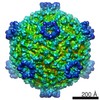 Bombyx mori cypovirus 1
 Authors
 Citation
 Structure visualization
 Downloads & links
 Other downloads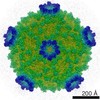
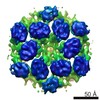
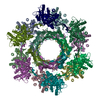
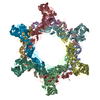
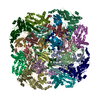
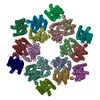
 PDBj
PDBj Assembly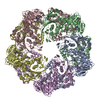
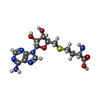
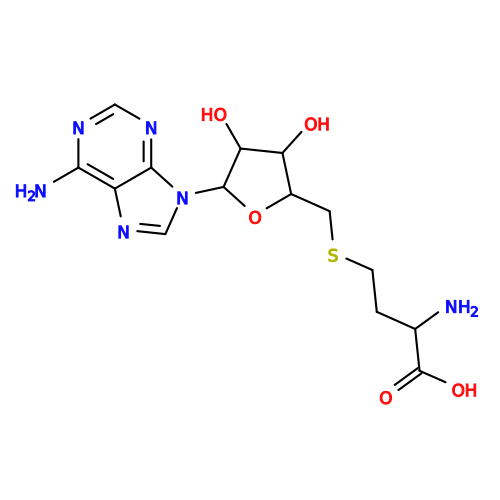 Mass: 384.411 Da / Num. of mol.: 10 / Source method: obtained synthetically / Formula: C14H20N6O5S
 Sample preparation
 Electron microscopy imaging
 FIELD EMISSION GUN / Accelerating voltage: 300 kV / Illumination mode: OTHER
 Processing