Resolution: 1.6→1.64 Å / Redundancy: 1.9 % / Mean I/σ(I) obs: 3.04 / Num. unique obs: 1958 / Rsym value: 0.261 / % possible all: 65.6
-
Processing
Software
Name
Version
Classification
PHENIX
(phenix.refine)
refinement
SERGUI
datacollection
HKL-2000
datareduction
HKL-2000
datascaling
PHASER
phasing
Refinement
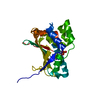
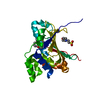
Method to determine structure: MOLECULAR REPLACEMENT / Resolution: 1.6→53.074 Å / SU ML: 0.19 / Isotropic thermal model: isotropic / Cross valid method: THROUGHOUT / σ(F): -3 / Phase error: 19.67 / Stereochemistry target values: Engh & Huber Details: (A) There is weak density for the compound in the binding site. Although the density for the chloro-benzene group is quite strong, the density for the benzisoxazole group becomes weak ...Details: (A) There is weak density for the compound in the binding site. Although the density for the chloro-benzene group is quite strong, the density for the benzisoxazole group becomes weak (approximately half of the group, closest to the chloro-benzene, is well resolved). Finally, density for the morpholine group is very weak, and likely indicates significant mobility of this group. (B) Density for the terminal morpoline group resolved only after a run with autoBuster (with the ligand omited from the structure). A futher run with the ligand roughly positioned but omited from the calculations (-Lpdb) provided the density used to refine the position of the ligand. However, the refined group B-factors for the ligand (~53) indicate that the ligand is highly mobile, and the modeled configuration is likely not the sole conformation of the tail of the compound
Rfactor
Num. reflection
% reflection
Selection details
Rfree
0.1961
1377
5.12 %
Random
Rwork
0.194
-
-
-
obs
0.194
27855
95.3 %
-
all
-
29232
-
-
Displacement parameters
Biso mean: 24.54 Å2
Baniso -1
Baniso -2
Baniso -3
1-
1.1206 Å2
-0 Å2
-6.2313 Å2
2-
-
-2.0617 Å2
-0 Å2
3-
-
-
-0.184 Å2
Refinement step
Cycle: LAST / Resolution: 1.6→53.074 Å
Protein
Nucleic acid
Ligand
Solvent
Total
Num. atoms
1678
0
27
199
1904
Refine LS restraints
Refine-ID
Type
Dev ideal
X-RAY DIFFRACTION
f_bond_d
0.008
X-RAY DIFFRACTION
f_angle_d
1.109
X-RAY DIFFRACTION
f_dihedral_angle_d
17.709
LS refinement shell
Refine-ID: X-RAY DIFFRACTION / Total num. of bins used: 10
Resolution (Å)
Rfactor Rfree
Num. reflection Rfree
Rfactor Rwork
Num. reflection Rwork
% reflection obs (%)
Num. reflection obs
1.6-1.6513
0.2555
91
0.2498
1663
60
1.6513-1.7174
0.2509
110
0.2408
81
2230
1.7174-1.7955
0.2186
144
0.2273
91
2510
1.7955-1.8902
0.2239
130
0.203
95
2620
1.8902-2.0086
0.1657
131
0.1978
97
2694
2.0086-2.1637
0.1909
154
0.1843
98
2713
2.1637-2.3814
0.1758
156
0.1876
99
2739
2.3814-2.726
0.1889
147
0.1854
99
2753
2.726-3.4344
0.1842
166
0.1834
100
2761
3.4344-47.639
0.1989
148
0.1869
100
2857
+
About Yorodumi
-
News
-
Feb 9, 2022. New format data for meta-information of EMDB entries
New format data for meta-information of EMDB entries
Version 3 of the EMDB header file is now the official format.
The previous official version 1.9 will be removed from the archive.
In the structure databanks used in Yorodumi, some data are registered as the other names, "COVID-19 virus" and "2019-nCoV". Here are the details of the virus and the list of structure data.
Jan 31, 2019. EMDB accession codes are about to change! (news from PDBe EMDB page)
EMDB accession codes are about to change! (news from PDBe EMDB page)
The allocation of 4 digits for EMDB accession codes will soon come to an end. Whilst these codes will remain in use, new EMDB accession codes will include an additional digit and will expand incrementally as the available range of codes is exhausted. The current 4-digit format prefixed with “EMD-” (i.e. EMD-XXXX) will advance to a 5-digit format (i.e. EMD-XXXXX), and so on. It is currently estimated that the 4-digit codes will be depleted around Spring 2019, at which point the 5-digit format will come into force.
The EM Navigator/Yorodumi systems omit the EMD- prefix.
Related info.:Q: What is EMD? / ID/Accession-code notation in Yorodumi/EM Navigator
Yorodumi is a browser for structure data from EMDB, PDB, SASBDB, etc.
This page is also the successor to EM Navigator detail page, and also detail information page/front-end page for Omokage search.
The word "yorodu" (or yorozu) is an old Japanese word meaning "ten thousand". "mi" (miru) is to see.
Related info.:EMDB / PDB / SASBDB / Comparison of 3 databanks / Yorodumi Search / Aug 31, 2016. New EM Navigator & Yorodumi / Yorodumi Papers / Jmol/JSmol / Function and homology information / Changes in new EM Navigator and Yorodumi
 Movie
Movie Controller

 Yorodumi
 Open data
 Basic information
 Components
 Keywords
 Function and homology information
 Homo sapiens (human)
 X-RAY DIFFRACTION /
  Authors
 Citation
 Structure visualization
 Downloads & links
 Other downloads

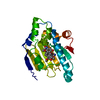
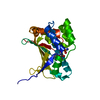
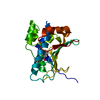
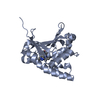
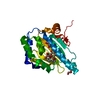
 PDBj
PDBj



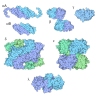
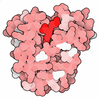


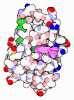
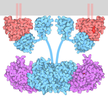
 Assembly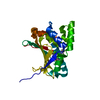

 Escherichia coli (E. coli) / Strain (production host): BL21DE3 / References: UniProt: P07900
 Mass: 389.833 Da / Num. of mol.: 1 / Source method: obtained synthetically / Formula: C19H20ClN3O4
 Mass: 18.015 Da / Num. of mol.: 199 / Source method: isolated from a natural source / Formula: H2O
 Sample preparation
 / Beamline: 22-ID / Wavelength: 0.97931 Å
 Processing