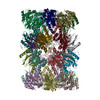
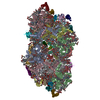
- EMDB-22259: Human 20S proteasome bound to an engineered 11S (PA26) activator -
+
Open data
ID or keywords:
Loading...
-
Basic information
Entry
Database: EMDB / ID: EMD-22259
Title
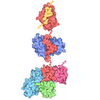
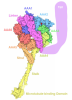
Human 20S proteasome bound to an engineered 11S (PA26) activator
Map data
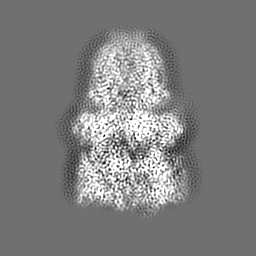
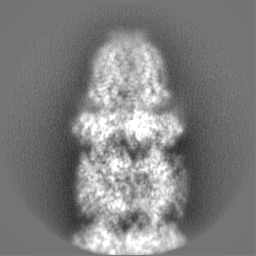
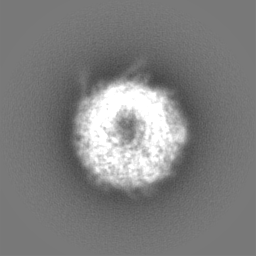
Sharpened and masked
Sample
Complex: PA26-bound proteasome
Complex: Proteasome
Protein or peptide: x 14 types
Complex: mutant PA26
Protein or peptide: x 1 types
Keywords
11S-bound / 20S proteasome / HYDROLASE
Function / homology
Function and homology information
proteasome activator complex / purine ribonucleoside triphosphate binding / CD8-positive, alpha-beta T cell differentiation / CD8-positive, alpha-beta T cell homeostasis / thymic T cell selection / Antigen processing: Ub, ATP-independent proteasomal degradation / structural constituent of proteasome / spermatoproteasome complex / negative regulation of regulatory T cell differentiation / T-helper 1 cell differentiation ...proteasome activator complex / purine ribonucleoside triphosphate binding / CD8-positive, alpha-beta T cell differentiation / CD8-positive, alpha-beta T cell homeostasis / thymic T cell selection / Antigen processing: Ub, ATP-independent proteasomal degradation / structural constituent of proteasome / spermatoproteasome complex / negative regulation of regulatory T cell differentiation / T-helper 1 cell differentiation / Regulation of ornithine decarboxylase (ODC) / proteasome core complex / Proteasome assembly / cellular response to type I interferon / T-helper 17 cell differentiation / Cross-presentation of soluble exogenous antigens (endosomes) / Somitogenesis / flagellated sperm motility / sperm end piece / immune system process / myofibril / proteasomal ubiquitin-independent protein catabolic process / ciliary tip / proteasome endopeptidase complex / NF-kappaB binding / proteasome core complex, beta-subunit complex / threonine-type endopeptidase activity / proteasome core complex, alpha-subunit complex / proteasome assembly / regulation of G1/S transition of mitotic cell cycle / positive regulation of interleukin-2 production / proteasome storage granule / response to type II interferon / proteasome complex / regulation of proteasomal protein catabolic process / meiotic cell cycle / sarcomere / Regulation of activated PAK-2p34 by proteasome mediated degradation / negative regulation of inflammatory response to antigenic stimulus / proteasomal protein catabolic process / Autodegradation of Cdh1 by Cdh1:APC/C / APC/C:Cdc20 mediated degradation of Securin / lipopolysaccharide binding / Asymmetric localization of PCP proteins / Ubiquitin-dependent degradation of Cyclin D / positive regulation of type II interferon production / SCF-beta-TrCP mediated degradation of Emi1 / AUF1 (hnRNP D0) binds and destabilizes mRNA / NIK-->noncanonical NF-kB signaling / P-body / TNFR2 non-canonical NF-kB pathway / protein catabolic process / Assembly of the pre-replicative complex / Vpu mediated degradation of CD4 / Cdc20:Phospho-APC/C mediated degradation of Cyclin A / Dectin-1 mediated noncanonical NF-kB signaling / Degradation of DVL / Degradation of AXIN / Degradation of CRY and PER proteins / Hh mutants are degraded by ERAD / Activation of NF-kappaB in B cells / G2/M Checkpoints / Degradation of GLI1 by the proteasome / Hedgehog ligand biogenesis / Regulation of RUNX3 expression and activity / Autodegradation of the E3 ubiquitin ligase COP1 / Defective CFTR causes cystic fibrosis / GSK3B and BTRC:CUL1-mediated-degradation of NFE2L2 / response to virus / Negative regulation of NOTCH4 signaling / AMPK-induced ERAD and lysosome mediated degradation of PD-L1(CD274) / Hedgehog 'on' state / APC/C:Cdh1 mediated degradation of Cdc20 and other APC/C:Cdh1 targeted proteins in late mitosis/early G1 / Vif-mediated degradation of APOBEC3G / FBXL7 down-regulates AURKA during mitotic entry and in early mitosis / Degradation of GLI2 by the proteasome / GLI3 is processed to GLI3R by the proteasome / MAPK6/MAPK4 signaling / GSK3B-mediated proteasomal degradation of PD-L1(CD274) / Degradation of CDH1 / Degradation of beta-catenin by the destruction complex / Oxygen-dependent proline hydroxylation of Hypoxia-inducible Factor Alpha / CDK-mediated phosphorylation and removal of Cdc6 / ABC-family protein mediated transport / CLEC7A (Dectin-1) signaling / Activation of STAT3 by cadherin engagement / SCF(Skp2)-mediated degradation of p27/p21 / FCERI mediated NF-kB activation / nuclear matrix / SPOP-mediated proteasomal degradation of PD-L1(CD274) / Regulation of expression of SLITs and ROBOs / Regulation of PTEN stability and activity / Ubiquitin-Mediated Degradation of Phosphorylated Cdc25A / Ribosome Quality Control (RQC) complex extracts and degrades nascent peptide / Interleukin-1 signaling / Orc1 removal from chromatin / peptidase activity / positive regulation of tumor necrosis factor production / Regulation of RUNX2 expression and activity / Regulation of RAS by GAPs Similarity search - Function
National Institutes of Health/National Institute of General Medical Sciences (NIH/NIGMS)
DP2-EB020402
United States
American Cancer Society
132279-PF-18-189-01- DMC
United States
Citation
Journal: Nat Commun / Year: 2022 Title: The YΦ motif defines the structure-activity relationships of human 20S proteasome activators. Authors: Kwadwo A Opoku-Nsiah / Andres H de la Pena / Sarah K Williams / Nikita Chopra / Andrej Sali / Gabriel C Lander / Jason E Gestwicki / Abstract: The 20S proteasome (20S) facilitates turnover of most eukaryotic proteins. Substrate entry into the 20S first requires opening of gating loops through binding of HbYX motifs that are present at the C- ...The 20S proteasome (20S) facilitates turnover of most eukaryotic proteins. Substrate entry into the 20S first requires opening of gating loops through binding of HbYX motifs that are present at the C-termini of certain proteasome activators (PAs). The HbYX motif has been predominantly characterized in the archaeal 20S, whereas little is known about the sequence preferences of the human 20S (h20S). Here, we synthesize and screen ~120 HbYX-like peptides, revealing unexpected differences from the archaeal system and defining the h20S recognition sequence as the Y-F/Y (YФ) motif. To gain further insight, we create a functional chimera of the optimized sequence, NLSYYT, fused to the model activator, PA26. A cryo-EM structure of PA26-h20S is used to identify key interactions, including non-canonical contacts and gate-opening mechanisms. Finally, we demonstrate that the YФ sequence preferences are tuned by valency, allowing multivalent PAs to sample greater sequence space. These results expand the model for termini-mediated gating and provide a template for the design of h20S activators.
History
Deposition
Jun 30, 2020
-
Header (metadata) release
Jul 22, 2020
-
Map release
Jul 22, 2020
-
Update
May 15, 2024
-
Current status
May 15, 2024
Processing site: RCSB / Status: Released
-
Structure visualization
Movie
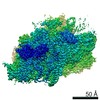
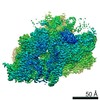
Surface view with section colored by density value
In the structure databanks used in Yorodumi, some data are registered as the other names, "COVID-19 virus" and "2019-nCoV". Here are the details of the virus and the list of structure data.
Jan 31, 2019. EMDB accession codes are about to change! (news from PDBe EMDB page)
EMDB accession codes are about to change! (news from PDBe EMDB page)
The allocation of 4 digits for EMDB accession codes will soon come to an end. Whilst these codes will remain in use, new EMDB accession codes will include an additional digit and will expand incrementally as the available range of codes is exhausted. The current 4-digit format prefixed with “EMD-” (i.e. EMD-XXXX) will advance to a 5-digit format (i.e. EMD-XXXXX), and so on. It is currently estimated that the 4-digit codes will be depleted around Spring 2019, at which point the 5-digit format will come into force.
The EM Navigator/Yorodumi systems omit the EMD- prefix.
Related info.:Q: What is EMD? / ID/Accession-code notation in Yorodumi/EM Navigator
Yorodumi is a browser for structure data from EMDB, PDB, SASBDB, etc.
This page is also the successor to EM Navigator detail page, and also detail information page/front-end page for Omokage search.
The word "yorodu" (or yorozu) is an old Japanese word meaning "ten thousand". "mi" (miru) is to see.
Related info.:EMDB / PDB / SASBDB / Comparison of 3 databanks / Yorodumi Search / Aug 31, 2016. New EM Navigator & Yorodumi / Yorodumi Papers / Jmol/JSmol / Function and homology information / Changes in new EM Navigator and Yorodumi
 Movie
Movie Controller

 Yorodumi
 Open data
 Basic information
 Map data
 Sample
 Keywords
 Function and homology information
 Homo sapiens (human) /
 Trypanosoma brucei (eukaryote)
 Authors
 United States, 2 items
  Citation
 Structure visualization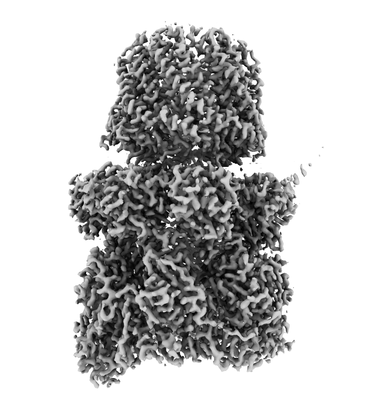
 Downloads & links
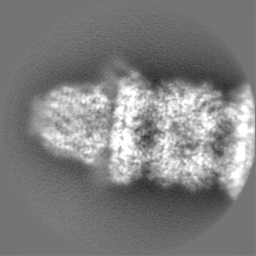
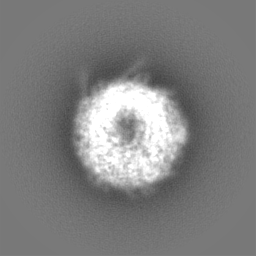
 emd_22259.png
 https://data.pdbj.org/pub/emdb/structures/EMD-22259



 Z (Sec.)
 Y (Row.)
 X (Col.)













 Sample components
 Escherichia coli BL21 (bacteria)
 Processing
 Electron microscopy
 FIELD EMISSION GUN