 Movie
Movie Controller


+ Open data

- Basic information
| Entry | Database: EMDB / ID: EMD-20082 | |||||||||||||||
|---|---|---|---|---|---|---|---|---|---|---|---|---|---|---|---|---|
| Title | Amyloid-Beta (20-34) wild type | |||||||||||||||
 Map data Map data | ||||||||||||||||
 Sample Sample |
| |||||||||||||||
 Keywords Keywords | protofilament / 2 sub 1 screw symmetry / PROTEIN FIBRIL | |||||||||||||||
| Function / homology |  Function and homology information Function and homology informationamyloid-beta complex / growth cone lamellipodium / Aggregated β-amyloid induces FXII autocatalysis / cellular response to norepinephrine stimulus / collateral sprouting in absence of injury / growth cone filopodium / hippocampal neuron apoptotic process / microglia development / regulation of Wnt signaling pathway / Formyl peptide receptors bind formyl peptides and many other ligands ...amyloid-beta complex / growth cone lamellipodium / Aggregated β-amyloid induces FXII autocatalysis / cellular response to norepinephrine stimulus / collateral sprouting in absence of injury / growth cone filopodium / hippocampal neuron apoptotic process / microglia development / regulation of Wnt signaling pathway / Formyl peptide receptors bind formyl peptides and many other ligands / axo-dendritic transport / Aggregated β-amyloid interacts with fibrinogen / axon midline choice point recognition / regulation of synapse structure or activity / positive regulation of synaptic transmission, cholinergic / astrocyte activation involved in immune response / NMDA selective glutamate receptor signaling pathway / regulation of spontaneous synaptic transmission / mating behavior / growth factor receptor binding / Insertion of tail-anchored proteins into the endoplasmic reticulum membrane / positive regulation of amyloid fibril formation / peptidase activator activity / PTB domain binding / Golgi-associated vesicle / Lysosome Vesicle Biogenesis / Deregulated CDK5 triggers multiple neurodegenerative pathways in Alzheimer's disease models / neuron remodeling / astrocyte projection / regulation of multicellular organism growth / nuclear envelope lumen / dendrite development / TRAF6 mediated NF-kB activation / positive regulation of protein metabolic process / negative regulation of long-term synaptic potentiation / signaling receptor activator activity / transition metal ion binding / Advanced glycosylation endproduct receptor signaling / The NLRP3 inflammasome / intracellular copper ion homeostasis / modulation of excitatory postsynaptic potential / main axon / ECM proteoglycans / positive regulation of T cell migration / response to insulin-like growth factor stimulus / regulation of presynapse assembly / extracellular matrix organization / swimming behavior / adult locomotory behavior / regulation of long-term neuronal synaptic plasticity / neuronal dense core vesicle / Purinergic signaling in leishmaniasis infection / positive regulation of calcium-mediated signaling / positive regulation of chemokine production / positive regulation of mitotic cell cycle / axonogenesis / cellular response to manganese ion / neuron projection maintenance / clathrin-coated pit / cellular response to cAMP / visual learning / astrocyte activation / synaptic cleft / Mitochondrial protein degradation / platelet alpha granule lumen / regulation of neuron apoptotic process / positive regulation of glycolytic process / Regulation of clotting cascade / response to interleukin-1 / learning / ionotropic glutamate receptor signaling pathway / locomotory behavior / cellular response to copper ion / endosome lumen / positive regulation of interleukin-1 beta production / central nervous system development / positive regulation of long-term synaptic potentiation / serine-type endopeptidase inhibitor activity / protein serine/threonine kinase binding / dendritic shaft / Post-translational protein phosphorylation / trans-Golgi network membrane / endocytosis / microglial cell activation / cellular response to nerve growth factor stimulus / positive regulation of non-canonical NF-kappaB signal transduction / positive regulation of interleukin-6 production / positive regulation of JNK cascade / synapse organization / TAK1-dependent IKK and NF-kappa-B activation / regulation of translation / Golgi lumen / recycling endosome / response to lead ion / cognition / Regulation of Insulin-like Growth Factor (IGF) transport and uptake by Insulin-like Growth Factor Binding Proteins (IGFBPs) / cellular response to amyloid-beta / neuron projection development / regulation of gene expression / calcium ion transport Similarity search - Function | |||||||||||||||
| Biological species |  Homo sapiens (human) Homo sapiens (human) | |||||||||||||||
| Method | electron crystallography / cryo EM | |||||||||||||||
 Authors Authors | Sawaya MR / Warmack RA | |||||||||||||||
| Funding support |  United States, 4 items United States, 4 items
| |||||||||||||||
 Citation Citation | Journal: Nat Commun / Year: 2019 Title: Structure of amyloid-β (20-34) with Alzheimer's-associated isomerization at Asp23 reveals a distinct protofilament interface. Authors: Rebeccah A Warmack / David R Boyer / Chih-Te Zee / Logan S Richards / Michael R Sawaya / Duilio Cascio / Tamir Gonen / David S Eisenberg / Steven G Clarke / Abstract: Amyloid-β (Aβ) harbors numerous posttranslational modifications (PTMs) that may affect Alzheimer's disease (AD) pathogenesis. Here we present the 1.1 Å resolution MicroED structure of an Aβ 20- ...Amyloid-β (Aβ) harbors numerous posttranslational modifications (PTMs) that may affect Alzheimer's disease (AD) pathogenesis. Here we present the 1.1 Å resolution MicroED structure of an Aβ 20-34 fibril with and without the disease-associated PTM, L-isoaspartate, at position 23 (L-isoAsp23). Both wild-type and L-isoAsp23 protofilaments adopt β-helix-like folds with tightly packed cores, resembling the cores of full-length fibrillar Aβ structures, and both self-associate through two distinct interfaces. One of these is a unique Aβ interface strengthened by the isoaspartyl modification. Powder diffraction patterns suggest a similar structure may be adopted by protofilaments of an analogous segment containing the heritable Iowa mutation, Asp23Asn. Consistent with its early onset phenotype in patients, Asp23Asn accelerates aggregation of Aβ 20-34, as does the L-isoAsp23 modification. These structures suggest that the enhanced amyloidogenicity of the modified Aβ segments may also reduce the concentration required to achieve nucleation and therefore help spur the pathogenesis of AD. | |||||||||||||||
| History |
|
- Structure visualization
| Movie |
Movie viewer |
|---|---|
| Structure viewer | EM map: SurfViewMolmilJmol/JSmol |
| Supplemental images |

- Downloads & links
-EMDB archive
| Map data | emd_20082.map.gz | 323.2 KB | EMDB map data format | |
|---|---|---|---|---|
| Header (meta data) | emd-20082-v30.xmlemd-20082.xml | 14.2 KB 14.2 KB | Display Display | EMDB header |
| Images |  emd_20082.png emd_20082.png | 331.7 KB | ||
| Filedesc metadata | emd-20082.cif.gz | 5.5 KB | ||
| Filedesc structureFactors | emd_20082_sf.cif.gz | 71.3 KB | ||
| Archive directory |  https://data.pdbj.org/pub/emdb/structures/EMD-20082ftp://data.pdbj.org/pub/emdb/structures/EMD-20082 https://data.pdbj.org/pub/emdb/structures/EMD-20082ftp://data.pdbj.org/pub/emdb/structures/EMD-20082 | HTTPS FTP |
-Related structure data
| Related structure data |  6oizMC  0405C  6nb9C M: atomic model generated by this map C: citing same article ( |
|---|---|
| Similar structure data |
-Links
| EMDB pages | EMDB (EBI/PDBe) / EMDataResource |
|---|---|
| Related items in Molecule of the Month |
-Map
| File | Download / File: emd_20082.map.gz / Format: CCP4 / Size: 350.6 KB / Type: IMAGE STORED AS FLOATING POINT NUMBER (4 BYTES) | ||||||||||||||||||||||||||||||||||||||||||||||||||||||||||||||||||||
|---|---|---|---|---|---|---|---|---|---|---|---|---|---|---|---|---|---|---|---|---|---|---|---|---|---|---|---|---|---|---|---|---|---|---|---|---|---|---|---|---|---|---|---|---|---|---|---|---|---|---|---|---|---|---|---|---|---|---|---|---|---|---|---|---|---|---|---|---|---|
| Projections & slices | Image control
Images are generated by Spider. generated in cubic-lattice coordinate | ||||||||||||||||||||||||||||||||||||||||||||||||||||||||||||||||||||
| Voxel size | X: 0.296 Å / Y: 0.29875 Å / Z: 0.3033 Å | ||||||||||||||||||||||||||||||||||||||||||||||||||||||||||||||||||||
| Density |
| ||||||||||||||||||||||||||||||||||||||||||||||||||||||||||||||||||||
| Symmetry | Space group: 4 | ||||||||||||||||||||||||||||||||||||||||||||||||||||||||||||||||||||
| Details | EMDB XML:
CCP4 map header:
| ||||||||||||||||||||||||||||||||||||||||||||||||||||||||||||||||||||
 Z (Sec.)
 X (Row.)
 Y (Col.)


-Supplemental data
- Sample components
-Entire : crystal of amyloid-beta residues 20-34 wild type
| Entire | Name: crystal of amyloid-beta residues 20-34 wild type |
|---|---|
| Components |
|
-Supramolecule #1: crystal of amyloid-beta residues 20-34 wild type
| Supramolecule | Name: crystal of amyloid-beta residues 20-34 wild type / type: complex / ID: 1 / Parent: 0 / Macromolecule list: #1 |
|---|---|
| Source (natural) | Organism: Homo sapiens (human) |
| Molecular weight | Theoretical: 6.21 kDa/nm |
-Macromolecule #1: Amyloid beta A4 protein
| Macromolecule | Name: Amyloid beta A4 protein / type: protein_or_peptide / ID: 1 / Number of copies: 1 / Enantiomer: LEVO |
|---|---|
| Source (natural) | Organism: Homo sapiens (human) |
| Molecular weight | Theoretical: 1.491666 KDa |
| Sequence | String: FAEDVGSNKG AIIGL UniProtKB: Amyloid-beta A4 protein |
-Macromolecule #2: water
| Macromolecule | Name: water / type: ligand / ID: 2 / Number of copies: 7 / Formula: HOH |
|---|---|
| Molecular weight | Theoretical: 18.015 Da |
| Chemical component information |  ChemComp-HOH: |
-Experimental details
-Structure determination
| Method | cryo EM |
|---|---|
 Processing Processing | electron crystallography |
| Aggregation state | 3D array |
-Sample preparation
| Concentration | 5.0 mg/mL | |||||||||||||||
|---|---|---|---|---|---|---|---|---|---|---|---|---|---|---|---|---|
| Buffer | pH: 7.5 Component:
| |||||||||||||||
| Grid | Model: Quantifoil, UltrAuFoil, R1.2/1.3 / Support film - Material: CARBON / Support film - topology: HOLEY ARRAY / Support film - Film thickness: 30 / Pretreatment - Type: GLOW DISCHARGE / Pretreatment - Time: 30 sec. / Details: 30 seconds on each side | |||||||||||||||
| Vitrification | Cryogen name: ETHANE / Chamber temperature: 100 K / Instrument: FEI VITROBOT MARK IV | |||||||||||||||
| Details | This sample is a crystal. | |||||||||||||||
| Crystal formation | Instrument: Varioscan plate reader / Atmosphere: air / Temperature: 310.0 K / Time: 30.0 HOUR / Details: shaken at 1200 rpm |
- Electron microscopy
| Microscope | FEI TALOS ARCTICA |
|---|---|
| Temperature | Min: 100.0 K / Max: 100.0 K |
| Image recording | Film or detector model: FEI CETA (4k x 4k) / Digitization - Dimensions - Width: 2048 pixel / Digitization - Dimensions - Height: 2048 pixel / Number grids imaged: 2 / Number diffraction images: 404 / Average exposure time: 3.0 sec. / Average electron dose: 0.01 e/Å2 |
| Electron beam | Acceleration voltage: 200 kV / Electron source:  FIELD EMISSION GUN FIELD EMISSION GUN |
| Electron optics | Illumination mode: FLOOD BEAM / Imaging mode: DIFFRACTION / Camera length: 1050 mm |
| Sample stage | Specimen holder model: FEI TITAN KRIOS AUTOGRID HOLDER / Cooling holder cryogen: NITROGEN |
| Experimental equipment | 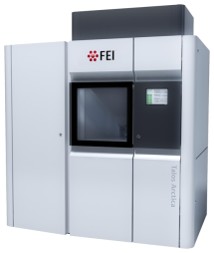 Model: Talos Arctica / Image courtesy: FEI Company |
-Image processing
| Final reconstruction | Resolution method: DIFFRACTION PATTERN/LAYERLINES |
|---|---|
| Crystallography statistics | Number intensities measured: 23638 / Number structure factors: 3546 / Fourier space coverage: 85.2 / R sym: 0.189 / R merge: 0.189 / Overall phase error: 22.7 / Overall phase residual: 0.1 / Phase error rejection criteria: 0.1 / High resolution: 1.1 Å / Shell - Shell ID: 1 / Shell - High resolution: 1.0 Å / Shell - Low resolution: 1.05 Å / Shell - Number structure factors: 315 / Shell - Phase residual: 0.1 / Shell - Fourier space coverage: 41.2 / Shell - Multiplicity: 3.09 |
-Atomic model buiding 1
| Refinement | Space: RECIPROCAL / Protocol: OTHER / Target criteria: maximum liklihood |
|---|---|
| Output model | PDB-6oiz: |
