Imp7:ImpB:H1.0 / Importin / Histone H1 / nuclear import / disordered interactions / TRANSPORT PROTEIN
機能・相同性
機能・相同性情報
RNA import into nucleus / Inhibition of nitric oxide production / mitotic chromosome movement towards spindle pole / regulation of cholesterol biosynthetic process / endoplasmic reticulum tubular network / positive regulation of transcription regulatory region DNA binding / establishment of mitotic spindle localization / Transport of Ribonucleoproteins into the Host Nucleus / astral microtubule organization / Regulation of cholesterol biosynthesis by SREBP (SREBF) ...RNA import into nucleus / Inhibition of nitric oxide production / mitotic chromosome movement towards spindle pole / regulation of cholesterol biosynthetic process / endoplasmic reticulum tubular network / positive regulation of transcription regulatory region DNA binding / establishment of mitotic spindle localization / Transport of Ribonucleoproteins into the Host Nucleus / astral microtubule organization / Regulation of cholesterol biosynthesis by SREBP (SREBF) / negative regulation of DNA recombination / importin-alpha family protein binding / Apoptosis induced DNA fragmentation / NS1 Mediated Effects on Host Pathways / Initiation of Nuclear Envelope (NE) Reformation / Nuclear import of Rev protein / Postmitotic nuclear pore complex (NPC) reformation / ribosomal protein import into nucleus / chromosome condensation / NLS-bearing protein import into nucleus / nuclear import signal receptor activity / nuclear localization sequence binding / Formation of Senescence-Associated Heterochromatin Foci (SAHF) / transcription repressor complex / minor groove of adenine-thymine-rich DNA binding / Maturation of hRSV A proteins / mitotic spindle assembly / nuclear pore / mitotic metaphase chromosome alignment / nucleosome binding / protein import into nucleus / Assembly of the ORC complex at the origin of replication / Maturation of DENV proteins / euchromatin / positive regulation of cholesterol biosynthetic process / Hsp90 protein binding / chromatin DNA binding / specific granule lumen / ISG15 antiviral mechanism / small GTPase binding / nucleosomal DNA binding / cytoplasmic stress granule / SARS-CoV-1 activates/modulates innate immune responses / Interferon alpha/beta signaling / structural constituent of chromatin / nucleosome / nuclear envelope / nucleosome assembly / nuclear membrane / double-stranded DNA binding / heterochromatin formation / ficolin-1-rich granule lumen / nuclear body / protein domain specific binding / Neutrophil degranulation / nucleolus / chromatin / enzyme binding / RNA binding / extracellular exosome / extracellular region / nucleoplasm / zinc ion binding / membrane / nucleus / cytosol / cytoplasm 類似検索 - 分子機能
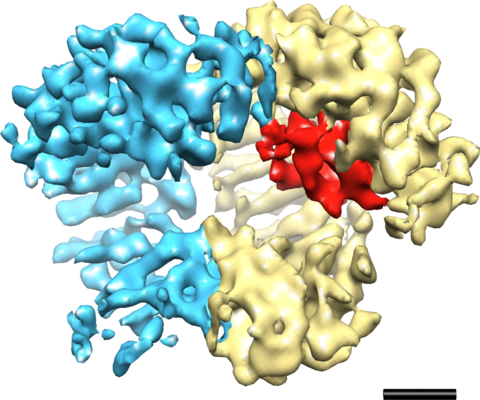
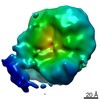
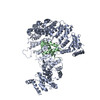
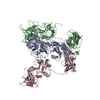
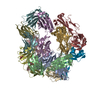
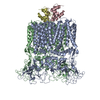
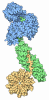
ジャーナル: Mol Cell / 年: 2019 タイトル: Fuzzy Interactions Form and Shape the Histone Transport Complex. 著者: Nives Ivic / Mia Potocnjak / Victor Solis-Mezarino / Franz Herzog / Silvija Bilokapic / Mario Halic / 要旨: Protein transport into the nucleus is mediated by transport receptors. Import of highly charged proteins, such as histone H1 and ribosomal proteins, requires a dimer of two transport receptors. In ...Protein transport into the nucleus is mediated by transport receptors. Import of highly charged proteins, such as histone H1 and ribosomal proteins, requires a dimer of two transport receptors. In this study, we determined the cryo-EM structure of the Imp7:Impβ:H1.0 complex, showing that the two importins form a cradle that accommodates the linker histone. The H1.0 globular domain is bound to Impβ, whereas the acidic loops of Impβ and Imp7 chaperone the positively charged C-terminal tail. Although it remains disordered, the H1 tail serves as a zipper that closes and stabilizes the structure through transient non-specific interactions with importins. Moreover, we found that the GGxxF and FxFG motifs in the Imp7 C-terminal tail are essential for Imp7:Impβ dimerization and H1 import, resembling importin interaction with nucleoporins, which, in turn, promote complex disassembly. The architecture of many other complexes might be similarly defined by rapidly exchanging electrostatic interactions mediated by disordered regions.
 ムービー
ムービー コントローラー


 データを開く
 基本情報
基本情報 マップデータ
 試料
試料 キーワード
キーワード 機能・相同性情報
 Homo sapiens (ヒト) /
  Xenopus laevis (アフリカツメガエル)
 データ登録者
 クロアチア, 2件
  引用
引用

 構造の表示
構造の表示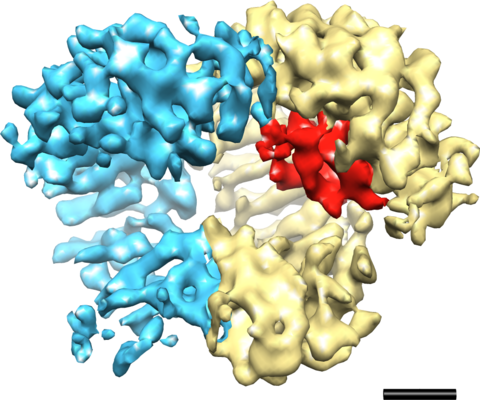
 ダウンロードとリンク
 emd_0366.png
 http://ftp.pdbj.org/pub/emdb/structures/EMD-0366

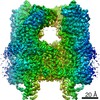
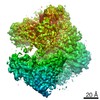


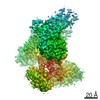

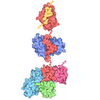
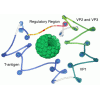
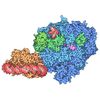
 Z (Sec.)
 Y (Row.)
 X (Col.)




 試料の構成要素
 Escherichia coli (大腸菌)
 解析
解析 電子顕微鏡法
 FIELD EMISSION GUN
