[English] 日本語
Yorodumi Papers
- Database of articles cited by EMDB/PDB/SASBDB data -

+
Search query

Keywords
Structure methods
Author
Journal
IF

-
Structure paper

TitleActivation of the angiotensin II type I receptor by a nonpeptide agonist.
Journal, issue, pagesProc Natl Acad Sci U S A, Vol. 123, Issue 32, Page e2602538123, Year 2026
Publish dateAug 11, 2026
AuthorsMeredith A Skiba / Jinghan Liu / Pengxiang Shen / Jihee Kim / Elizabeth Wren / Morgan S A Gilman / Dean Staus / Conor McMahon / Jeffrey S Smith / Robert J Lefkowitz / Daniel Kahne / Laura M Wingler / Andrew C Kruse /
PubMed AbstractThe angiotensin II type I receptor (AT1R) is a G protein-coupled receptor that regulates the cardiovascular system and as a result is one of the most successful pharmacological targets for the ...The angiotensin II type I receptor (AT1R) is a G protein-coupled receptor that regulates the cardiovascular system and as a result is one of the most successful pharmacological targets for the treatment of hypertension. Within the angiotensin receptor pharmacological landscape, agonists are peptide ligands, whereas potent antagonists are predominantly small molecules. Three decades ago, a small number of nonpeptide AT1R agonists were identified. These molecules largely share a chemical scaffold with AT1R antagonists, but appeared to interact with the receptor in a manner that diverges from both antagonists and peptide agonists. Here, we revisit L-162,313, the prototype nonpeptide AT1R agonist and determine how the antagonist-like chemical scaffold acts as an agonist. L-162,313 binds similarly to AT1R antagonists, but unlike antagonists, it engages the same activation switches as peptide agonists. We map the spatial relationship required for activation of AT1R by nonpeptide agonists and used this information to design a small library of L-162,313 derivatives. These rationally designed derivatives had the expected reduced or enhanced potency based on the structural basis for activation. Our data resolve a long-standing pharmacological mystery and provide a foundation for generating more efficacious small molecule AT1R agonists.
External linksProc Natl Acad Sci U S A / PubMed:42550893
MethodsEM (single particle)
Resolution3.2 - 3.4 Å
Structure data

EMDB-74919, PDB-9zxc:
Structure of AT118-R nanobody in complex with the angiotensin II type I receptor bound to losartan
Method: EM (single particle) / Resolution: 3.4 Å

EMDB-74920, PDB-9zxd:
Structure of AT118-R nanobody in complex with the angiotensin II type I receptor bound to L-162,313
Method: EM (single particle) / Resolution: 3.2 Å

Chemicals

ChemComp-Y01:
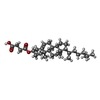
CHOLESTEROL HEMISUCCINATE

ChemComp-LSN:
[2-butyl-5-chloranyl-3-[[4-[2-(2H-1,2,3,4-tetrazol-5-yl)phenyl]phenyl]methyl]imidazol-4-yl]methanol

PDB-1c42:
Unknown entry

Source
  • homo sapiens (human)
  • synthetic construct (others)
  • escherichia coli (E. coli)
KeywordsMEMBRANE PROTEIN / GPCR / nanobody

+
About Yorodumi Papers

-
News

-
Feb 9, 2022. New format data for meta-information of EMDB entries

New format data for meta-information of EMDB entries

  • Version 3 of the EMDB header file is now the official format.
  • The previous official version 1.9 will be removed from the archive.

Related info.:EMDB header

External links:wwPDB to switch to version 3 of the EMDB data model

-
Aug 12, 2020. Covid-19 info

Covid-19 info

URL: https://pdbj.org/emnavi/covid19.php

New page: Covid-19 featured information page in EM Navigator.

Related info.:Covid-19 info / Mar 5, 2020. Novel coronavirus structure data

+
Mar 5, 2020. Novel coronavirus structure data

Novel coronavirus structure data

Related info.:Yorodumi Speices / Aug 12, 2020. Covid-19 info

External links:COVID-19 featured content - PDBj / Molecule of the Month (242):Coronavirus Proteases

+
Jan 31, 2019. EMDB accession codes are about to change! (news from PDBe EMDB page)

EMDB accession codes are about to change! (news from PDBe EMDB page)

  • The allocation of 4 digits for EMDB accession codes will soon come to an end. Whilst these codes will remain in use, new EMDB accession codes will include an additional digit and will expand incrementally as the available range of codes is exhausted. The current 4-digit format prefixed with “EMD-” (i.e. EMD-XXXX) will advance to a 5-digit format (i.e. EMD-XXXXX), and so on. It is currently estimated that the 4-digit codes will be depleted around Spring 2019, at which point the 5-digit format will come into force.
  • The EM Navigator/Yorodumi systems omit the EMD- prefix.

Related info.:Q: What is EMD? / ID/Accession-code notation in Yorodumi/EM Navigator

External links:EMDB Accession Codes are Changing Soon! / Contact to PDBj

+
Jul 12, 2017. Major update of PDB

Major update of PDB

  • wwPDB released updated PDB data conforming to the new PDBx/mmCIF dictionary.
  • This is a major update changing the version number from 4 to 5, and with Remediation, in which all the entries are updated.
  • In this update, many items about electron microscopy experimental information are reorganized (e.g. em_software).
  • Now, EM Navigator and Yorodumi are based on the updated data.

External links:wwPDB Remediation / Enriched Model Files Conforming to OneDep Data Standards Now Available in the PDB FTP Archive

-
Yorodumi Papers

Database of articles cited by EMDB/PDB/SASBDB data

  • Database of articles cited by EMDB, PDB, and SASBDB entries
  • Using PubMed data

Related info.:EMDB / PDB / SASBDB / Yorodumi / EMN Papers / Changes in new EM Navigator and Yorodumi

Read more