[English] 日本語
Yorodumi Papers
- Database of articles cited by EMDB/PDB/SASBDB data -

+
Search query

Keywords
Structure methods
Author
Journal
IF

-
Structure paper

TitleCryo-EM structures of Oryza sativa MRP5 reveal a phytate accumulation mechanism in plant vacuoles.
Journal, issue, pagesPlant Cell, Year 2026
Publish dateMar 24, 2026
AuthorsJiaqi Zuo / Jie Zhang / Ying Tang / Lihuan Jiang / Shuo Cao / Yan Liu / Cuicui Shen / Chuang Wang / Hao Chen / Lizhong Xiong / Ping Yin / Zhou Gong / Zhu Liu /
PubMed AbstractPhytate (phytic acid, or InsP6), the primary phosphorus storage compound in plants, plays essential roles in nutrient homeostasis and cellular signaling. However, its strong metal-chelating ...Phytate (phytic acid, or InsP6), the primary phosphorus storage compound in plants, plays essential roles in nutrient homeostasis and cellular signaling. However, its strong metal-chelating properties make cytosolic accumulation cytotoxic, necessitating its sequestration into vacuoles for safe storage. Here, we present the cryo-EM structures of the rice vacuolar phytate transporter, OsMRP5, captured in distinct functional states. These structures reveal the molecular basis of OsMRP5 function as an ATP-binding cassette (ABC) transporter. OsMRP5 employs a specialized substrate-recognition mechanism, uniquely adapted to bind the fully hydrophilic InsP6 through extensive electrostatic and hydrogen-bonding interactions within two distinct, highly polar binding sites in its central cavity. A distinctive electropositive tunnel, positioned above the central cavity, forms a continuous pathway connecting the InsP6-binding pocket to the vacuolar export site. This tunnel likely generates an electrostatic attraction that facilitates the movement of the highly anionic InsP6 through the transporter. By mapping mutations from low-phytic acid (lpa) crop variants onto the OsMRP5 structures, we pinpoint their conserved locations critical for transporter function and validate their impact experimentally. These results reveal how OsMRP5 recognizes and transports the highly charged InsP6 molecule into vacuoles, providing a molecular framework for targeted manipulation of this agriculturally important transporter.
External linksPlant Cell / PubMed:41875395
MethodsEM (single particle)
Resolution2.63 - 3.5 Å
Structure data

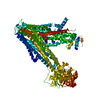
EMDB-65282, PDB-9vrb:
Cryo-EM structure of ATP-bound Oryza sativa MRP5 with E1424Q mutation
Method: EM (single particle) / Resolution: 2.63 Å

EMDB-65283, PDB-9vrc:
Cryo-EM structure of Oryza sativa multidrug resistance protein 5 (MRP5)
Method: EM (single particle) / Resolution: 3.21 Å

EMDB-65284, PDB-9vrd:
Cryo-EM structure of rice multidrug resistance protein 5 (MRP5) with InsP6 in state A
Method: EM (single particle) / Resolution: 3.03 Å

EMDB-65285, PDB-9vre:
Cryo-EM structure of rice multidrug resistance protein 5 (MRP5) with InsP6 in state B
Method: EM (single particle) / Resolution: 3.5 Å

Chemicals

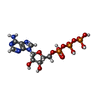
ChemComp-ATP:
ADENOSINE-5'-TRIPHOSPHATE / ATP, energy-carrying molecule*YM

ChemComp-MG:
Unknown entry

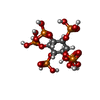
ChemComp-IHP:
INOSITOL HEXAKISPHOSPHATE

Source
  • oryza sativa japonica group (Japanese rice)

KeywordsTRANSPORT PROTEIN / ABC-type transporter / Monomer

+
About Yorodumi Papers

-
News

-
Feb 9, 2022. New format data for meta-information of EMDB entries

New format data for meta-information of EMDB entries

  • Version 3 of the EMDB header file is now the official format.
  • The previous official version 1.9 will be removed from the archive.

Related info.:EMDB header

External links:wwPDB to switch to version 3 of the EMDB data model

-
Aug 12, 2020. Covid-19 info

Covid-19 info

URL: https://pdbj.org/emnavi/covid19.php

New page: Covid-19 featured information page in EM Navigator.

Related info.:Covid-19 info / Mar 5, 2020. Novel coronavirus structure data

+
Mar 5, 2020. Novel coronavirus structure data

Novel coronavirus structure data

Related info.:Yorodumi Speices / Aug 12, 2020. Covid-19 info

External links:COVID-19 featured content - PDBj / Molecule of the Month (242):Coronavirus Proteases

+
Jan 31, 2019. EMDB accession codes are about to change! (news from PDBe EMDB page)

EMDB accession codes are about to change! (news from PDBe EMDB page)

  • The allocation of 4 digits for EMDB accession codes will soon come to an end. Whilst these codes will remain in use, new EMDB accession codes will include an additional digit and will expand incrementally as the available range of codes is exhausted. The current 4-digit format prefixed with “EMD-” (i.e. EMD-XXXX) will advance to a 5-digit format (i.e. EMD-XXXXX), and so on. It is currently estimated that the 4-digit codes will be depleted around Spring 2019, at which point the 5-digit format will come into force.
  • The EM Navigator/Yorodumi systems omit the EMD- prefix.

Related info.:Q: What is EMD? / ID/Accession-code notation in Yorodumi/EM Navigator

External links:EMDB Accession Codes are Changing Soon! / Contact to PDBj

+
Jul 12, 2017. Major update of PDB

Major update of PDB

  • wwPDB released updated PDB data conforming to the new PDBx/mmCIF dictionary.
  • This is a major update changing the version number from 4 to 5, and with Remediation, in which all the entries are updated.
  • In this update, many items about electron microscopy experimental information are reorganized (e.g. em_software).
  • Now, EM Navigator and Yorodumi are based on the updated data.

External links:wwPDB Remediation / Enriched Model Files Conforming to OneDep Data Standards Now Available in the PDB FTP Archive

-
Yorodumi Papers

Database of articles cited by EMDB/PDB/SASBDB data

  • Database of articles cited by EMDB, PDB, and SASBDB entries
  • Using PubMed data

Related info.:EMDB / PDB / SASBDB / Yorodumi / EMN Papers / Changes in new EM Navigator and Yorodumi

Read more