 Movie
Movie Controller

[English] 日本語
 Yorodumi
- PDB-9vrc: Cryo-EM structure of Oryza sativa multidrug resistance protein 5 ... -
+ Open data

- Basic information
| Entry | Database: PDB / ID: 9vrc | |||||||||||||||||||||||||||
|---|---|---|---|---|---|---|---|---|---|---|---|---|---|---|---|---|---|---|---|---|---|---|---|---|---|---|---|---|
| Title | Cryo-EM structure of Oryza sativa multidrug resistance protein 5 (MRP5) | |||||||||||||||||||||||||||
 Components Components | ABC transporter C family member 13 | |||||||||||||||||||||||||||
 Keywords Keywords | TRANSPORT PROTEIN / ABC-type transporter / Monomer | |||||||||||||||||||||||||||
| Function / homology |  Function and homology information Function and homology informationTranslocases / ABC-type transporter activity / transmembrane transport / ATP hydrolysis activity / ATP binding / membrane Similarity search - Function | |||||||||||||||||||||||||||
| Biological species |   Oryza sativa Japonica Group (Japanese rice) Oryza sativa Japonica Group (Japanese rice) | |||||||||||||||||||||||||||
| Method | ELECTRON MICROSCOPY / single particle reconstruction / cryo EM / Resolution: 3.21 Å | |||||||||||||||||||||||||||
 Authors Authors | Zou, J. / Zhang, J. / Liu, Z. | |||||||||||||||||||||||||||
| Funding support |  China, 1items China, 1items
| |||||||||||||||||||||||||||
 Citation Citation | Journal: Plant Cell / Year: 2026 Title: Cryo-EM structures of Oryza sativa MRP5 reveal a phytate accumulation mechanism in plant vacuoles. Authors: Jiaqi Zuo / Jie Zhang / Ying Tang / Lihuan Jiang / Shuo Cao / Yan Liu / Cuicui Shen / Chuang Wang / Hao Chen / Lizhong Xiong / Ping Yin / Zhou Gong / Zhu Liu / Abstract: Phytate (phytic acid, or InsP6), the primary phosphorus storage compound in plants, plays essential roles in nutrient homeostasis and cellular signaling. However, its strong metal-chelating ...Phytate (phytic acid, or InsP6), the primary phosphorus storage compound in plants, plays essential roles in nutrient homeostasis and cellular signaling. However, its strong metal-chelating properties make cytosolic accumulation cytotoxic, necessitating its sequestration into vacuoles for safe storage. Here, we present the cryo-EM structures of the rice vacuolar phytate transporter, OsMRP5, captured in distinct functional states. These structures reveal the molecular basis of OsMRP5 function as an ATP-binding cassette (ABC) transporter. OsMRP5 employs a specialized substrate-recognition mechanism, uniquely adapted to bind the fully hydrophilic InsP6 through extensive electrostatic and hydrogen-bonding interactions within two distinct, highly polar binding sites in its central cavity. A distinctive electropositive tunnel, positioned above the central cavity, forms a continuous pathway connecting the InsP6-binding pocket to the vacuolar export site. This tunnel likely generates an electrostatic attraction that facilitates the movement of the highly anionic InsP6 through the transporter. By mapping mutations from low-phytic acid (lpa) crop variants onto the OsMRP5 structures, we pinpoint their conserved locations critical for transporter function and validate their impact experimentally. These results reveal how OsMRP5 recognizes and transports the highly charged InsP6 molecules into vacuoles, providing a molecular framework for targeted manipulation of this agriculturally important transporter. | |||||||||||||||||||||||||||
| History |
|
- Structure visualization
| Structure viewer | Molecule: MolmilJmol/JSmol |
|---|
- Downloads & links
-Download
| PDBx/mmCIF format | 9vrc.cif.gz | 173.2 KB | Display | PDBx/mmCIF format |
|---|---|---|---|---|
| PDB format | pdb9vrc.ent.gz | 125.6 KB | Display | PDB format |
| PDBx/mmJSON format | 9vrc.json.gz | Tree view | PDBx/mmJSON format | |
| Others |  Other downloads Other downloads |
-Validation report
| Arichive directory | https://data.pdbj.org/pub/pdb/validation_reports/vr/9vrcftp://data.pdbj.org/pub/pdb/validation_reports/vr/9vrc | HTTPS FTP |
|---|
-Related structure data
| Related structure data |  65283MC  9vrbC  9vrdC 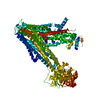 9vreC M: map data used to model this data C: citing same article ( |
|---|---|
| Similar structure data |


-Links
 PDBj
PDBj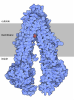
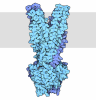
- Assembly
| Deposited unit | 
|
|---|---|
| 1 |
|
-Components
| #1: Protein | Mass: 166321.906 Da / Num. of mol.: 1 Source method: isolated from a genetically manipulated source Source: (gene. exp.) Oryza sativa Japonica Group (Japanese rice)Gene: ABCC13, LPA2, Os03g0142800, LOC_Os03g04920 / Production host:  Homo sapiens (human) / References: UniProt: Q10RX7, Translocases Homo sapiens (human) / References: UniProt: Q10RX7, Translocases |
|---|---|
| Has protein modification | N |
-Experimental details
-Experiment
| Experiment | Method: ELECTRON MICROSCOPY |
|---|---|
| EM experiment | Aggregation state: PARTICLE / 3D reconstruction method: single particle reconstruction |
- Sample preparation
| Component | Name: Multidrug-resistance associated protein 5 / Type: COMPLEX / Entity ID: all / Source: RECOMBINANT |
|---|---|
| Molecular weight | Experimental value: NO |
| Source (natural) | Organism: Oryza sativa Japonica Group (Japanese rice) |
| Source (recombinant) | Organism: Homo sapiens (human) |
| Buffer solution | pH: 8 / Details: 150mM NaCl, 25mM Tris-HCL, 0.0002m/v GDN |
| Specimen | Embedding applied: NO / Shadowing applied: NO / Staining applied: NO / Vitrification applied: YES |
| Vitrification | Instrument: FEI VITROBOT MARK IV / Cryogen name: ETHANE / Humidity: 100 % / Chamber temperature: 281 K |
- Electron microscopy imaging
| Experimental equipment |  Model: Titan Krios / Image courtesy: FEI Company |
|---|---|
| Microscopy | Model: TFS KRIOS |
| Electron gun | Electron source:  FIELD EMISSION GUN / Accelerating voltage: 300 kV / Illumination mode: SPOT SCAN FIELD EMISSION GUN / Accelerating voltage: 300 kV / Illumination mode: SPOT SCAN |
| Electron lens | Mode: BRIGHT FIELD / Nominal defocus max: 1800 nm / Nominal defocus min: 1400 nm / Cs: 2.7 mm |
| Image recording | Electron dose: 50 e/Å2 / Film or detector model: GATAN K3 BIOQUANTUM (6k x 4k) |
| Image scans | Width: 5760 / Height: 4092 |
- Processing
| EM software |
| ||||||||||||||||||||||||
|---|---|---|---|---|---|---|---|---|---|---|---|---|---|---|---|---|---|---|---|---|---|---|---|---|---|
| CTF correction | Type: PHASE FLIPPING AND AMPLITUDE CORRECTION | ||||||||||||||||||||||||
| 3D reconstruction | Resolution: 3.21 Å / Resolution method: FSC 0.143 CUT-OFF / Num. of particles: 136844 / Symmetry type: POINT | ||||||||||||||||||||||||
| Refinement | Highest resolution: 3.21 Å Stereochemistry target values: REAL-SPACE (WEIGHTED MAP SUM AT ATOM CENTERS) | ||||||||||||||||||||||||
| Refine LS restraints |
|
