[English] 日本語
Yorodumi Papers
- Database of articles cited by EMDB/PDB/SASBDB data -

+
Search query

Keywords
Structure methods
Author
Journal
IF

-
Structure paper

TitleMechanisms of KCNQ1 gating modulation by KCNE1/3 for cell-specific function.
Journal, issue, pagesCell Res, Vol. 35, Issue 11, Page 876-886, Year 2025
Publish dateJul 31, 2025
AuthorsChenxi Cui / Lu Zhao / Ali A Kermani / Shuzong Du / Tanadet Pipatpolkai / Meiqin Jiang / Sagar Chittori / Yong Zi Tan / Jingyi Shi / Lucie Delemotte / Jianmin Cui / Ji Sun /
PubMed AbstractKCNQ1 potassium channels are essential for physiological processes such as cardiac rhythm and intestinal chloride secretion. KCNE family subunits (KCNE1-5) associate with KCNQ1, conferring distinct ...KCNQ1 potassium channels are essential for physiological processes such as cardiac rhythm and intestinal chloride secretion. KCNE family subunits (KCNE1-5) associate with KCNQ1, conferring distinct properties across various tissues. KCNQ1 activation requires membrane depolarization and phosphatidylinositol 4,5-bisphosphate (PIP2) whose cellular levels are controlled by Gαq-coupled GPCR activation. While modulation of KCNQ1's voltage-dependent activation by KCNE1/3 is well-characterized, their effects on PIP2-dependent gating of KCNQ1 via GPCR signaling remain less understood. Here we resolved structures of KCNQ1-KCNE1 and reassessed the reported KCNQ1-KCNE3 structures with and without PIP2. We revealed that KCNQ1-KCNE1/3 complexes feature two PIP2-binding sites, with KCNE1/3 contributing to a previously overlooked, uncharacterized site involving residues critical for coupling voltage sensor and pore domains. Via this site, KCNE1 and KCNE3 distinctly modulate the PIP2-dependent gating, in addition to the voltage sensitivity, of KCNQ1. Consequently, KCNE3 converts KCNQ1 into a voltage-insensitive PIP2-gated channel governed by GPCR signaling to maintain ion homeostasis in non-excitable cells. KCNE1, by significantly enhancing KCNQ1's PIP2 affinity and resistance to GPCR regulation, forms predominantly voltage-gated channels with KCNQ1 for conducting the slow-delayed rectifier current in excitable cardiac cells. Our study highlights how KCNE1/3 modulates KCNQ1 gating in different cellular contexts, providing insights into tissue-specifically targeting multi-functional channels.
External linksCell Res / PubMed:40745202 / PubMed Central
MethodsEM (single particle)
Resolution2.7 - 3.9 Å
Structure data

EMDB-64997, PDB-9vec:
structure of human KCNQ1-KCNE1-CaM complex
Method: EM (single particle) / Resolution: 2.7 Å

EMDB-65008, PDB-9vei:
structure of human KCNQ1-KCNE1-CaM complex with PIP2
Method: EM (single particle) / Resolution: 3.9 Å

EMDB-65013, PDB-9ven:
structure of human KCNQ1-CaM-PIP2 complex with bent conformation
Method: EM (single particle) / Resolution: 3.8 Å

EMDB-65014, PDB-9veo:
structure of human KCNQ1-CaM-PIP2 complex with straight conformation
Method: EM (single particle) / Resolution: 3.7 Å

PDB-9wd8:
structure of human KCNQ1-KCNE3-CaM complex with two PIP2
Method: ELECTRON MICROSCOPY / Resolution: 3.9 Å

Chemicals

ChemComp-CA:
Unknown entry

ChemComp-PT5:
[(2R)-1-octadecanoyloxy-3-[oxidanyl-[(1R,2R,3S,4R,5R,6S)-2,3,6-tris(oxidanyl)-4,5-diphosphonooxy-cyclohexyl]oxy-phospho / phospholipid*YM

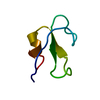
PDB-1bbg:
RAGWEED POLLEN ALLERGEN FROM AMBROSIA TRIFIDA V, NMR, MINIMIZED AVERAGE STRUCTURE

Source
  • homo sapiens (human)
KeywordsMEMBRANE PROTEIN / potassium channel complex

+
About Yorodumi Papers

-
News

-
Feb 9, 2022. New format data for meta-information of EMDB entries

New format data for meta-information of EMDB entries

  • Version 3 of the EMDB header file is now the official format.
  • The previous official version 1.9 will be removed from the archive.

Related info.:EMDB header

External links:wwPDB to switch to version 3 of the EMDB data model

-
Aug 12, 2020. Covid-19 info

Covid-19 info

URL: https://pdbj.org/emnavi/covid19.php

New page: Covid-19 featured information page in EM Navigator.

Related info.:Covid-19 info / Mar 5, 2020. Novel coronavirus structure data

+
Mar 5, 2020. Novel coronavirus structure data

Novel coronavirus structure data

Related info.:Yorodumi Speices / Aug 12, 2020. Covid-19 info

External links:COVID-19 featured content - PDBj / Molecule of the Month (242):Coronavirus Proteases

+
Jan 31, 2019. EMDB accession codes are about to change! (news from PDBe EMDB page)

EMDB accession codes are about to change! (news from PDBe EMDB page)

  • The allocation of 4 digits for EMDB accession codes will soon come to an end. Whilst these codes will remain in use, new EMDB accession codes will include an additional digit and will expand incrementally as the available range of codes is exhausted. The current 4-digit format prefixed with “EMD-” (i.e. EMD-XXXX) will advance to a 5-digit format (i.e. EMD-XXXXX), and so on. It is currently estimated that the 4-digit codes will be depleted around Spring 2019, at which point the 5-digit format will come into force.
  • The EM Navigator/Yorodumi systems omit the EMD- prefix.

Related info.:Q: What is EMD? / ID/Accession-code notation in Yorodumi/EM Navigator

External links:EMDB Accession Codes are Changing Soon! / Contact to PDBj

+
Jul 12, 2017. Major update of PDB

Major update of PDB

  • wwPDB released updated PDB data conforming to the new PDBx/mmCIF dictionary.
  • This is a major update changing the version number from 4 to 5, and with Remediation, in which all the entries are updated.
  • In this update, many items about electron microscopy experimental information are reorganized (e.g. em_software).
  • Now, EM Navigator and Yorodumi are based on the updated data.

External links:wwPDB Remediation / Enriched Model Files Conforming to OneDep Data Standards Now Available in the PDB FTP Archive

-
Yorodumi Papers

Database of articles cited by EMDB/PDB/SASBDB data

  • Database of articles cited by EMDB, PDB, and SASBDB entries
  • Using PubMed data

Related info.:EMDB / PDB / SASBDB / Yorodumi / EMN Papers / Changes in new EM Navigator and Yorodumi

Read more