 Movie
Movie Controller
 Structure viewers
 About Yorodumi Papers


+Search query
-Structure paper
| Title | Structure-guided design of 7-azaindole DNMT1 inhibitors active against hypomethylating agent-resistant acute myeloid leukemia. |
|---|---|
| Journal, issue, pages | Proc Natl Acad Sci U S A, Vol. 123, Issue 15, Page e2532472123, Year 2026 |
| Publish date | Apr 14, 2026 |
 Authors Authors | Shibing Tang / Liangyi Zong / Shuyuan Ma / Yini Shang / Jiale Wei / Jianguang Liu / Ying Cui / Huahui Guo / Kang Zou / Kezhi Wang / Hongkun Li / Fei Ye / Jing Huang / Cheng Luo / Zhihai Li / Stephen B Baylin / Xiangqian Kong /   |
| PubMed Abstract | Pharmacological reversal of abnormal promoter DNA hypermethylation at tumor suppressor genes (TSGs) is a key therapeutic paradigm for cancer management. However, the clinical efficacy of currently ...Pharmacological reversal of abnormal promoter DNA hypermethylation at tumor suppressor genes (TSGs) is a key therapeutic paradigm for cancer management. However, the clinical efficacy of currently approved nucleoside analog hypomethylating agents (HMAs) is limited by dose-dependent toxicity and high resistance rates. Nonnucleoside, DNA methyltransferase 1 (DNMT1)-selective inhibitors offer a promising alternative. To date, only limited chemotypes, exemplified by the dicyanopyridine derivative GSK3685032 (GSK5032), have demonstrated translatable DNMT1 inhibition, with resistance emerging upon prolonged exposure. To address these limitations, we employ structure-guided scaffold hopping and chemical optimization to develop a series of DNMT1 inhibitors (DNMT1i) featuring a bicyclic 7-azaindole scaffold. We identify DMI46, a potent enzymatic DNMT1i capable of reversing cancer-specific DNA methylation abnormalities and TSG silencing, leading to robust antileukemic effects and favorable tolerability. Cryoelectron microscopy (cryo-EM) studies reveal that the 7-azaindole inhibitor exhibits enhanced intercalation into hemi-methylated CpG dyads and increased minor-groove contacts within the DNMT1/hemimethylated DNA complex compared to GSK5032. These structural features enable sustained DNMT1 targeting and significant antiproliferative activity of DMI46 in GSK5032-resistant acute myeloid leukemia (AML) cells. We also demonstrate DMI46's capacity to overcome AML resistance to nucleoside-based HMAs both in vitro and in vivo. These findings introduce a distinct DNMT1i chemotype with enhanced on-target engagement and broad applicability against HMA-resistant AML. |
 External links External links | Proc Natl Acad Sci U S A / PubMed:41955111 / PubMed Central |
| Methods | EM (single particle) |
| Resolution | 2.77 Å |
| Structure data | EMDB-64750: CryoEM structure of human DNMT1 (aa 698-1616) bound to hemimethylated dsDNA and Inhibitor DMI26 |
| Chemicals |  ChemComp-ZN: 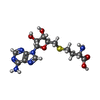 ChemComp-SAH: 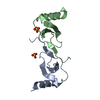 PDB-1eqt: |
| Source |
|
 Keywords Keywords | TRANSFERASE / DNA Methyltransferase 1 / DNA methylation inhibitor |


 homo sapiens (human)