[English] 日本語
Yorodumi Papers
- Database of articles cited by EMDB/PDB/SASBDB data -

+
Search query

Keywords
Structure methods
Author
Journal
IF

-
Structure paper

TitleBioactive lipid-mediated structural and functional regulation of the essential human potassium channel Kir7.1.
Journal, issue, pagesNat Commun, Year 2026
Publish dateFeb 11, 2026
AuthorsQingwei Niu / Simon Vu / Yuanjiang Xu / Mingxing Qian / Anastasiia Rudenko / Jin Ye / Jianwei Zeng / Wei Huang / Douglas F Covey / Rui Zhang / Ziao Fu / Polina V Lishko /
PubMed AbstractThe inwardly rectifying potassium channel Kir7.1 is essential for the physiological function of diverse tissues, including the retinal pigment epithelium and the gestational myometrium. Loss-of- ...The inwardly rectifying potassium channel Kir7.1 is essential for the physiological function of diverse tissues, including the retinal pigment epithelium and the gestational myometrium. Loss-of-function mutations in KCNJ13, which encodes Kir7.1, or conditional ablation of Kir7.1 in the retinal pigment epithelium, lead to early-onset vision loss. Despite strong genetic evidence supporting Kir7.1 as a therapeutic target, its regulation by endogenous ligands-beyond phosphoinositides-remains poorly understood. Here, we report cryo-electron microscopy structures of human Kir7.1 in multiple functional states at resolutions ranging from 2.8 Å to 4.0 Å. These structures uncover the molecular basis of Kir7.1 modulation by PIP, its selectivity, rectification, and identify a distinct steroid-binding site that may mediate cooperative channel gating. Our data suggest that endogenous cholesterol acts as an inhibitory ligand, which is displaced by select activating steroids. These activating steroids work in concert with PIP to promote channel opening through profound changes in cytoplasmic domains, and the linker region. Electrophysiological analyses define a pharmacological landscape of Kir7.1 activators, providing innovative tools to probe and modulate channel function in both physiological and pathological contexts.
External linksNat Commun / PubMed:41672996
MethodsEM (single particle)
Resolution3.3 - 4.0 Å
Structure data

EMDB-71798, PDB-9pr5:
Cryo-EM structure of the human inward-rectifier potassium 7.1 channel (Kir7.1) extended state
Method: EM (single particle) / Resolution: 3.3 Å

EMDB-71799, PDB-9pr6:
Cryo-EM structure of the human inward-rectifier potassium 7.1 channel (Kir7.1) docked state
Method: EM (single particle) / Resolution: 3.9 Å

EMDB-71800, PDB-9pr7:
Cryo-EM structure of the human inward-rectifier potassium 7.1 channel (Kir7.1) with enantiomer of 17-hydroxyprogesterone caproate
Method: EM (single particle) / Resolution: 4.0 Å

Chemicals

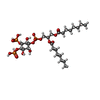
ChemComp-PIO:
[(2R)-2-octanoyloxy-3-[oxidanyl-[(1R,2R,3S,4R,5R,6S)-2,3,6-tris(oxidanyl)-4,5-diphosphonooxy-cyclohexyl]oxy-phosphoryl]oxy-propyl] octanoate

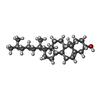
ChemComp-CLR:
CHOLESTEROL

PDB-1cjg:
NMR STRUCTURE OF LAC REPRESSOR HP62-DNA COMPLEX

Source
  • homo sapiens (human)
KeywordsMEMBRANE PROTEIN / inwardly rectifying potassium channel Kir7.1 / KCNJ13 / electrophysiology / ion channels / steroids / steroid enantiomers

+
About Yorodumi Papers

-
News

-
Feb 9, 2022. New format data for meta-information of EMDB entries

New format data for meta-information of EMDB entries

  • Version 3 of the EMDB header file is now the official format.
  • The previous official version 1.9 will be removed from the archive.

Related info.:EMDB header

External links:wwPDB to switch to version 3 of the EMDB data model

-
Aug 12, 2020. Covid-19 info

Covid-19 info

URL: https://pdbj.org/emnavi/covid19.php

New page: Covid-19 featured information page in EM Navigator.

Related info.:Covid-19 info / Mar 5, 2020. Novel coronavirus structure data

+
Mar 5, 2020. Novel coronavirus structure data

Novel coronavirus structure data

Related info.:Yorodumi Speices / Aug 12, 2020. Covid-19 info

External links:COVID-19 featured content - PDBj / Molecule of the Month (242):Coronavirus Proteases

+
Jan 31, 2019. EMDB accession codes are about to change! (news from PDBe EMDB page)

EMDB accession codes are about to change! (news from PDBe EMDB page)

  • The allocation of 4 digits for EMDB accession codes will soon come to an end. Whilst these codes will remain in use, new EMDB accession codes will include an additional digit and will expand incrementally as the available range of codes is exhausted. The current 4-digit format prefixed with “EMD-” (i.e. EMD-XXXX) will advance to a 5-digit format (i.e. EMD-XXXXX), and so on. It is currently estimated that the 4-digit codes will be depleted around Spring 2019, at which point the 5-digit format will come into force.
  • The EM Navigator/Yorodumi systems omit the EMD- prefix.

Related info.:Q: What is EMD? / ID/Accession-code notation in Yorodumi/EM Navigator

External links:EMDB Accession Codes are Changing Soon! / Contact to PDBj

+
Jul 12, 2017. Major update of PDB

Major update of PDB

  • wwPDB released updated PDB data conforming to the new PDBx/mmCIF dictionary.
  • This is a major update changing the version number from 4 to 5, and with Remediation, in which all the entries are updated.
  • In this update, many items about electron microscopy experimental information are reorganized (e.g. em_software).
  • Now, EM Navigator and Yorodumi are based on the updated data.

External links:wwPDB Remediation / Enriched Model Files Conforming to OneDep Data Standards Now Available in the PDB FTP Archive

-
Yorodumi Papers

Database of articles cited by EMDB/PDB/SASBDB data

  • Database of articles cited by EMDB, PDB, and SASBDB entries
  • Using PubMed data

Related info.:EMDB / PDB / SASBDB / Yorodumi / EMN Papers / Changes in new EM Navigator and Yorodumi

Read more