 Movie
Movie Controller

[English] 日本語
 Yorodumi
- PDB-9pr5: Cryo-EM structure of the human inward-rectifier potassium 7.1 cha... -
+ Open data

- Basic information
| Entry | Database: PDB / ID: 9pr5 | ||||||||||||||||||||||||||||||
|---|---|---|---|---|---|---|---|---|---|---|---|---|---|---|---|---|---|---|---|---|---|---|---|---|---|---|---|---|---|---|---|
| Title | Cryo-EM structure of the human inward-rectifier potassium 7.1 channel (Kir7.1) extended state | ||||||||||||||||||||||||||||||
 Components Components | Inward rectifier potassium channel 13 | ||||||||||||||||||||||||||||||
 Keywords Keywords | MEMBRANE PROTEIN / inwardly rectifying potassium channel Kir7.1 / KCNJ13 / electrophysiology / ion channels / steroids / steroid enantiomers | ||||||||||||||||||||||||||||||
| Function / homology |  Function and homology information Function and homology informationinward rectifier potassium channel activity / monoatomic ion channel complex / potassium ion import across plasma membrane / intracellular potassium ion homeostasis / potassium ion transport / regulation of membrane potential / plasma membrane Similarity search - Function | ||||||||||||||||||||||||||||||
| Biological species |  Homo sapiens (human) Homo sapiens (human) | ||||||||||||||||||||||||||||||
| Method | ELECTRON MICROSCOPY / single particle reconstruction / cryo EM / Resolution: 3.3 Å | ||||||||||||||||||||||||||||||
 Authors Authors | Niu, Q. / Vu, S. / Zhang, R. / Fu, Z. / Lishko, P.V. | ||||||||||||||||||||||||||||||
| Funding support |  United States, 1items United States, 1items
| ||||||||||||||||||||||||||||||
 Citation Citation | Journal: Nat Commun / Year: 2026 Title: Bioactive lipid-mediated structural and functional regulation of the essential human potassium channel Kir7.1. Authors: Qingwei Niu / Simon Vu / Yuanjian Xu / Mingxing Qian / Anastasiia Rudenko / Jin Ye / Jianwei Zeng / Wei Huang / Douglas F Covey / Rui Zhang / Ziao Fu / Polina V Lishko / Abstract: The inwardly rectifying potassium channel Kir7.1 is essential for the physiological function of diverse tissues, including the retinal pigment epithelium and the gestational myometrium. Loss-of- ...The inwardly rectifying potassium channel Kir7.1 is essential for the physiological function of diverse tissues, including the retinal pigment epithelium and the gestational myometrium. Loss-of-function mutations in KCNJ13, which encodes Kir7.1, or conditional ablation of Kir7.1 in the retinal pigment epithelium, lead to early-onset vision loss. Despite strong genetic evidence supporting Kir7.1 as a therapeutic target, its regulation by endogenous ligands-beyond phosphoinositides-remains poorly understood. Here, we report cryo-electron microscopy structures of human Kir7.1 in multiple functional states at resolutions ranging from 2.8 Å to 4.0 Å. These structures uncover the molecular basis of Kir7.1 modulation by PIP, its selectivity, rectification, and identify a distinct steroid-binding site that may mediate cooperative channel gating. Our data suggest that endogenous cholesterol acts as an inhibitory ligand, which is displaced by select activating steroids. These activating steroids work in concert with PIP to promote channel opening through profound changes in cytoplasmic domains, and the linker region. Electrophysiological analyses define a pharmacological landscape of Kir7.1 activators, providing innovative tools to probe and modulate channel function in both physiological and pathological contexts. | ||||||||||||||||||||||||||||||
| History |
|
- Structure visualization
| Structure viewer | Molecule: MolmilJmol/JSmol |
|---|
- Downloads & links
-Download
| PDBx/mmCIF format | 9pr5.cif.gz | 458.2 KB | Display | PDBx/mmCIF format |
|---|---|---|---|---|
| PDB format | pdb9pr5.ent.gz | 383.9 KB | Display | PDB format |
| PDBx/mmJSON format | 9pr5.json.gz | Tree view | PDBx/mmJSON format | |
| Others |  Other downloads Other downloads |
-Validation report
| Arichive directory | https://data.pdbj.org/pub/pdb/validation_reports/pr/9pr5ftp://data.pdbj.org/pub/pdb/validation_reports/pr/9pr5 | HTTPS FTP |
|---|
-Related structure data
| Related structure data |  71798MC  9pr6C  9pr7C M: map data used to model this data C: citing same article ( |
|---|---|
| Similar structure data |


-Links
 PDBj
PDBj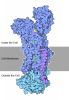
- Assembly
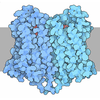
| Deposited unit | 
|
|---|---|
| 1 |
|
-Components
| #1: Protein | Mass: 40569.453 Da / Num. of mol.: 4 Source method: isolated from a genetically manipulated source Source: (gene. exp.) Homo sapiens (human) / Gene: KCNJ13 / Production host: Homo sapiens (human) / References: UniProt: O60928#2: Chemical | ChemComp-PIO / [( 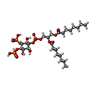  Mass: 746.566 Da / Num. of mol.: 4 / Source method: obtained synthetically / Formula: C25H49O19P3 / Feature type: SUBJECT OF INVESTIGATION Mass: 746.566 Da / Num. of mol.: 4 / Source method: obtained synthetically / Formula: C25H49O19P3 / Feature type: SUBJECT OF INVESTIGATION#3: Chemical | ChemComp-CLR / 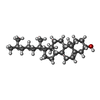 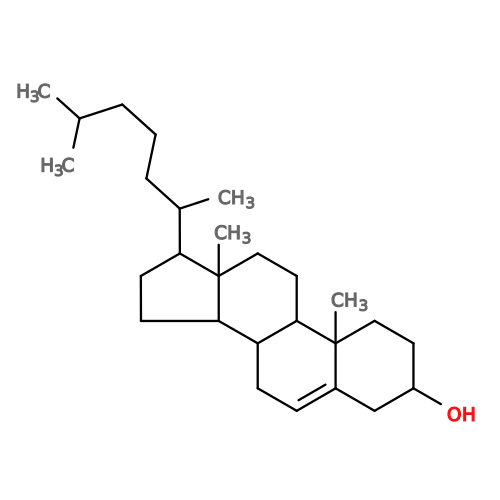 Mass: 386.654 Da / Num. of mol.: 4 / Source method: obtained synthetically / Formula: C27H46O Mass: 386.654 Da / Num. of mol.: 4 / Source method: obtained synthetically / Formula: C27H46OHas ligand of interest | Y | Has protein modification | Y | |
|---|
-Experimental details
-Experiment
| Experiment | Method: ELECTRON MICROSCOPY |
|---|---|
| EM experiment | Aggregation state: PARTICLE / 3D reconstruction method: single particle reconstruction |
- Sample preparation
| Component | Name: human inward-rectifier potassium 7.1 channel (Kir7.1) extended state Type: COMPLEX / Entity ID: #1 / Source: RECOMBINANT |
|---|---|
| Molecular weight | Value: 0.16 MDa / Experimental value: YES |
| Source (natural) | Organism: Homo sapiens (human) |
| Source (recombinant) | Organism: Homo sapiens (human) |
| Buffer solution | pH: 7.5 / Details: 20mM Tris-HCl pH 7.5, 150 mM KCl, 0.02% GDN |
| Specimen | Embedding applied: NO / Shadowing applied: NO / Staining applied: NO / Vitrification applied: YES |
| Specimen support | Details: Pelco easiGlow / Grid material: GOLD / Grid mesh size: 300 divisions/in. / Grid type: UltrAuFoil R0./1 |
| Vitrification | Instrument: FEI VITROBOT MARK IV / Cryogen name: ETHANE / Humidity: 100 % / Chamber temperature: 277.15 K |
- Electron microscopy imaging
| Experimental equipment |  Model: Titan Krios / Image courtesy: FEI Company |
|---|---|
| Microscopy | Model: TFS KRIOS |
| Electron gun | Electron source:  FIELD EMISSION GUN / Accelerating voltage: 300 kV / Illumination mode: FLOOD BEAM FIELD EMISSION GUN / Accelerating voltage: 300 kV / Illumination mode: FLOOD BEAM |
| Electron lens | Mode: BRIGHT FIELD / Nominal magnification: 130000 X / Nominal defocus max: 2800 nm / Nominal defocus min: 400 nm / Alignment procedure: COMA FREE |
| Specimen holder | Cryogen: NITROGEN / Specimen holder model: FEI TITAN KRIOS AUTOGRID HOLDER |
| Image recording | Electron dose: 40 e/Å2 / Film or detector model: FEI FALCON IV (4k x 4k) / Num. of real images: 12677 |
- Processing
| EM software |
| ||||||||||||||||||||||||||||||
|---|---|---|---|---|---|---|---|---|---|---|---|---|---|---|---|---|---|---|---|---|---|---|---|---|---|---|---|---|---|---|---|
| CTF correction | Type: PHASE FLIPPING AND AMPLITUDE CORRECTION | ||||||||||||||||||||||||||||||
| Particle selection | Num. of particles selected: 3859111 | ||||||||||||||||||||||||||||||
| Symmetry | Point symmetry: C4 (4 fold cyclic) | ||||||||||||||||||||||||||||||
| 3D reconstruction | Resolution: 3.3 Å / Resolution method: FSC 0.143 CUT-OFF / Num. of particles: 109323 / Algorithm: FOURIER SPACE / Num. of class averages: 1 / Symmetry type: POINT | ||||||||||||||||||||||||||||||
| Atomic model building | Protocol: BACKBONE TRACE | ||||||||||||||||||||||||||||||
| Atomic model building | Source name: AlphaFold / Type: in silico model | ||||||||||||||||||||||||||||||
| Refinement | Highest resolution: 3.3 Å Stereochemistry target values: REAL-SPACE (WEIGHTED MAP SUM AT ATOM CENTERS) | ||||||||||||||||||||||||||||||
| Refine LS restraints |
|
