[English] 日本語
Yorodumi Papers
- Database of articles cited by EMDB/PDB/SASBDB data -

+
Search query

Keywords
Structure methods
Author
Journal
IF

-
Structure paper

TitleActivating and inhibiting nucleotide signals coordinate bacterial anti-phage defense.
Journal, issue, pagesbioRxiv, Year 2025
Publish dateJul 9, 2025
AuthorsSonomi Yamaguchi / Samantha G Fernandez / Douglas R Wassarman / Marlen Lüders / Frank Schwede / Philip J Kranzusch /
PubMed AbstractThe cellular nucleotide pool is a major focal point of the host immune response to viral infection. Immune effector proteins that disrupt the nucleotide pool allow animal and bacterial cells to ...The cellular nucleotide pool is a major focal point of the host immune response to viral infection. Immune effector proteins that disrupt the nucleotide pool allow animal and bacterial cells to broadly restrict diverse viruses, but reduced nucleotide availability induces cellular toxicity and can limit host fitness(Ahmad et al., 1998; Goldstone et al., 2011; Hsueh et al., 2022; Itsko & Schaaper, 2014; Tal et al., 2022). Here we discover a bacterial anti-phage defense system named Clover that overcomes this tradeoff by encoding a deoxynucleoside triphosphohydrolase enzyme (CloA) that dynamically responds to both an activating phage cue and an inhibitory nucleotide immune signal produced by a partnering regulatory enzyme (CloB). Analysis of Clover phage restriction in cells and reconstitution of enzymatic function in vitro demonstrate that CloA is a dGTPase that responds to viral enzymes that increase cellular levels of dTTP. To restrain CloA activation in the absence of infection, we show that CloB synthesizes a dTTP-related inhibitory nucleotide signal p3diT (5'-triphosphothymidyl-3'5'-thymidine) that binds to CloA and suppresses activation. Cryo-EM structures of CloA in activated and suppressed states reveal how dTTP and p3diT control distinct allosteric sites and regulate effector function. Our results define how nucleotide signals coordinate both activation and inhibition of antiviral immunity and explain how cells balance defense and immune-mediated toxicity.
External linksbioRxiv / PubMed:40672243 / PubMed Central
MethodsEM (single particle) / X-ray diffraction
Resolution2.37 - 2.68 Å
Structure data

EMDB-71386, PDB-9p8s:
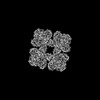
Structure of CloA apo
Method: EM (single particle) / Resolution: 2.37 Å

EMDB-71388, PDB-9p8t:
Structure of CloA co-expressed with CloB
Method: EM (single particle) / Resolution: 2.65 Å

EMDB-71389, PDB-9p8u:
Structure of CloA in complex with dGTP and p3diT
Method: EM (single particle) / Resolution: 2.56 Å

EMDB-71390, PDB-9p8v:
Structure of CloA in complex with dGTP and dTTP
Method: EM (single particle) / Resolution: 2.59 Å

PDB-9p8w:
Anti-phage dGTPase from Shewanella putrefaciens CN-32
Method: X-RAY DIFFRACTION / Resolution: 2.68 Å

Chemicals

ChemComp-MG:
Unknown entry

ChemComp-DGT:
2'-DEOXYGUANOSINE-5'-TRIPHOSPHATE

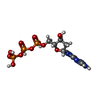
ChemComp-TTP:
THYMIDINE-5'-TRIPHOSPHATE

ChemComp-HOH:
WATER

Source
  • salmonella enterica (bacteria)
  • synthetic construct (others)
  • shewanella putrefaciens cn-32 (bacteria)
KeywordsHYDROLASE / deoxynucleoside triphosphohydrolase

+
About Yorodumi Papers

-
News

-
Feb 9, 2022. New format data for meta-information of EMDB entries

New format data for meta-information of EMDB entries

  • Version 3 of the EMDB header file is now the official format.
  • The previous official version 1.9 will be removed from the archive.

Related info.:EMDB header

External links:wwPDB to switch to version 3 of the EMDB data model

-
Aug 12, 2020. Covid-19 info

Covid-19 info

URL: https://pdbj.org/emnavi/covid19.php

New page: Covid-19 featured information page in EM Navigator.

Related info.:Covid-19 info / Mar 5, 2020. Novel coronavirus structure data

+
Mar 5, 2020. Novel coronavirus structure data

Novel coronavirus structure data

Related info.:Yorodumi Speices / Aug 12, 2020. Covid-19 info

External links:COVID-19 featured content - PDBj / Molecule of the Month (242):Coronavirus Proteases

+
Jan 31, 2019. EMDB accession codes are about to change! (news from PDBe EMDB page)

EMDB accession codes are about to change! (news from PDBe EMDB page)

  • The allocation of 4 digits for EMDB accession codes will soon come to an end. Whilst these codes will remain in use, new EMDB accession codes will include an additional digit and will expand incrementally as the available range of codes is exhausted. The current 4-digit format prefixed with “EMD-” (i.e. EMD-XXXX) will advance to a 5-digit format (i.e. EMD-XXXXX), and so on. It is currently estimated that the 4-digit codes will be depleted around Spring 2019, at which point the 5-digit format will come into force.
  • The EM Navigator/Yorodumi systems omit the EMD- prefix.

Related info.:Q: What is EMD? / ID/Accession-code notation in Yorodumi/EM Navigator

External links:EMDB Accession Codes are Changing Soon! / Contact to PDBj

+
Jul 12, 2017. Major update of PDB

Major update of PDB

  • wwPDB released updated PDB data conforming to the new PDBx/mmCIF dictionary.
  • This is a major update changing the version number from 4 to 5, and with Remediation, in which all the entries are updated.
  • In this update, many items about electron microscopy experimental information are reorganized (e.g. em_software).
  • Now, EM Navigator and Yorodumi are based on the updated data.

External links:wwPDB Remediation / Enriched Model Files Conforming to OneDep Data Standards Now Available in the PDB FTP Archive

-
Yorodumi Papers

Database of articles cited by EMDB/PDB/SASBDB data

  • Database of articles cited by EMDB, PDB, and SASBDB entries
  • Using PubMed data

Related info.:EMDB / PDB / SASBDB / Yorodumi / EMN Papers / Changes in new EM Navigator and Yorodumi

Read more