[English] 日本語
Yorodumi Papers
- Database of articles cited by EMDB/PDB/SASBDB data -

+
Search query

Keywords
Structure methods
Author
Journal
IF

-
Structure paper

TitleSnapshots of the dynamic basis of NTSR1 G protein subtype promiscuity.
Journal, issue, pagesNature, Year 2026
Publish dateJun 22, 2025 (structure data deposition date)
AuthorsAlina A Vo / Arnab Modak / Sumin Lu / Scott C Blanchard / Nevin A Lambert / Michael J Robertson /
PubMed AbstractG-protein-coupled receptors (GPCRs) are capable of signalling through four families of G protein α subunits. Although hundreds of nucleotide-free GPCR-G protein complex structures have been solved, ...G-protein-coupled receptors (GPCRs) are capable of signalling through four families of G protein α subunits. Although hundreds of nucleotide-free GPCR-G protein complex structures have been solved, the mechanism of G protein subtype selectivity remains poorly understood, with recent studies suggesting a role for dynamic nucleotide-bound intermediate states. Here we use time-resolved cryo-electron microscopy to visualize the GTP-induced activation of Gαβγ and Gαβγ heterotrimers bound to the neurotensin receptor 1 (NTSR1), which has been demonstrated to be highly promiscuous in G protein coupling and to possess unusual conformations in the nucleotide-free complex. We resolve ensembles of states along the G protein activation pathway, with differences in the structures and their relative populations between Gα and Gα. Structural analysis reveals a key role for several motifs, including intracellular loop 2 (ICL2) and ICL3, in stabilizing the observed intermediate states. Our results are supported by molecular dynamics simulations and kinetic bioluminescence resonance energy transfer experiments, which reveal that the stability of these intermediate states and the signalling of various G proteins are correlated with ICL2 and ICL3 sequences. Single-molecule fluorescence assays of GTP-induced NTSR1-G protein complex dissociation reveal that NTSR1 is liberated significantly faster from Gα, consistent with the relative lack of stable Gα-GTP intermediate states compared with Gα. These findings highlight that transient intermediate-state complexes along the G protein activation pathway have an important role in G protein selection that cannot be explained by nucleotide-free states alone.
External linksNature / PubMed:41813894
MethodsEM (single particle)
Resolution2.1 - 3.9 Å
Structure data

PDB-9p7z:
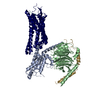
NTSR1-Gi-NTS(8-13) Complex in the Canonical, AHD Open State (C-Open-Apo)
Method: ELECTRON MICROSCOPY / Resolution: 2.1 Å

PDB-9p80:
NTSR1-Gi-NTS(8-13) Complex in the Non-Canonical, AHD Open State (NC-Open-Apo)
Method: ELECTRON MICROSCOPY / Resolution: 2.3 Å

PDB-9p81:
NTSR1-Gi-NTS(8-13), GTP-bound Complex in the Canonical, AHD Open State (C-Open-GTP)
Method: ELECTRON MICROSCOPY / Resolution: 2.6 Å

PDB-9p82:
NTSR1-Gi-NTS(8-13) GTP-Bound Complex in the Canonical, AHD Closed State (C-Closed-GTP)
Method: ELECTRON MICROSCOPY / Resolution: 2.4 Å

PDB-9p83:
NTSR1-Gi-NTS(8-13) GTP-Bound Complex in the Non-Canonical, AHD Open State (NC-Open-GTP)
Method: ELECTRON MICROSCOPY / Resolution: 3.2 Å

PDB-9p84:
NTSR1-Gi-NTS(8-13) GTP-Bound Complex in the Non-Canonical, AHD Closed State (NC-Closed-GTP)
Method: ELECTRON MICROSCOPY / Resolution: 2.7 Å

PDB-9p85:
NTSR1-Gi-NTS(8-13) GTP-Bound Complex in the Canonical, AHD Closed State, 3DVA Sorted (C-Closed*-GTP)
Method: ELECTRON MICROSCOPY / Resolution: 3 Å

PDB-9p86:
NTSR1-G11-NTS(8-13) Complex in the Canonical, AHD Open State (C-Open-Apo)
Method: ELECTRON MICROSCOPY / Resolution: 2.9 Å

PDB-9p87:
NTSR1-G11-NTS(8-13) Complex in the Canonical, AHD Partially Closed State (C-P-Closed-Apo)
Method: ELECTRON MICROSCOPY / Resolution: 2.8 Å

PDB-9p88:
NTSR1-G11-NTS(8-13) Complex in the Non-Canonical, AHD Open State (NC-Open-Apo)
Method: ELECTRON MICROSCOPY / Resolution: 2.9 Å

PDB-9p89:
NTSR1-G11-NTS(8-13) GTP-Bound Complex in the Canonical, AHD Closed State 3DVA Separated 1 (C-Closed-GTP)
Method: ELECTRON MICROSCOPY / Resolution: 3.9 Å

PDB-9p8a:
NTSR1-G11-NTS(8-13) GTP-Bound Complex in the Canonical, AHD Closed State 3DVA Separated 2 (C-Closed*-GTP)
Method: ELECTRON MICROSCOPY / Resolution: 3.7 Å

Chemicals

ChemComp-MG:
Unknown entry

ChemComp-GTP:
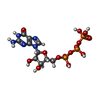
GUANOSINE-5'-TRIPHOSPHATE / GTP, energy-carrying molecule*YM

ChemComp-HOH:
WATER

Source
  • homo sapiens (human)
KeywordsSIGNALING PROTEIN / Complex / Agonist

+
About Yorodumi Papers

-
News

-
Feb 9, 2022. New format data for meta-information of EMDB entries

New format data for meta-information of EMDB entries

  • Version 3 of the EMDB header file is now the official format.
  • The previous official version 1.9 will be removed from the archive.

Related info.:EMDB header

External links:wwPDB to switch to version 3 of the EMDB data model

-
Aug 12, 2020. Covid-19 info

Covid-19 info

URL: https://pdbj.org/emnavi/covid19.php

New page: Covid-19 featured information page in EM Navigator.

Related info.:Covid-19 info / Mar 5, 2020. Novel coronavirus structure data

+
Mar 5, 2020. Novel coronavirus structure data

Novel coronavirus structure data

Related info.:Yorodumi Speices / Aug 12, 2020. Covid-19 info

External links:COVID-19 featured content - PDBj / Molecule of the Month (242):Coronavirus Proteases

+
Jan 31, 2019. EMDB accession codes are about to change! (news from PDBe EMDB page)

EMDB accession codes are about to change! (news from PDBe EMDB page)

  • The allocation of 4 digits for EMDB accession codes will soon come to an end. Whilst these codes will remain in use, new EMDB accession codes will include an additional digit and will expand incrementally as the available range of codes is exhausted. The current 4-digit format prefixed with “EMD-” (i.e. EMD-XXXX) will advance to a 5-digit format (i.e. EMD-XXXXX), and so on. It is currently estimated that the 4-digit codes will be depleted around Spring 2019, at which point the 5-digit format will come into force.
  • The EM Navigator/Yorodumi systems omit the EMD- prefix.

Related info.:Q: What is EMD? / ID/Accession-code notation in Yorodumi/EM Navigator

External links:EMDB Accession Codes are Changing Soon! / Contact to PDBj

+
Jul 12, 2017. Major update of PDB

Major update of PDB

  • wwPDB released updated PDB data conforming to the new PDBx/mmCIF dictionary.
  • This is a major update changing the version number from 4 to 5, and with Remediation, in which all the entries are updated.
  • In this update, many items about electron microscopy experimental information are reorganized (e.g. em_software).
  • Now, EM Navigator and Yorodumi are based on the updated data.

External links:wwPDB Remediation / Enriched Model Files Conforming to OneDep Data Standards Now Available in the PDB FTP Archive

-
Yorodumi Papers

Database of articles cited by EMDB/PDB/SASBDB data

  • Database of articles cited by EMDB, PDB, and SASBDB entries
  • Using PubMed data

Related info.:EMDB / PDB / SASBDB / Yorodumi / EMN Papers / Changes in new EM Navigator and Yorodumi

Read more