 Movie
Movie Controller
 Structure viewers
 About Yorodumi Papers


+Search query
-Structure paper
| Title | Rapid elicitation of neutralizing Asn332-glycan-independent antibodies to the V3-glycan epitope of HIV-1 Env in nonhuman primates. |
|---|---|
| Journal, issue, pages | Nat Immunol, Vol. 27, Issue 3, Page 586-599, Year 2026 |
| Publish date | Feb 3, 2026 |
 Authors Authors | Ignacio Relano-Rodriguez / Jianqiu Du / Zi Jie Lin / Margaret Kerwin / Marta Tarquis-Medina / Eduardo Urbano / Jiayan Cui / Meagan Watkins / Christy L Lavine / Peng Zhao / Rumi Habib / Colby Agostino / Sukanya Ghosh / Joyce Park / Caroline Boroughs / Agnes A Walsh / Mariane B Melo / Niharika Shukla / George M Shaw / Beatrice H Hahn / Darrell J Irvine / Lance Wells / David B Weiner / Michael S Seaman / Daniel W Kulp / Ronald S Veazey / Jesper Pallesen / Amelia Escolano /  |
| PubMed Abstract | Sequential immunization is a promising approach to elicit broadly neutralizing antibodies (bNAbs) against the HIV-1 Envelope (Env). However, available protocols are inefficient and involve multiple ...Sequential immunization is a promising approach to elicit broadly neutralizing antibodies (bNAbs) against the HIV-1 Envelope (Env). However, available protocols are inefficient and involve multiple immunizations over long periods of time. Here, we present WIN332, a new engineered Env immunogen that induces a new class of Asn332-glycan-independent antibodies to the conserved V3-glycan epitope of Env with low inhibitory activity indicative of a neutralization activity after a single bolus immunization in nonhuman primates. WIN332 binds to precursors of canonical human Asn332-glycan-dependent (type-I) V3-glycan bNAbs but also of a first-of-its-class Asn332-glycan-independent (type-II) V3-glycan bNAb. A single immunization elicits low inhibitory serum and monoclonal antibodies that are boosted and affinity matured with a heterologous immunogen. Electron microscopy polyclonal epitope mapping analysis of serum antibodies, antibody cloning and cryogenic electron microscopy analysis reveals that WIN332 elicits Asn332-glycan-independent antibodies with striking sequence and binding similarities with the most potent human type-I and type-II V3-glycan bNAbs. Thus, WIN332 is a promising vaccine candidate to streamline V3-glycan bNAb elicitation. |
 External links External links | Nat Immunol / PubMed:41634485 / PubMed Central |
| Methods | EM (single particle) |
| Resolution | 3.79 - 3.94 Å |
| Structure data | EMDB-70231, PDB-9o8m: EMDB-70395, PDB-9oed: |
| Chemicals | 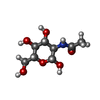 ChemComp-NAG: |
| Source |
|
 Keywords Keywords | VIRAL PROTEIN / HIV-1 Env / antibody |


 homo sapiens (human)
 human immunodeficiency virus 1
 macaca mulatta (Rhesus monkey)