[English] 日本語
Yorodumi Papers
- Database of articles cited by EMDB/PDB/SASBDB data -

+
Search query

Keywords
Structure methods
Author
Journal
IF

-
Structure paper

TitleRecovering high-resolution information using energy filtering in MicroED.
Journal, issue, pagesStruct Dyn, Vol. 12, Issue 3, Page 034702, Year 2025
Publish dateMay 13, 2025
AuthorsMax T B Clabbers / Tamir Gonen
PubMed AbstractInelastic scattering poses a significant challenge in electron crystallography by elevating background noise and broadening Bragg peaks, thereby reducing the overall signal-to-noise ratio. This is ...Inelastic scattering poses a significant challenge in electron crystallography by elevating background noise and broadening Bragg peaks, thereby reducing the overall signal-to-noise ratio. This is particularly detrimental to data quality in structural biology, as the diffraction signal is relatively weak. These effects are aggravated even further by the decay of the diffracted intensities as a result of accumulated radiation damage, and rapidly fading high-resolution information can disappear beneath the noise. Loss of high-resolution reflections can partly be mitigated using energy filtering, which removes inelastically scattered electrons and improves data quality and resolution. Here, we systematically compared unfiltered and energy-filtered microcrystal electron diffraction data from proteinase K crystals, first collecting an unfiltered dataset followed directly by a second sweep using the same settings but with the energy filter inserted. Our results show that energy filtering consistently reduces noise, sharpens Bragg peaks, and extends high-resolution information, even though the absorbed dose was doubled for the second pass. Importantly, our results demonstrate that high-resolution information can be recovered by inserting the energy filter slit. Energy-filtered datasets showed improved intensity statistics and better internal consistency, highlighting the effectiveness of energy filtering for improving data quality. These findings underscore its potential to overcome limitations in macromolecular electron crystallography, enabling higher-resolution structures with greater reliability.
External linksStruct Dyn / PubMed:40370641 / PubMed Central
MethodsEM (electron crystallography)
Resolution1.3 Å
Structure data

EMDB-70378, PDB-9odv:
MicroED structure of proteinase K without energy filtering
Method: EM (electron crystallography) / Resolution: 1.3 Å

EMDB-70379, PDB-9odw:
MicroED structure of proteinase K with energy filtering
Method: EM (electron crystallography) / Resolution: 1.3 Å

Chemicals

ChemComp-CA:
Unknown entry

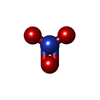
ChemComp-NO3:
NITRATE ION

ChemComp-HOH:
WATER

Source
  • parengyodontium album (fungus)
KeywordsHYDROLASE / serine protease

+
About Yorodumi Papers

-
News

-
Feb 9, 2022. New format data for meta-information of EMDB entries

New format data for meta-information of EMDB entries

  • Version 3 of the EMDB header file is now the official format.
  • The previous official version 1.9 will be removed from the archive.

Related info.:EMDB header

External links:wwPDB to switch to version 3 of the EMDB data model

-
Aug 12, 2020. Covid-19 info

Covid-19 info

URL: https://pdbj.org/emnavi/covid19.php

New page: Covid-19 featured information page in EM Navigator.

Related info.:Covid-19 info / Mar 5, 2020. Novel coronavirus structure data

+
Mar 5, 2020. Novel coronavirus structure data

Novel coronavirus structure data

Related info.:Yorodumi Speices / Aug 12, 2020. Covid-19 info

External links:COVID-19 featured content - PDBj / Molecule of the Month (242):Coronavirus Proteases

+
Jan 31, 2019. EMDB accession codes are about to change! (news from PDBe EMDB page)

EMDB accession codes are about to change! (news from PDBe EMDB page)

  • The allocation of 4 digits for EMDB accession codes will soon come to an end. Whilst these codes will remain in use, new EMDB accession codes will include an additional digit and will expand incrementally as the available range of codes is exhausted. The current 4-digit format prefixed with “EMD-” (i.e. EMD-XXXX) will advance to a 5-digit format (i.e. EMD-XXXXX), and so on. It is currently estimated that the 4-digit codes will be depleted around Spring 2019, at which point the 5-digit format will come into force.
  • The EM Navigator/Yorodumi systems omit the EMD- prefix.

Related info.:Q: What is EMD? / ID/Accession-code notation in Yorodumi/EM Navigator

External links:EMDB Accession Codes are Changing Soon! / Contact to PDBj

+
Jul 12, 2017. Major update of PDB

Major update of PDB

  • wwPDB released updated PDB data conforming to the new PDBx/mmCIF dictionary.
  • This is a major update changing the version number from 4 to 5, and with Remediation, in which all the entries are updated.
  • In this update, many items about electron microscopy experimental information are reorganized (e.g. em_software).
  • Now, EM Navigator and Yorodumi are based on the updated data.

External links:wwPDB Remediation / Enriched Model Files Conforming to OneDep Data Standards Now Available in the PDB FTP Archive

-
Yorodumi Papers

Database of articles cited by EMDB/PDB/SASBDB data

  • Database of articles cited by EMDB, PDB, and SASBDB entries
  • Using PubMed data

Related info.:EMDB / PDB / SASBDB / Yorodumi / EMN Papers / Changes in new EM Navigator and Yorodumi

Read more