Niko W Vlahakis / Cameron W Flowers / Mengting Liu / Matthew P Agdanowski / Samuel Johnson / Jacob A Summers / Lian M C Jacobs / Catherine Keyser / Phoebe Russell / Samuel L Rose / Julien Orlans / Nima Adhami / Yu Chen / Michael R Sawaya / Shibom Basu / Daniele de Sanctis / Yu Chen / Soichi Wakatsuki / Hosea M Nelson / Joseph A Loo / Yi Tang / Jose A Rodriguez /
PubMed Abstract
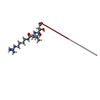
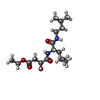
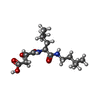
With the goal of accelerating the discovery of small molecule-protein complexes, we leverage fast, low-dose, event-based electron counting microcrystal electron diffraction (MicroED) data collection ...With the goal of accelerating the discovery of small molecule-protein complexes, we leverage fast, low-dose, event-based electron counting microcrystal electron diffraction (MicroED) data collection and native mass spectrometry. This approach, which we term electron diffraction with native mass spectrometry (ED-MS), allows assignment of protein target structures bound to ligands with data obtained from crystal slurries soaked with mixtures of known inhibitors and crude biosynthetic reactions. This extends to libraries of printed ligands dispensed directly onto TEM grids for later soaking with microcrystal slurries, and complexes with noncovalent ligands. ED-MS resolves structures of the natural product, epoxide-based cysteine protease inhibitor E-64, and its biosynthetic analogs bound to the model cysteine protease, papain. It further identifies papain binding to its preferred natural products, by showing that two analogs of E-64 outcompete others in binding to papain crystals, and by detecting papain bound to E-64 and an analog from crude biosynthetic reactions, without purification. ED-MS also resolves binding of the CTX-M-14 β-lactamase, a target of active drug development, to the non-β-lactam inhibitor, avibactam, alone or in a cocktail of unrelated compounds. These results illustrate the utility of ED-MS for natural product ligand discovery and for structure-based screening of small molecule binders to macromolecular targets, promising utility for drug discovery.
PDB-9nbp: MicroED structure of the papain-E-64 complex from microcrystals mixed on-grid with microarrayed ligand Method: ELECTRON CRYSTALLOGRAPHY / Resolution: 2.8 Å
PDB-9nbq: MicroED structure of papain co-crystallized with E-64D Method: ELECTRON CRYSTALLOGRAPHY / Resolution: 2.3 Å
PDB-9nc1: MicroED structure of papain-E-64 complex from microcrystals soaked with protease inhibitor cocktail Method: ELECTRON CRYSTALLOGRAPHY / Resolution: 2.4 Å
PDB-9nca: MicroED structure of microcrystals soaked with a mixture of E-64, E-64C, and E-64D Method: ELECTRON CRYSTALLOGRAPHY / Resolution: 2.5 Å
PDB-9ncc: Serial synchrotron X-ray diffraction structure of the apo form of papain Method: X-RAY DIFFRACTION / Resolution: 1.8 Å
PDB-9oqe: X-ray diffraction structure of apo-form CTX-M-14 beta-lactamase Method: X-RAY DIFFRACTION / Resolution: 1.5 Å
PDB-9or3: X-ray diffraction structure of CTX-M-14 beta-lactamase co-crystallized with avibactam Method: X-RAY DIFFRACTION / Resolution: 1.6 Å
PDB-9or7: X-ray diffraction structure of CTX-M-14 beta-lactamase soaked with avibactam Method: X-RAY DIFFRACTION / Resolution: 1.5 Å
PDB-9orb: X-ray diffraction structure of the CTX-M-14 beta-lactamase-avibactam complex an inhibitor cocktail-soaked crystal Method: X-RAY DIFFRACTION / Resolution: 1.5 Å
PDB-9org: MicroED structure of apo-form CTX-M-14 beta-lactamase Method: ELECTRON CRYSTALLOGRAPHY / Resolution: 2.5 Å
PDB-9orh: MicroED structure of the CTX-M-14 beta-lactamase-avibactam complex from inhibitor cocktail-soaked crystals Method: ELECTRON CRYSTALLOGRAPHY / Resolution: 2 Å
PDB-9orl: MicroED structure of CTX-M-14 beta-lactamase soaked with avibactam Method: ELECTRON CRYSTALLOGRAPHY / Resolution: 2.3 Å
PDB-9ors: MicroED structure of CTX-M-14 beta-lactamase co-crystallized with avibactam Method: ELECTRON CRYSTALLOGRAPHY / Resolution: 2 Å
PDB-9orv: X-ray diffraction structure of lysozyme co-crystallized with N,N',N"-triacetylchitotriose Method: X-RAY DIFFRACTION / Resolution: 1.6 Å
PDB-9orw: X-ray diffraction structure of apo-form lysozyme Method: X-RAY DIFFRACTION / Resolution: 1.5 Å
PDB-9orx: X-ray diffraction structure of lysozyme complexed with N,N',N"-triacetylchitotriose from a cocktail-soaked crystal Method: X-RAY DIFFRACTION / Resolution: 1.5 Å
PDB-9ory: X-ray diffraction structure of lysozyme soaked with N,N',N"-triacetylchitotriose Method: X-RAY DIFFRACTION / Resolution: 1.4 Å
PDB-9orz: MicroED structure of apo-form lysozyme Method: ELECTRON CRYSTALLOGRAPHY / Resolution: 2.3 Å
PDB-9os0: MicroED structure of lysozyme complexed with N,N',N"-triacetylchitotriose from cocktail-soaked crystals Method: ELECTRON CRYSTALLOGRAPHY / Resolution: 2.4 Å
PDB-9os1: MicroED structure of lysozyme co-crystallized with N,N',N"-triacetylchitotriose Method: ELECTRON CRYSTALLOGRAPHY / Resolution: 2.3 Å
PDB-9os8: MicroED structure of lysozyme soaked with N,N',N"-triacetylchitotriose Method: ELECTRON CRYSTALLOGRAPHY / Resolution: 2.3 Å
In the structure databanks used in Yorodumi, some data are registered as the other names, "COVID-19 virus" and "2019-nCoV". Here are the details of the virus and the list of structure data.
Jan 31, 2019. EMDB accession codes are about to change! (news from PDBe EMDB page)
EMDB accession codes are about to change! (news from PDBe EMDB page)
The allocation of 4 digits for EMDB accession codes will soon come to an end. Whilst these codes will remain in use, new EMDB accession codes will include an additional digit and will expand incrementally as the available range of codes is exhausted. The current 4-digit format prefixed with “EMD-” (i.e. EMD-XXXX) will advance to a 5-digit format (i.e. EMD-XXXXX), and so on. It is currently estimated that the 4-digit codes will be depleted around Spring 2019, at which point the 5-digit format will come into force.
The EM Navigator/Yorodumi systems omit the EMD- prefix.
Related info.:Q: What is EMD? / ID/Accession-code notation in Yorodumi/EM Navigator
 Movie
Movie Controller
 Structure viewers
 About Yorodumi Papers


 Authors

 External links





 Keywords
 carica papaya (papaya)
 escherichia coli (E. coli)
 gallus gallus (chicken)