[English] 日本語
Yorodumi Papers
- Database of articles cited by EMDB/PDB/SASBDB data -

+
Search query

Keywords
Structure methods
Author
Journal
IF

-
Structure paper

TitleShort 5' UTRs serve as a marker for viral mRNA translation inhibition by the IFIT2-IFIT3 antiviral complex.
Journal, issue, pagesbioRxiv, Year 2025
Publish dateFeb 11, 2025
AuthorsDustin R Glasner / Candace Todd / Brian Cook / Agustina D'Urso / Shivani Khosla / Elena Estrada / Jaxon D Wagner / Mason D Bartels / Pierce Ford / Jordan Prych / Katie Hatch / Brian A Yee / Kaori M Ego / Qishan Liang / Sarah R Holland / James Brett Case / Kevin D Corbett / Michael S Diamond / Gene W Yeo / Mark A Herzik / Eric L Van Nostrand / Matthew D Daugherty /
PubMed AbstractRecognition of "non-self" nucleic acids, including cytoplasmic dsDNA, dsRNA, or mRNAs lacking proper 5' cap structures, is critical for the innate immune response to viruses. Here, we demonstrate ...Recognition of "non-self" nucleic acids, including cytoplasmic dsDNA, dsRNA, or mRNAs lacking proper 5' cap structures, is critical for the innate immune response to viruses. Here, we demonstrate that short 5' untranslated regions (UTRs), a characteristic of many viral mRNAs, can also serve as a molecular pattern for innate immune recognition via the interferon-induced proteins IFIT2 and IFIT3. The IFIT2-IFIT3 heterodimer, formed through an intricate domain swap structure resolved by cryo-EM, mediates viral mRNA 5' end recognition, translation inhibition, and ultimately antiviral activity. Critically, 5' UTR lengths <50 nucleotides are necessary and sufficient to sensitize an mRNA to translation inhibition by the IFIT2-IFIT3 complex. Accordingly, diverse viruses whose mRNAs contain short 5' UTRs, such as vesicular stomatitis virus and parainfluenza virus 3, are sensitive to IFIT2-IFIT3-mediated antiviral activity. Our work thus reveals a pattern of antiviral nucleic acid immune recognition that takes advantage of the inherent constraints on viral genome size.
External linksbioRxiv / PubMed:39990370 / PubMed Central
MethodsEM (single particle)
Resolution3.22 Å
Structure data

EMDB-48323, PDB-9mk9:
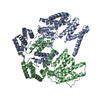
Structure of the IFIT2-IFIT3 heterodimer from Mus musculus
Method: EM (single particle) / Resolution: 3.22 Å

Source
  • mus musculus (house mouse)
KeywordsANTIVIRAL PROTEIN / innate immune recognition / interferon-induced proteins / non-self nucleic acids

+
About Yorodumi Papers

-
News

-
Feb 9, 2022. New format data for meta-information of EMDB entries

New format data for meta-information of EMDB entries

  • Version 3 of the EMDB header file is now the official format.
  • The previous official version 1.9 will be removed from the archive.

Related info.:EMDB header

External links:wwPDB to switch to version 3 of the EMDB data model

-
Aug 12, 2020. Covid-19 info

Covid-19 info

URL: https://pdbj.org/emnavi/covid19.php

New page: Covid-19 featured information page in EM Navigator.

Related info.:Covid-19 info / Mar 5, 2020. Novel coronavirus structure data

+
Mar 5, 2020. Novel coronavirus structure data

Novel coronavirus structure data

Related info.:Yorodumi Speices / Aug 12, 2020. Covid-19 info

External links:COVID-19 featured content - PDBj / Molecule of the Month (242):Coronavirus Proteases

+
Jan 31, 2019. EMDB accession codes are about to change! (news from PDBe EMDB page)

EMDB accession codes are about to change! (news from PDBe EMDB page)

  • The allocation of 4 digits for EMDB accession codes will soon come to an end. Whilst these codes will remain in use, new EMDB accession codes will include an additional digit and will expand incrementally as the available range of codes is exhausted. The current 4-digit format prefixed with “EMD-” (i.e. EMD-XXXX) will advance to a 5-digit format (i.e. EMD-XXXXX), and so on. It is currently estimated that the 4-digit codes will be depleted around Spring 2019, at which point the 5-digit format will come into force.
  • The EM Navigator/Yorodumi systems omit the EMD- prefix.

Related info.:Q: What is EMD? / ID/Accession-code notation in Yorodumi/EM Navigator

External links:EMDB Accession Codes are Changing Soon! / Contact to PDBj

+
Jul 12, 2017. Major update of PDB

Major update of PDB

  • wwPDB released updated PDB data conforming to the new PDBx/mmCIF dictionary.
  • This is a major update changing the version number from 4 to 5, and with Remediation, in which all the entries are updated.
  • In this update, many items about electron microscopy experimental information are reorganized (e.g. em_software).
  • Now, EM Navigator and Yorodumi are based on the updated data.

External links:wwPDB Remediation / Enriched Model Files Conforming to OneDep Data Standards Now Available in the PDB FTP Archive

-
Yorodumi Papers

Database of articles cited by EMDB/PDB/SASBDB data

  • Database of articles cited by EMDB, PDB, and SASBDB entries
  • Using PubMed data

Related info.:EMDB / PDB / SASBDB / Yorodumi / EMN Papers / Changes in new EM Navigator and Yorodumi

Read more