 Movie
Movie Controller
 Structure viewers
 About Yorodumi Papers


+Search query
-Structure paper
| Title | Substrate specificity and transport mechanism of the chloroplast dicarboxylate transporters DiT1 and DiT2. |
|---|---|
| Journal, issue, pages | Plant Cell, Vol. 38, Issue 3, Year 2026 |
| Publish date | Mar 3, 2026 |
 Authors Authors | Zhao Yang / Xue Zhang / Jingtao Zheng / Shunhao Zhou / Ming-Ju Amy Lyu / Miaolian Ma / Xin-Guang Zhu / Fang Yu / Peng Zhang /  |
| PubMed Abstract | Dicarboxylate transporters (DiTs) mediate the exchange of dicarboxylates across the chloroplast inner membrane, playing critical roles in C/N coupling, photorespiration, chloroplast redox ...Dicarboxylate transporters (DiTs) mediate the exchange of dicarboxylates across the chloroplast inner membrane, playing critical roles in C/N coupling, photorespiration, chloroplast redox homeostasis, and C4 photosynthesis. DiT1 and DiT2 are Na⁺-independent exchangers of the solute carrier 13 (SLC13) family, and exhibit overlapping yet distinct substrate specificities: DiT1 transports 2-oxoglutarate, malate, and oxaloacetate, while DiT2 additionally transports glutamate and aspartate. However, the structural determinants of their substrate specificity and transport mechanism remain unclear. Here, we determined cryo-electron microscopy structures of Arabidopsis thaliana DiT1 and DiT2.1 bound to diverse substrates in dual conformational states. Structural analyses revealed that AtDiT1 possesses a singular dicarboxylate-binding site that is electrostatically incompatible with amino acid substrates, whereas AtDiT2.1 has 2 distinct sites to accommodate C4- and C5-dicarboxylates, thus allowing amino acids to bind without electrostatic repulsion. Phylogenetic analysis identified an A226S substitution in the substrate-binding site of DiT1, emerging during evolution in the charophyte ancestor of land plants. This substitution enhances oxaloacetate binding affinity in DiT1, which may have improved adaptation to terrestrial environments. Additionally, 2 conserved positively charged residues in DiTs functionally mimic Na⁺ used by SLC13 co-transporters, thereby enabling a Na⁺-independent elevator-type transport mechanism. These findings provide critical structural and mechanistic insights into the functional divergence of plant DiTs. |
 External links External links | Plant Cell / PubMed:41731698 |
| Methods | EM (single particle) |
| Resolution | 2.41 - 2.94 Å |
| Structure data | EMDB-63803, PDB-9mcr: EMDB-63804, PDB-9mcs: EMDB-63805, PDB-9mct: EMDB-63806, PDB-9mcu: EMDB-63807, PDB-9mcv: EMDB-63808, PDB-9u32: |
| Chemicals |  ChemComp-OAA:  ChemComp-HOH: 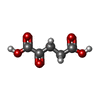 ChemComp-AKG: 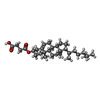 ChemComp-Y01: 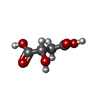 ChemComp-LMR: 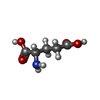 ChemComp-GLU: |
| Source |
|
 Keywords Keywords | TRANSPORT PROTEIN / chloroplast / dicarboxylate transporters / C/N coupling / C4 photosynthesis |


 arabidopsis thaliana (thale cress)