[English] 日本語
Yorodumi Papers
- Database of articles cited by EMDB/PDB/SASBDB data -

+
Search query

Keywords
Structure methods
Author
Journal
IF

-
Structure paper

TitleStructure of a photosystem I supercomplex from close to an ancestral red alga.
Journal, issue, pagesSci Adv, Vol. 11, Issue 20, Page eadv7488, Year 2025
Publish dateMay 16, 2025
AuthorsKoji Kato / Minoru Kumazawa / Yoshiki Nakajima / Takehiro Suzuki / Naoshi Dohmae / Jian-Ren Shen / Kentaro Ifuku / Ryo Nagao /
PubMed AbstractRed algae exhibit unique photosynthetic adaptations, characterized by photosystem I (PSI) supercomplexes containing light-harvesting complexes (LHCs), forming PSI-LHCI supercomplexes. In this study, ...Red algae exhibit unique photosynthetic adaptations, characterized by photosystem I (PSI) supercomplexes containing light-harvesting complexes (LHCs), forming PSI-LHCI supercomplexes. In this study, we solved the PSI-LHCI structure of NIES-3638 at 2.19-angstrom resolution using cryo-electron microscopy, revealing a PSI monomer core associated with seven LHCI subunits. Structural analysis uncovered the absence of phylloquinones, the common secondary electron acceptor in PSI of photosynthetic organisms, suggesting adaptation to a benzoquinone-like molecule. Phylogenetic analysis suggests that retains traits characteristic of an ancestral red alga, including distinctive LHCI binding and interaction patterns. Variations in LHCI composition and interactions across red algae, particularly in red-lineage chlorophyll /-binding-like protein and red algal LHCs, highlight evolutionary divergence and specialization. These findings not only deepen our understanding of red algal PSI-LHCI diversification but also enable us to predict features of an ancestral red algal PSI-LHCI supercomplex, providing a framework to explore evolutionary adaptations from an ancestral red alga.
External linksSci Adv / PubMed:40378202 / PubMed Central
MethodsEM (single particle)
Resolution2.19 Å
Structure data

EMDB-62242, PDB-9kc5:
PSI-LHCI of the red alga Galdieria sulphuraria NIES-3638
Method: EM (single particle) / Resolution: 2.19 Å

Chemicals

ChemComp-CL0:
CHLOROPHYLL A ISOMER

ChemComp-CLA:
CHLOROPHYLL A

PDB-1l64:
TOLERANCE OF T4 LYSOZYME TO MULTIPLE XAA (RIGHT ARROW) ALA SUBSTITUTIONS: A POLYALANINE ALPHA-HELIX CONTAINING TEN CONSECUTIVE ALANINES

ChemComp-LHG:
1,2-DIPALMITOYL-PHOSPHATIDYL-GLYCEROLE / phospholipid*YM

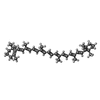
ChemComp-BCR:
BETA-CAROTENE

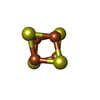
ChemComp-SF4:
IRON/SULFUR CLUSTER


ChemComp, No image

ChemComp-UNL:
Unknown ligand

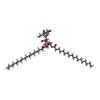
ChemComp-DGD:
DIGALACTOSYL DIACYL GLYCEROL (DGDG)


ChemComp, No image

ChemComp-5X6:
Unknown entry

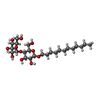
ChemComp-LMT:
DODECYL-BETA-D-MALTOSIDE / detergent*YM

ChemComp-RRX:
(3R)-beta,beta-caroten-3-ol

ChemComp-HOH:
WATER

Source
  • galdieria sulphuraria (eukaryote)
KeywordsPHOTOSYNTHESIS / Photosystem I / ELECTRON TRANSPORT

+
About Yorodumi Papers

-
News

-
Feb 9, 2022. New format data for meta-information of EMDB entries

New format data for meta-information of EMDB entries

  • Version 3 of the EMDB header file is now the official format.
  • The previous official version 1.9 will be removed from the archive.

Related info.:EMDB header

External links:wwPDB to switch to version 3 of the EMDB data model

-
Aug 12, 2020. Covid-19 info

Covid-19 info

URL: https://pdbj.org/emnavi/covid19.php

New page: Covid-19 featured information page in EM Navigator.

Related info.:Covid-19 info / Mar 5, 2020. Novel coronavirus structure data

+
Mar 5, 2020. Novel coronavirus structure data

Novel coronavirus structure data

Related info.:Yorodumi Speices / Aug 12, 2020. Covid-19 info

External links:COVID-19 featured content - PDBj / Molecule of the Month (242):Coronavirus Proteases

+
Jan 31, 2019. EMDB accession codes are about to change! (news from PDBe EMDB page)

EMDB accession codes are about to change! (news from PDBe EMDB page)

  • The allocation of 4 digits for EMDB accession codes will soon come to an end. Whilst these codes will remain in use, new EMDB accession codes will include an additional digit and will expand incrementally as the available range of codes is exhausted. The current 4-digit format prefixed with “EMD-” (i.e. EMD-XXXX) will advance to a 5-digit format (i.e. EMD-XXXXX), and so on. It is currently estimated that the 4-digit codes will be depleted around Spring 2019, at which point the 5-digit format will come into force.
  • The EM Navigator/Yorodumi systems omit the EMD- prefix.

Related info.:Q: What is EMD? / ID/Accession-code notation in Yorodumi/EM Navigator

External links:EMDB Accession Codes are Changing Soon! / Contact to PDBj

+
Jul 12, 2017. Major update of PDB

Major update of PDB

  • wwPDB released updated PDB data conforming to the new PDBx/mmCIF dictionary.
  • This is a major update changing the version number from 4 to 5, and with Remediation, in which all the entries are updated.
  • In this update, many items about electron microscopy experimental information are reorganized (e.g. em_software).
  • Now, EM Navigator and Yorodumi are based on the updated data.

External links:wwPDB Remediation / Enriched Model Files Conforming to OneDep Data Standards Now Available in the PDB FTP Archive

-
Yorodumi Papers

Database of articles cited by EMDB/PDB/SASBDB data

  • Database of articles cited by EMDB, PDB, and SASBDB entries
  • Using PubMed data

Related info.:EMDB / PDB / SASBDB / Yorodumi / EMN Papers / Changes in new EM Navigator and Yorodumi

Read more