 Movie
Movie Controller
 Structure viewers
 About Yorodumi Papers


+Search query
-Structure paper
| Title | Chanoclavine synthase operates by an NADPH-independent superoxide mechanism. |
|---|---|
| Journal, issue, pages | Nature, Vol. 640, Issue 8059, Page 840-846, Year 2025 |
| Publish date | Mar 5, 2025 |
 Authors Authors | Chun-Chi Chen / Zhi-Pu Yu / Ziwei Liu / Yongpeng Yao / Peter-Leon Hagedoorn / Rob Alexander Schmitz / Lujia Yang / Lu Yu / Aokun Liu / Xiang Sheng / Hao Su / Yaqing Ma / Te Wang / Jian-Wen Huang / Lilan Zhang / Juzhang Yan / Jinping Bao / Chengsen Cui / Xian Li / Panpan Shen / Wuyuan Zhang / Jian Min / Chang-Yun Wang / Rey-Ting Guo / Shu-Shan Gao /   |
| PubMed Abstract | More than ten ergot alkaloids comprising both natural and semi-synthetic products are used to treat various diseases. The central C ring forms the core pharmacophore for ergot alkaloids, giving them ...More than ten ergot alkaloids comprising both natural and semi-synthetic products are used to treat various diseases. The central C ring forms the core pharmacophore for ergot alkaloids, giving them structural similarity to neurotransmitters, thus enabling their modulation of neurotransmitter receptors. The haem catalase chanoclavine synthase (EasC) catalyses the construction of this ring through complex radical oxidative cyclization. Unlike canonical catalases, which catalyse HO disproportionation, EasC and its homologues represent a broader class of catalases that catalyse O-dependent radical reactions. We have elucidated the structure of EasC by cryo-electron microscopy, revealing a nicotinamide adenine dinucleotide phosphate (reduced) (NADPH)-binding pocket and a haem pocket common to all haem catalases, with a unique homodimeric architecture that is, to our knowledge, previously unobserved. The substrate prechanoclavine unprecedentedly binds in the NADPH-binding pocket, instead of the previously suspected haem-binding pocket, and two pockets were connected by a slender tunnel. Contrary to the established mechanisms, EasC uses superoxide rather than the more generally used transient haem iron-oxygen complexes (such as compounds I, II and III), to mediate substrate transformation through superoxide-mediated cooperative catalysis of the two distant pockets. We propose that this reactive oxygen species mechanism could be widespread in metalloenzyme-catalysed reactions. |
 External links External links | Nature / PubMed:40044871 / PubMed Central |
| Methods | EM (single particle) |
| Resolution | 2.33 - 2.64 Å |
| Structure data | EMDB-61387, PDB-9jdb: EMDB-61388, PDB-9jdc: |
| Chemicals | 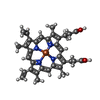 ChemComp-HEM: 
ChemComp-LH6: |
| Source |
|
 Keywords Keywords | OXIDOREDUCTASE / Alkaloid metabolism / Heme / Metal-binding / Peroxidase |



 claviceps fusiformis (fungus)