 Movie
Movie Controller
 Structure viewers
 About Yorodumi Papers


+Search query
-Structure paper
| Title | Targeting NAT10 attenuates homologous recombination via destabilizing DNA:RNA hybrids and overcomes PARP inhibitor resistance in cancers. |
|---|---|
| Journal, issue, pages | Drug Resist Updat, Vol. 81, Page 101241, Year 2025 |
| Publish date | Mar 22, 2025 |
 Authors Authors | Zhu Xu / Mingming Zhu / Longpo Geng / Jun Zhang / Jing Xia / Qiang Wang / Hongda An / Anliang Xia / Yuanyuan Yu / Shihan Liu / Junjie Tong / Wei-Guo Zhu / Yiyang Jiang / Beicheng Sun /  |
| PubMed Abstract | AIMS: RNA metabolism has been extensively studied in DNA double-strand break (DSB) repair. The RNA acetyltransferase N-acetyltransferase 10 (NAT10)-mediated N4-acetylcytidine (ac4C) modification in ...AIMS: RNA metabolism has been extensively studied in DNA double-strand break (DSB) repair. The RNA acetyltransferase N-acetyltransferase 10 (NAT10)-mediated N4-acetylcytidine (ac4C) modification in DSB repair remains largely elusive. In this study, we aim to decipher the role for ac4C modification by NAT10 in DSB repair in hepatocellular carcinoma (HCC). METHODS: Laser micro-irradiation and chromatin immunoprecipitation (ChIP) were used to assess the accumulation of ac4C modification and NAT10 at DSB sites. Cryo-electron microscopy (cryo-EM) was used to determine the structures of NAT10 in complex with its inhibitor, remodelin. Hepatocyte-specific deletion of NAT10 mouse models were adopted to detect the effects of NAT10 on HCC progression. Subcutaneous xenograft, human HCC organoid and patient-derived xenograft (PDX) model were exploited to determine the therapy efficiency of the combination of a poly (ADP-ribose) polymerase 1 (PARP1) inhibitor (PARPi) and remodelin. RESULTS: NAT10 promptly accumulates at DSB sites, where it executes ac4C modification on RNAs at DNA:RNA hybrids dependent on PARP1. This in turn enhances the stability of DNA:RNA hybrids and promotes homologous recombination (HR) repair. The ablation of NAT10 curtails HCC progression. Furthermore, the cryo-EM yields a remarkable 2.9 angstroms resolution structure of NAT10-remodelin, showcasing a C2 symmetric architecture. Remodelin treatment significantly enhanced the sensitivity of HCC cells to a PARPi and targeting NAT10 also restored sensitivity to a PARPi in ovarian and breast cancer cells that had developed resistance. CONCLUSION: Our study elucidated the mechanism of NAT10-mediated ac4C modification in DSB repair, revealing that targeting NAT10 confers synthetic lethality to PARP inhibition in HCC. Our findings suggest that co-inhibition of NAT10 and PARP1 is an effective novel therapeutic strategy for patients with HCC and have the potential to overcome PARPi resistance. |
 External links External links | Drug Resist Updat / PubMed:40132530 |
| Methods | EM (single particle) |
| Resolution | 2.9 Å |
| Structure data | EMDB-61113, PDB-9j3c: |
| Chemicals | 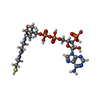 ChemComp-COA: |
| Source |
|
 Keywords Keywords | TRANSFERASE / NAT10 / acyltransferase / N4-acetylcytidine |


 homo sapiens (human)