[English] 日本語
Yorodumi Papers
- Database of articles cited by EMDB/PDB/SASBDB data -

+
Search query

Keywords
Structure methods
Author
Journal
IF

-
Structure paper

TitleBispecific antibody-antigen complex structures reveal activity enhancement by domain rearrangement.
Journal, issue, pagesCell Rep, Vol. 44, Issue 7, Page 115965, Year 2025
Publish dateJul 22, 2025
AuthorsKyohei Sato / Shiro Uehara / Atsushi Tsugita / Mayuka Ishii / Shieru Ishiyama / Atsushi Maejima / Ishin Nakahara / Misae Nazuka / Takashi Matsui / Gatsogiannis Christos / Takeshi Yokoyama / Izumi Kumagai / Koki Makabe / Ryutaro Asano / Yoshikazu Tanaka /
PubMed AbstractBispecific antibodies (BsAbs) have been developed as anti-cancer drugs that accumulate activated T cells on cancer cells by bridging the antigens present in each cell. Ex3 is a diabody-type BsAb ...Bispecific antibodies (BsAbs) have been developed as anti-cancer drugs that accumulate activated T cells on cancer cells by bridging the antigens present in each cell. Ex3 is a diabody-type BsAb composed of an anti-epidermal growth factor receptor (EGFR) antibody and an anti-CD3 antibody. In the design of Ex3, the LH-type domain order (Ex3LH) is shown to have more than 100-fold greater anti-cancer activity than the HL-type domain order (Ex3HL). To understand this phenomenon of activity enhancement by domain-order rearrangement, we report here cryoelectron microscopy (cryo-EM) structures of both Ex3HL and Ex3LH in complex with EGFR and CD3. A structural comparison of the HL and LH types reveals that the domain rearrangement leads to drastic structural changes and that the avoidance of steric hindrance by a favorable bridging angle on the cell surface is the fundamental mechanism for this activity enhancement.
External linksCell Rep / PubMed:40664209
MethodsEM (single particle)
Resolution2.93 - 3.91 Å
Structure data

EMDB-60764, PDB-9ip7:
Local refinement structure of sEGFR and 528 Fv (from HL-type bispecific diabody Ex3) complex
Method: EM (single particle) / Resolution: 3.21 Å

EMDB-60765: HL-type bispecific diabody Ex3 composed of 528 and OKT3 Fvs in ternary complex with sEGFR and CD3gamma-epsilon (closed conformation)
PDB-9ip8: Poly-alanine model for HL-type bispecific diabody Ex3 composed of 528 and OKT3 Fvs in ternary complex with sEGFR and CD3gamma-epsilon (closed conformation)
Method: EM (single particle) / Resolution: 3.91 Å

EMDB-60766: HL-type bispecific diabody Ex3 composed of 528 and OKT3 Fvs in ternary complex with sEGFR and CD3gamma-epsilon (middle conformation)
PDB-9ip9: Poly-alanine model for HL-type bispecific diabody Ex3 composed of 528 and OKT3 Fvs in ternary complex with sEGFR and CD3gamma-epsilon (middle conformation)
Method: EM (single particle) / Resolution: 3.64 Å

EMDB-60767: HL-type bispecific diabody Ex3 composed of 528 and OKT3 Fvs in ternary complex with sEGFR and CD3gamma-epsilon (open conformation)
PDB-9ipa: Poly-alanine model for HL-type bispecific diabody Ex3 composed of 528 and OKT3 Fvs in ternary complex with sEGFR and CD3gamma-epsilon (open conformation)
Method: EM (single particle) / Resolution: 3.85 Å

EMDB-60768, PDB-9ipb:
Local refinement structure of sEGFR and 528 Fv (from LH-type bispecific diabody Ex3) complex
Method: EM (single particle) / Resolution: 2.93 Å

EMDB-60769: LH-type bispecific diabody Ex3 composed of 528 and OKT3 Fvs in ternary complex with sEGFR and CD3gamma-epsilon (closed conformation)
PDB-9ipc: Poly-alanine model for LH-type bispecific diabody Ex3 composed of 528 and OKT3 Fvs in ternary complex with sEGFR and CD3gamma-epsilon (closed conformation)
Method: EM (single particle) / Resolution: 3.4 Å

EMDB-60770: LH-type bispecific diabody Ex3 composed of 528 and OKT3 Fvs in ternary complex with sEGFR and CD3gamma-epsilon (middle conformation)
PDB-9ipd: Poly-alanine model for LH-type bispecific diabody Ex3 composed of 528 and OKT3 Fvs in ternary complex with sEGFR and CD3gamma-epsilon (middle conformation)
Method: EM (single particle) / Resolution: 3.29 Å

EMDB-60771: LH-type bispecific diabody Ex3 composed of 528 and OKT3 Fvs in ternary complex with sEGFR and CD3gamma-epsilon (open conformation)
PDB-9ipe: Poly-alanine model for LH-type bispecific diabody Ex3 composed of 528 and OKT3 Fvs in ternary complex with sEGFR and CD3gamma-epsilon (open conformation)
Method: EM (single particle) / Resolution: 3.31 Å

Chemicals

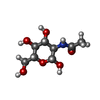
ChemComp-NAG:
2-acetamido-2-deoxy-beta-D-glucopyranose

Source
  • homo sapiens (human)
  • synthetic construct (others)
  • synthetic consturct (others)
KeywordsANTITUMOR PROTEIN/IMMUNE SYSTEM / bispecific antibody / diabody / EGFR / HL / Ex3 / 528 / local refinement / ANTITUMOR PROTEIN / ANTITUMOR PROTEIN-IMMUNE SYSTEM complex / CD3 / ternary complex / OKT3 / LH

+
About Yorodumi Papers

-
News

-
Feb 9, 2022. New format data for meta-information of EMDB entries

New format data for meta-information of EMDB entries

  • Version 3 of the EMDB header file is now the official format.
  • The previous official version 1.9 will be removed from the archive.

Related info.:EMDB header

External links:wwPDB to switch to version 3 of the EMDB data model

-
Aug 12, 2020. Covid-19 info

Covid-19 info

URL: https://pdbj.org/emnavi/covid19.php

New page: Covid-19 featured information page in EM Navigator.

Related info.:Covid-19 info / Mar 5, 2020. Novel coronavirus structure data

+
Mar 5, 2020. Novel coronavirus structure data

Novel coronavirus structure data

Related info.:Yorodumi Speices / Aug 12, 2020. Covid-19 info

External links:COVID-19 featured content - PDBj / Molecule of the Month (242):Coronavirus Proteases

+
Jan 31, 2019. EMDB accession codes are about to change! (news from PDBe EMDB page)

EMDB accession codes are about to change! (news from PDBe EMDB page)

  • The allocation of 4 digits for EMDB accession codes will soon come to an end. Whilst these codes will remain in use, new EMDB accession codes will include an additional digit and will expand incrementally as the available range of codes is exhausted. The current 4-digit format prefixed with “EMD-” (i.e. EMD-XXXX) will advance to a 5-digit format (i.e. EMD-XXXXX), and so on. It is currently estimated that the 4-digit codes will be depleted around Spring 2019, at which point the 5-digit format will come into force.
  • The EM Navigator/Yorodumi systems omit the EMD- prefix.

Related info.:Q: What is EMD? / ID/Accession-code notation in Yorodumi/EM Navigator

External links:EMDB Accession Codes are Changing Soon! / Contact to PDBj

+
Jul 12, 2017. Major update of PDB

Major update of PDB

  • wwPDB released updated PDB data conforming to the new PDBx/mmCIF dictionary.
  • This is a major update changing the version number from 4 to 5, and with Remediation, in which all the entries are updated.
  • In this update, many items about electron microscopy experimental information are reorganized (e.g. em_software).
  • Now, EM Navigator and Yorodumi are based on the updated data.

External links:wwPDB Remediation / Enriched Model Files Conforming to OneDep Data Standards Now Available in the PDB FTP Archive

-
Yorodumi Papers

Database of articles cited by EMDB/PDB/SASBDB data

  • Database of articles cited by EMDB, PDB, and SASBDB entries
  • Using PubMed data

Related info.:EMDB / PDB / SASBDB / Yorodumi / EMN Papers / Changes in new EM Navigator and Yorodumi

Read more